A real framework for analyzing a chess position
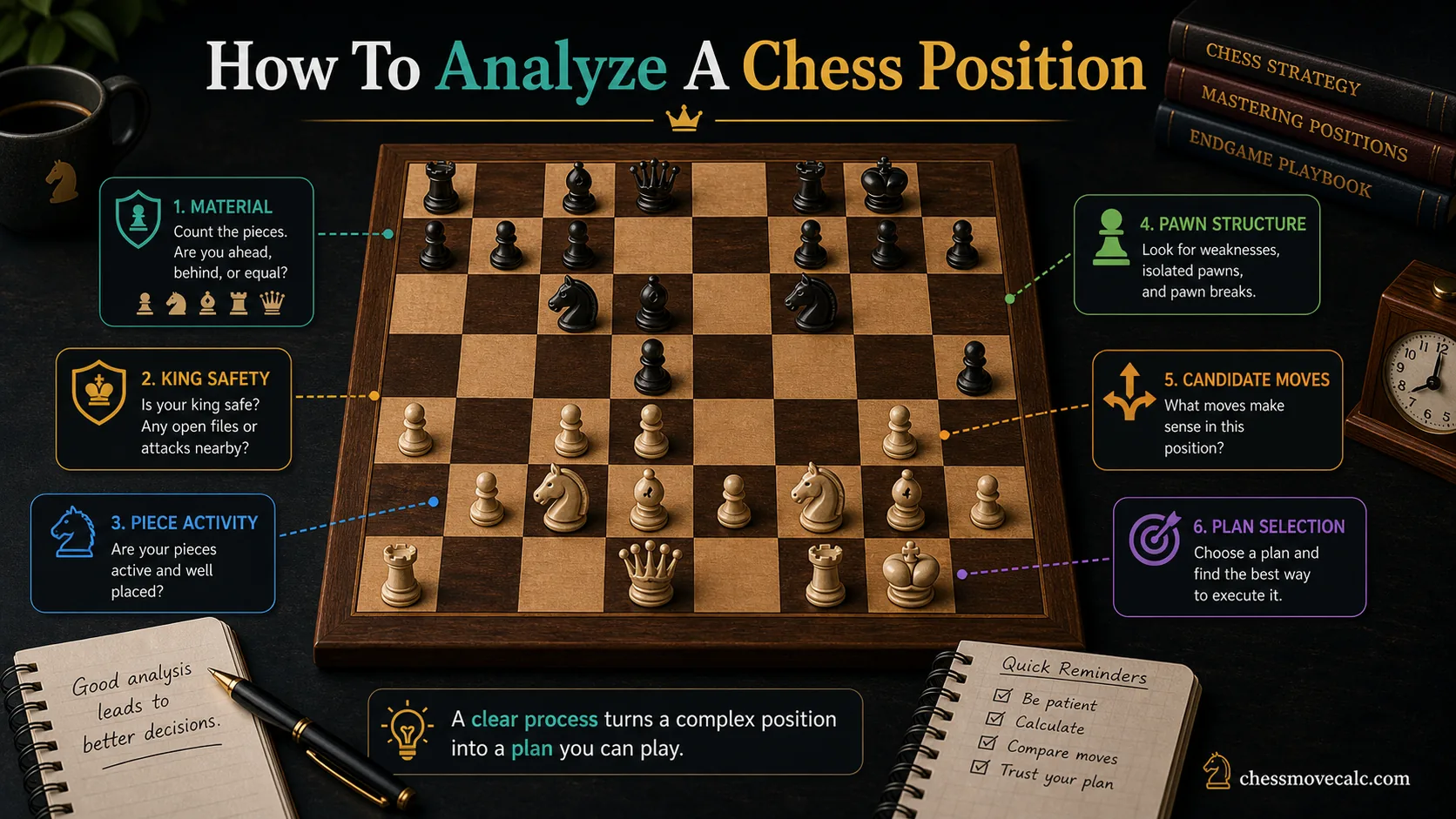
Good position analysis is structured. You are not guessing. You are checking the right things in the right order.
Chess position analysis starts with a description you can defend: count the material, check king safety, compare piece activity, and identify weak pawns or squares. Before using a chess analyzer, write down which side you prefer and one reason. Then use the engine to test the concrete moves supporting that judgment.
That missing layer matters more than most players realize. If you do not know how to evaluate a position yourself, you will misuse every tool after that. A best-move calculator becomes a crutch, not a teacher. Stockfish evaluations become mysterious numbers. Post-game review becomes a blur of arrows and red bars. The players who improve faster learn to describe a position in plain language first: who is safer, who is more active, where the weaknesses are, and which side has the simpler plan.
A single-position evaluation helps you choose a plan in the middlegame or understand an opening snapshot. To turn that evaluation into a move, follow the next-move calculation checklist. For reviewing a complete PGN, use the game-analysis workflow.
The five pillars are simple: material, king safety, piece activity, pawn structure, and plan. If you keep revisiting them in the same order, your evaluations become calmer and more accurate. You stop being hypnotized by one tactical idea or one shiny pawn grab. You start noticing which side has the worst piece, which king is easier to attack, whether the pawn structure creates targets, and whether the position calls for aggression, simplification, or patience.
Once you have that human read, then the engine becomes powerful. You can compare your judgment with the engine's judgment and learn from the gap. That is why this article links naturally to our Stockfish depth and evaluation explainer and our practical guide on using Stockfish online. First think, then verify, then extract the lesson.
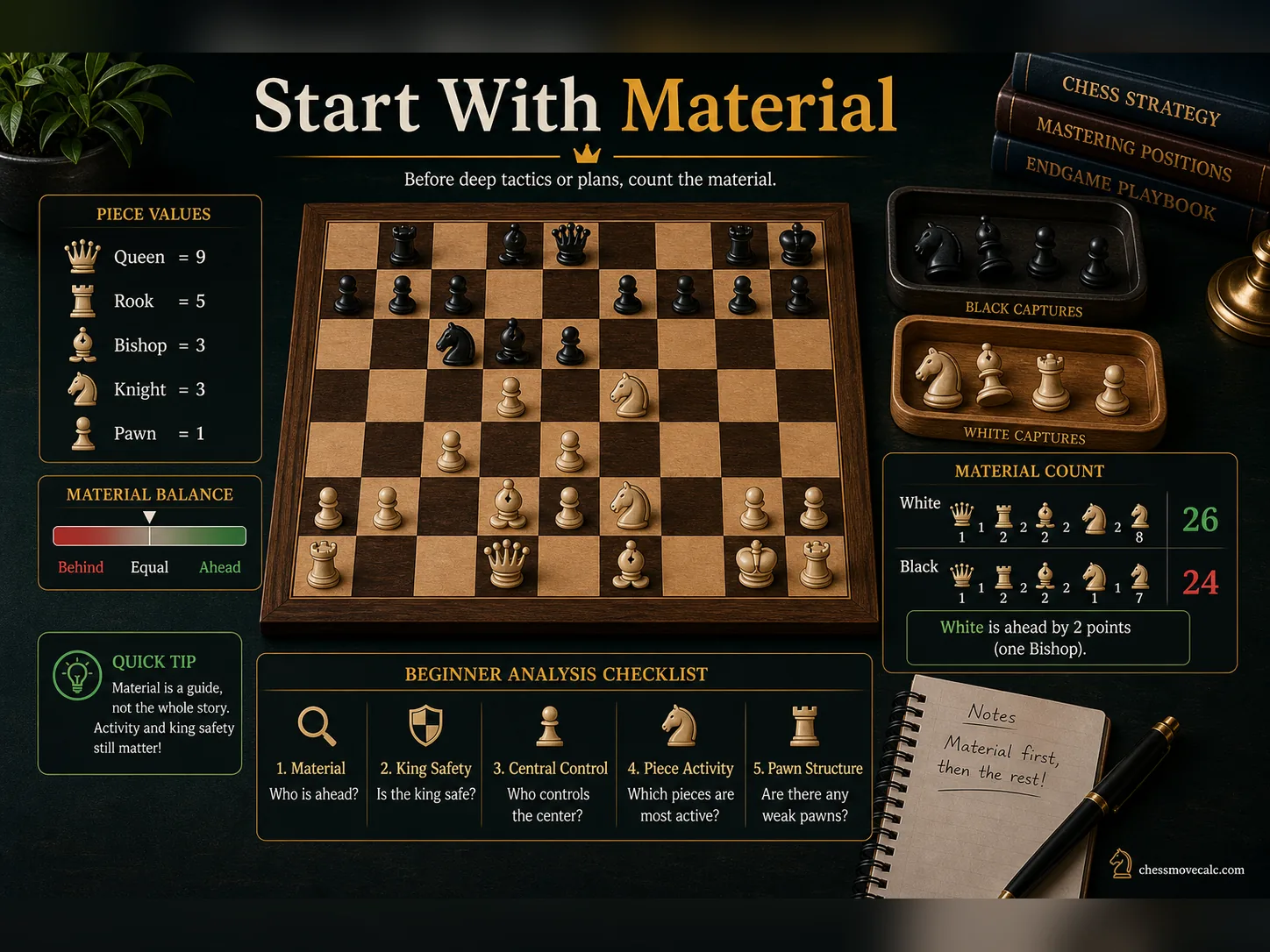
Material is the first checkpoint, not the full verdict. Count it, then ask what the imbalance actually means.
Start with material, but do not stop there
The first step in any chess position analysis is simple: count the pieces and note the imbalance. Is one side up a pawn, the exchange, or a full piece? Are the queens still on the board? Has one side invested material into a direct attack? This first scan gives you the raw facts before emotions or tactical fantasies take over.
Material matters because it shapes the long-term direction of the game. If you are up a clean pawn in a quiet endgame, simplification often becomes attractive. If you are down exchange but have active pieces and the safer king, the position may still be unclear. Beginners often make the same mistake here: they either worship material too much or ignore it completely because an attack feels exciting. Good analysis lives in the middle.
Compensation is the idea to keep in your head. If one side is down material, what are they getting in return? It might be initiative, lead in development, open lines toward the king, a dangerous passed pawn, or a dominant outpost. When you can say, “White is down a pawn but has the bishop pair, more space, and the easier kingside attack,” you are already analyzing like a stronger player.
Quick question
Is the material edge clean, or is it being balanced by activity, initiative, king pressure, or a passed pawn?
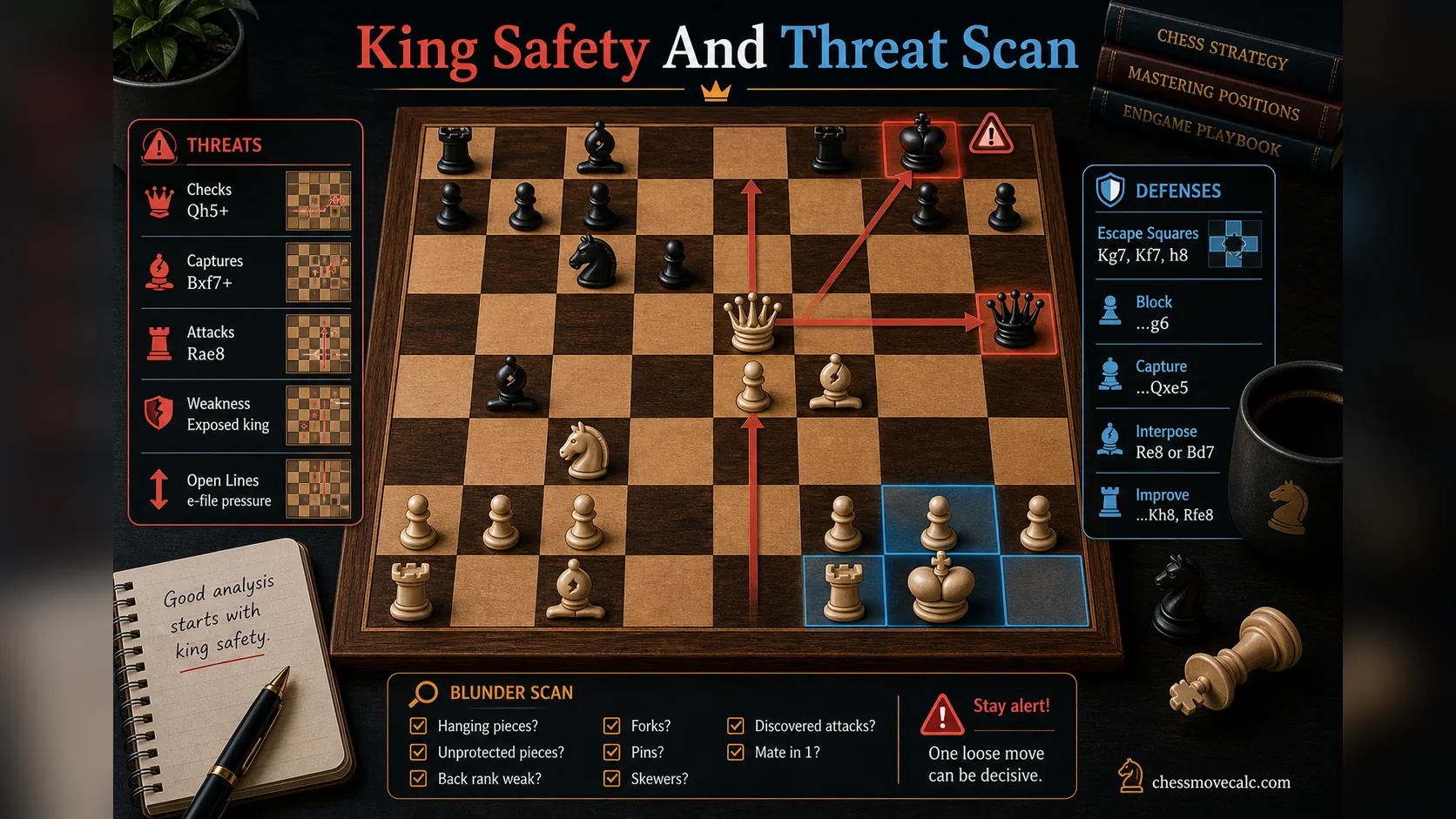
Before you calculate your own dream line, check what the opponent is threatening right now.
Check king safety and immediate threats next
After material, look for danger. Which king is easier to attack? Are there open files, exposed diagonals, weakened dark squares, or back-rank issues? Is a queen and rook battery already aimed at the king? Are there loose pieces hanging around the board? A beautiful strategic plan is worthless if you miss a tactical shot on the next move.
This is why many strong players begin their analysis with the question, “What does my opponent want?” That single question filters out a shocking number of bad moves. Maybe they threaten mate on the back rank. Maybe they want a fork. Maybe they are preparing a pawn break that opens your king. If you identify the real threat first, you stop analyzing fantasy variations that would never be allowed in a real game.
King safety often outweighs small material differences. A side can be up a pawn and still be practically worse if the king is under direct fire and the defenders are uncoordinated. Conversely, a side may be down material but close to winning if the opponent's king has no shelter. This is why engine scores can swing violently in tactical positions: king exposure changes the evaluation faster than almost anything else.
- Scan checks, captures, and threats before you compare quiet plans.
- Notice loose pieces, weak back ranks, and open lines near the king.
- If one side has an immediate tactical threat, that usually becomes the priority of the position.
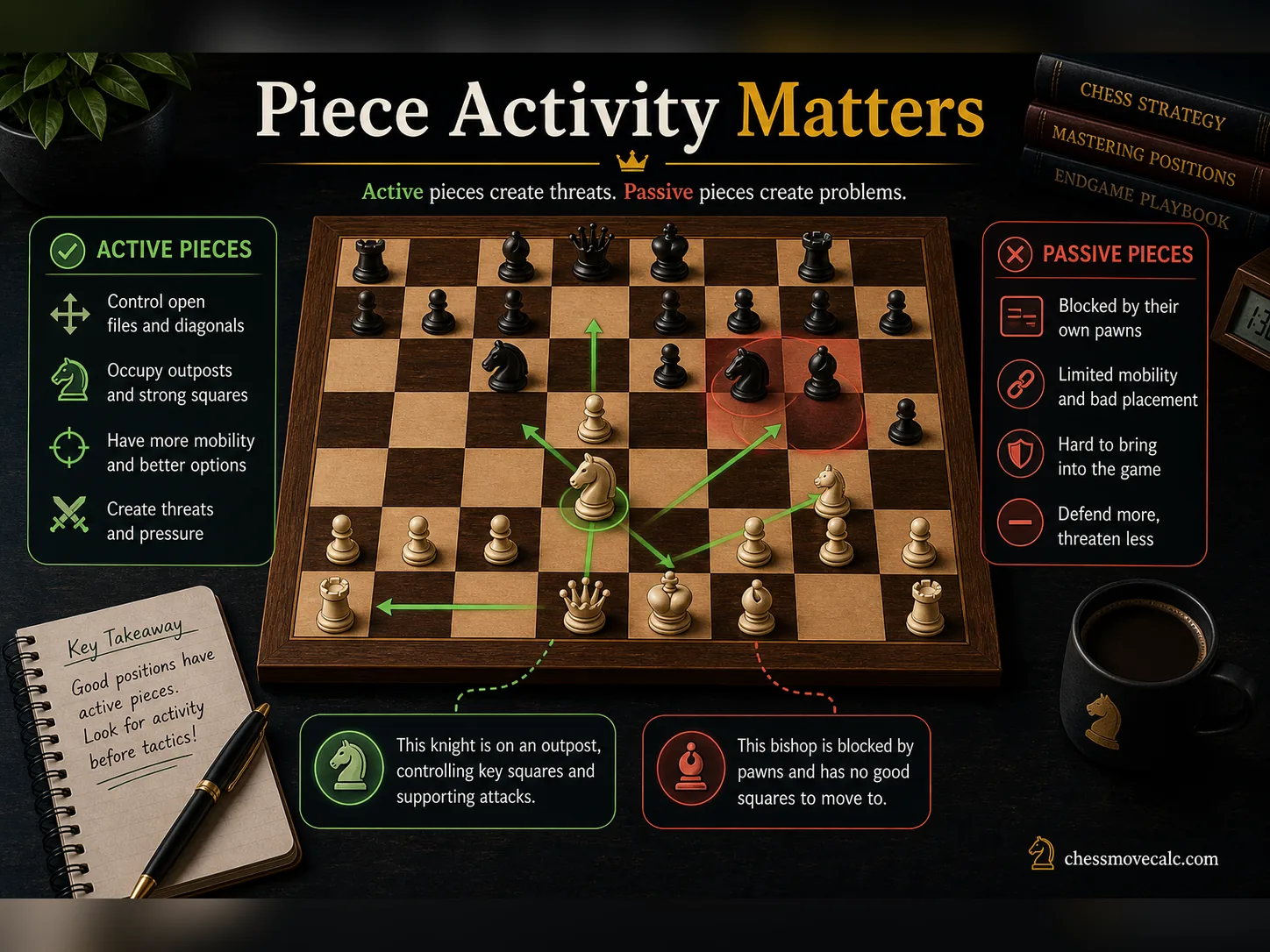
A passive extra piece can be less useful than an active army with targets, open files, and central control.
Evaluate piece activity, not just piece count
Piece activity is where many beginner evaluations level up. Ask yourself which side's pieces are doing more work. Are the rooks on open files or trapped behind pawns? Are the bishops staring through long diagonals or blocked by their own structure? Are the knights centralized on strong outposts or buried on the rim? Active pieces create threats, support breaks, and help the king. Passive pieces mostly wait.
One useful shortcut is the worst-piece principle. Find the worst piece on each side and compare them. If your worst piece is a sleeping rook and the opponent's worst piece is an active knight near your king, that tells you something important even before you start calculating concrete moves. Strong players constantly improve their worst piece because activity tends to snowball.
Development also belongs here. In some positions the side with fewer pawns or even a small material deficit is better developed and faster to the critical squares. That can justify dynamic play. The moment you say, “Black's queen rook and bishop are spectators while White's pieces dominate the center,” you are no longer just counting units. You are reading the board.
Helpful habit
Compare each side's worst piece, best file, best diagonal, and strongest outpost. That usually reveals whose army is easier to coordinate.
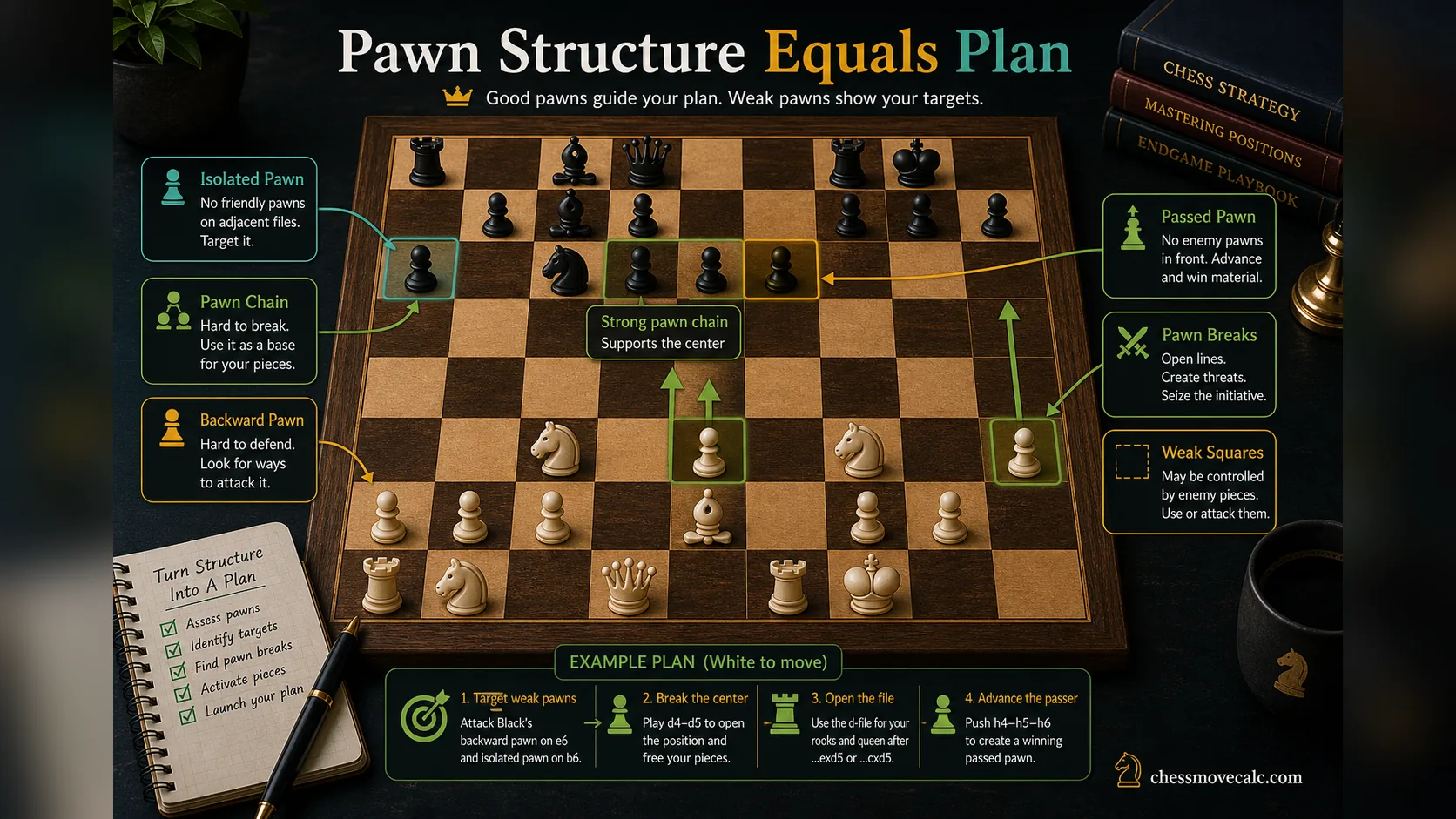
Pawn structure is not decoration. It tells you where the weaknesses live and which plans make strategic sense.
Read the pawn structure because it usually reveals the plan
If you want to analyze a chess position without drifting, learn to read the pawns. Is there an isolated pawn, doubled pawns, a backward pawn, or a passed pawn? Which side has more space? Which pawn breaks are available? Many middlegame plans are hiding in these answers long before a tactic appears.
An isolated pawn can be a weakness in the endgame but a source of activity in the middlegame. Doubled pawns can be ugly, but sometimes they open a file for a rook. A passed pawn can be a future queen or at least a permanent distraction. A backward pawn can anchor the opponent's pressure. This is why serious position analysis never stops at “the structure looks bad.” You want to name the exact weakness and the exact consequence.
Pawn structure also tells you which side should seek exchanges. If your weakness is static, trades can make it harder to defend later. If your advantage is activity or attack, trading attacking pieces may help the opponent survive. If you have a healthier structure and a long endgame edge, simplification may be your friend. If you have better piece activity but worse pawns, you may need to keep tension and play faster.
This is one of the biggest differences between casual analysis and useful analysis. Casual analysis says, “White looks a bit better.” Useful analysis says, “White has a queenside majority, Black has a backward pawn on d6, and White's plan is to pressure the half-open file before the structure can be fixed.” That level of clarity helps both your move choice and your later engine review.
Common beginner trap
Do not call every doubled pawn bad or every isolated pawn losing. Ask what the structure gives and what it takes away.
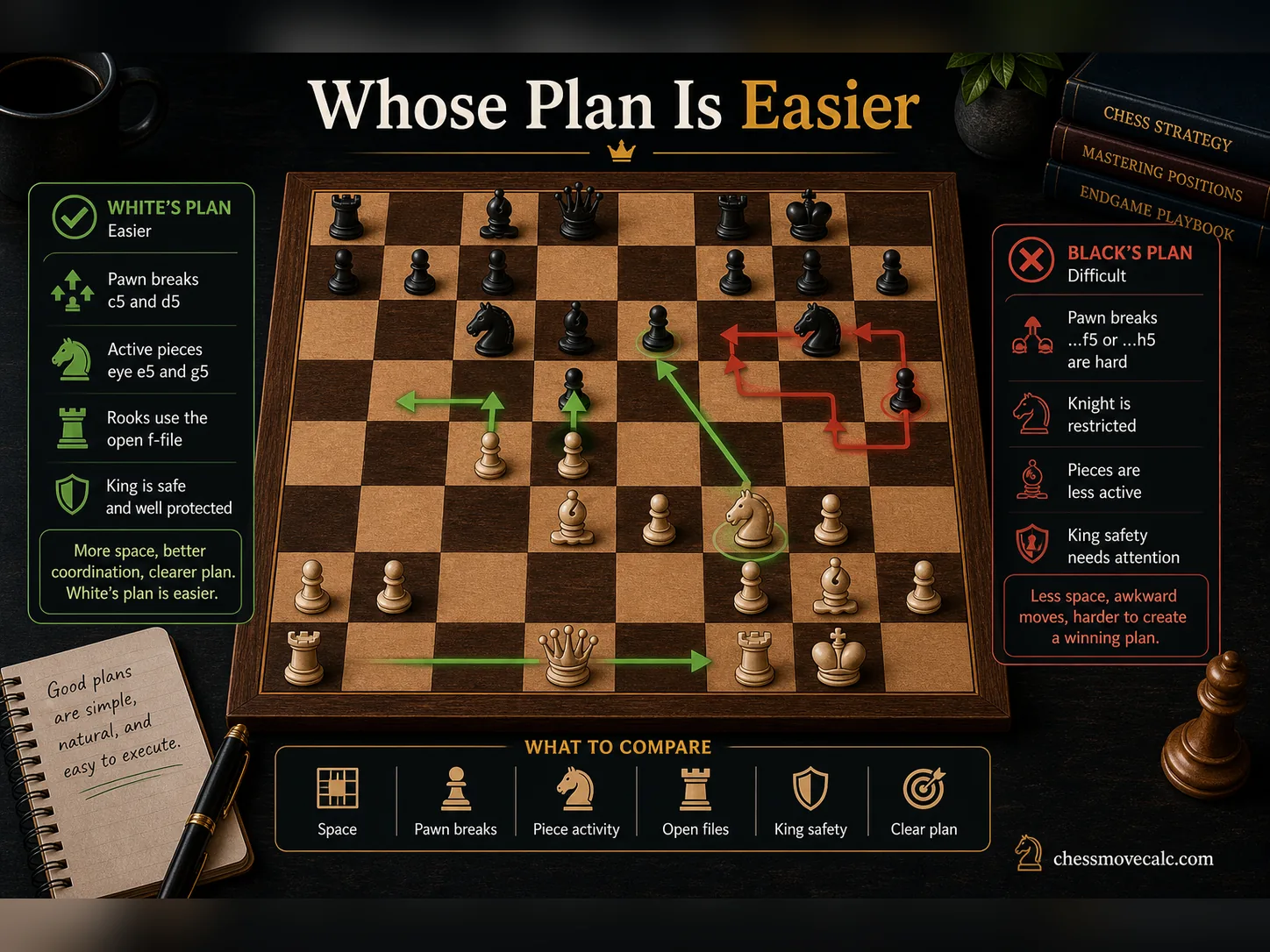
Even when the position is objectively equal, one side may still be much easier to play.
Decide whose plan is easier to execute
The final human question before you calculate concrete moves is usually practical: whose plan is easier? Two positions can be objectively equal by engine standards and still feel completely different for humans. One side may have a natural rook lift, a simple kingside push, or a target they can attack again and again. The other side may need perfect defense and several only moves.
Easy plans matter because chess is played by humans under time pressure. If your side has a direct, low-risk plan and the opponent needs precision, that is a real edge even if the evaluation is modest. Strong players are constantly asking whether the attack is easy to organize, whether the endgame favors one structure, or whether the defensive resources are awkward to find.
A useful summary sentence is: “White's plan is easier because the attack on the backward pawn is automatic, while Black needs several regrouping moves before counterplay exists.” Statements like that prevent random move selection. They also help you transition naturally into best-move comparison, because now you know what the move should be trying to achieve.
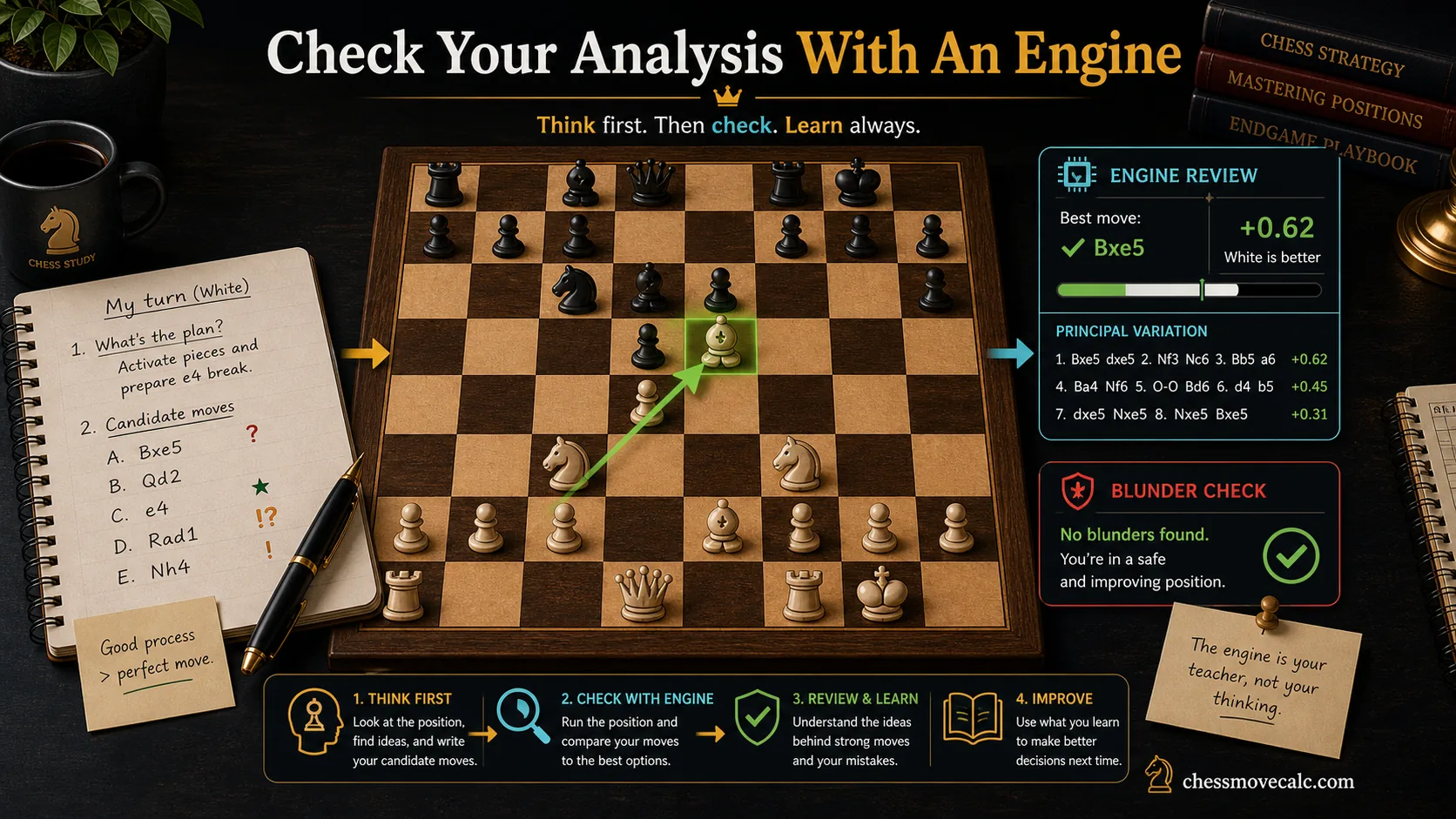
The engine should confirm, correct, or sharpen your evaluation, not replace your first look at the position.
Verify your read with an engine the smart way
Once you have your own verdict, then it is time to check the engine. The right sequence is simple: write down who you think is better and why, note your candidate moves, then run the position through the ChessMoveCalc next move solver or another analysis board. This keeps your brain involved. If you open the engine first, you skip the training part.
When the engine disagrees with you, do not focus only on the numeric evaluation. Ask what factor you misread. Was king safety worse than you thought? Did you underestimate a tactical defense? Did a pawn break change the whole structure? Did your “active” piece actually have no real target? This is where our article on depth, centipawns, and principal variation becomes useful, because it helps you interpret what the engine is really saying.
The best engine sessions are specific. You are not trying to memorize every line. You are trying to identify the reason the evaluation changed. If the engine preferred a move because it prevented counterplay, that is the lesson. If it liked a quiet rook lift because it improved the worst piece, that is the lesson. If the move you loved failed because of one hidden tactical shot, that is the lesson.
Smart review loop
Human verdict first. Engine second. Compare reasons, not just moves. Save the pattern that changed the evaluation.
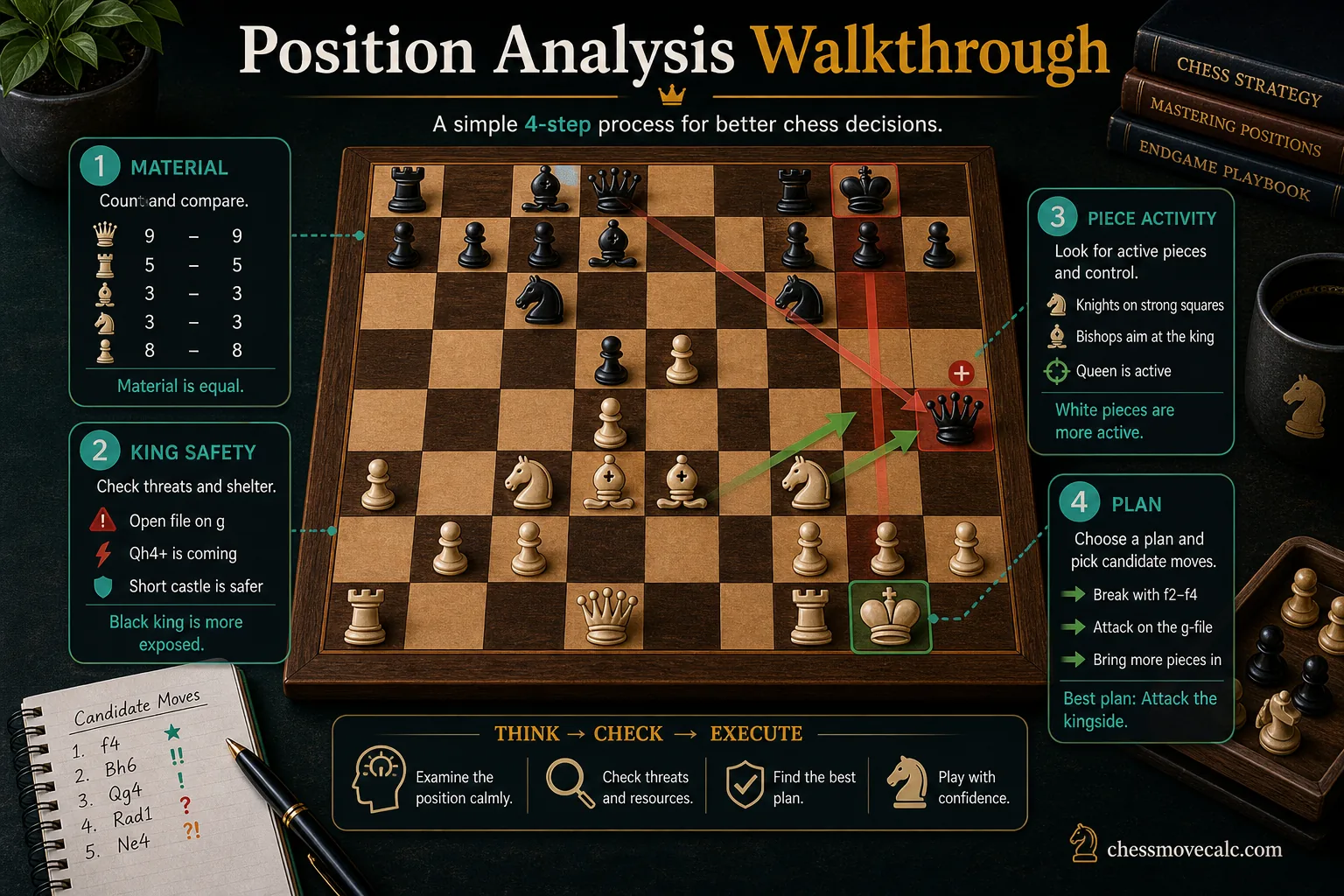
A worked example forces the checklist to become concrete instead of staying theoretical.
Example: how to analyze one position step by step
Imagine a middlegame where White has a small space edge, a rook on the semi-open e-file, and a knight planted on d5. Black has the bishop pair, but the king is a little airy and the d6 pawn is backward. How do we talk about that position clearly?
Step one: material is equal, so there is no immediate need to simplify or panic. Step two: king safety favors White slightly because Black's king has fewer pawn shields and White's rook and queen can pressure the center. Step three: piece activity favors White because the knight on d5 is excellent, the rook already has a file, and Black's queenside rook is still passive. Step four: pawn structure gives White a target on d6 and a practical route for pressure. Step five: the easiest plan is also White's: double rooks on the file, improve the dark-squared bishop, and squeeze.
Notice what we did not do. We did not start by calculating ten moves deep. We first named the imbalances. That narrows the candidate moves automatically. Moves that improve pressure on d6 or support the active knight rise in value. Random pawn pushes that weaken White's own king fall in value. Suddenly the board feels less chaotic because the position has a story.
Now comes the engine check. Suppose the engine agrees White is better, but instead of your attacking move it prefers a quiet rook lift. That tells you something important: White's edge may be more technical than tactical. The engine is not just disagreeing on a move. It is correcting your understanding of the position. That is exactly how manual analysis and engine analysis should work together.
If you want to go one step further after this process, the next layer is to connect the positional story with actual calculation. That is where our article on how to calculate the next move picks up the thread. Position analysis tells you what matters. Calculation tells you whether the plan works tactically.
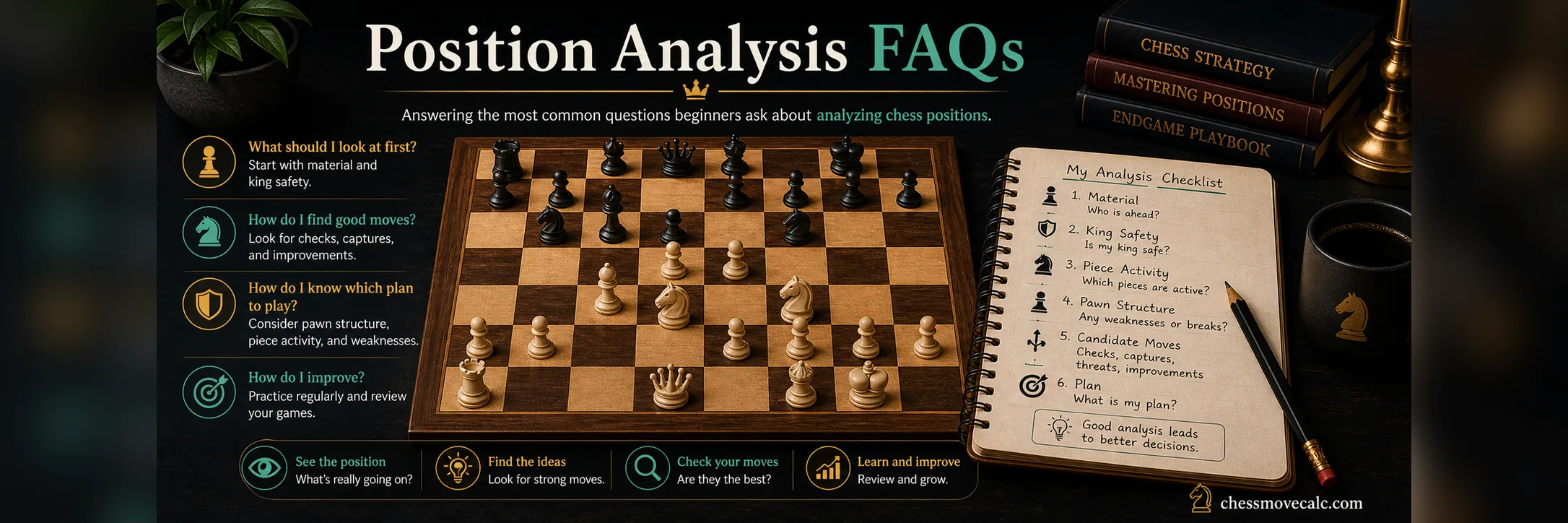
Chess position analysis FAQs
What should I look at first in a chess position?
Start with material and immediate threats. That gives you the base facts and prevents you from missing tactical danger.
Is material more important than king safety?
No. A material edge can be outweighed if the king is exposed and the opponent has direct attacking resources.
How do I know if a position is winning?
You usually need more than “it looks nice.” A winning position combines a real advantage with a plan the opponent cannot realistically stop.
Should beginners use engines during analysis?
Yes, but only after making a human evaluation first. That way the engine becomes a coach instead of a substitute.
What is the easiest way to improve position analysis?
Use the same checklist every time: material, king safety, activity, pawn structure, plan, then engine verification.
How long should I spend analyzing one position?
In training, spend long enough to identify the real imbalances and candidate plans. In practical games, compress the same checklist to fit the clock.
Analyze a real position with a clearer framework
Load a position into the solver, form your own evaluation first, and then compare your read with the engine's answer.