Read the engine like a coach, not like a slot machine
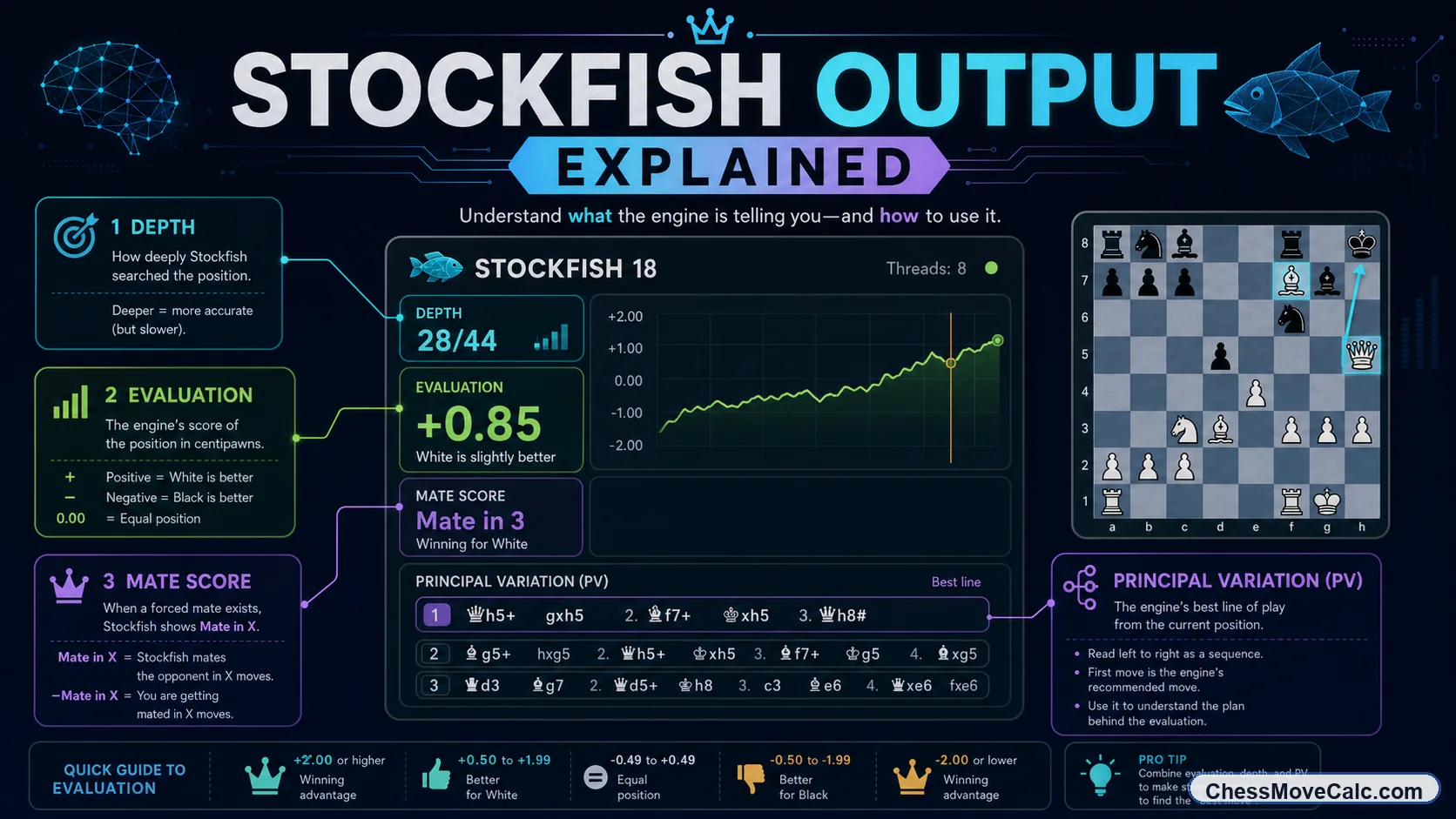
Good engine use starts when the numbers stop feeling mysterious and start feeling interpretable.
Once players start using Stockfish online, the next confusion arrives immediately: depth numbers, centipawn scores, mate values, and a line of moves called the principal variation. If you are using chess engine analysis, stockfish best move, chess engine best move, or a stockfish move calculator, you do not just need the tool. You need translation.
Engine output is often explained in one of two unhelpful ways: too technical, assuming readers already understand the concepts, or too shallow, giving one-sentence definitions with no practical interpretation. This guide stays visual, beginner-safe, and honest about what the numbers can and cannot tell you.
This article is intentionally narrower than How to Use Stockfish Online. That page teaches the browser workflow. This page owns the literacy layer: what depth, evaluation, centipawns, mate scores, and principal variation actually mean. Once you understand these concepts, every analysis board, Stockfish calculator, and best-move tool becomes more useful.
It also makes you harder to mislead. Without engine literacy, players often make three predictable errors. They overvalue small score differences, panic when the top move changes during search, and treat the principal variation as if it were the only playable human line. None of those habits leads to stronger chess. Engine output is powerful, but only when you interpret it inside the practical context of the position.
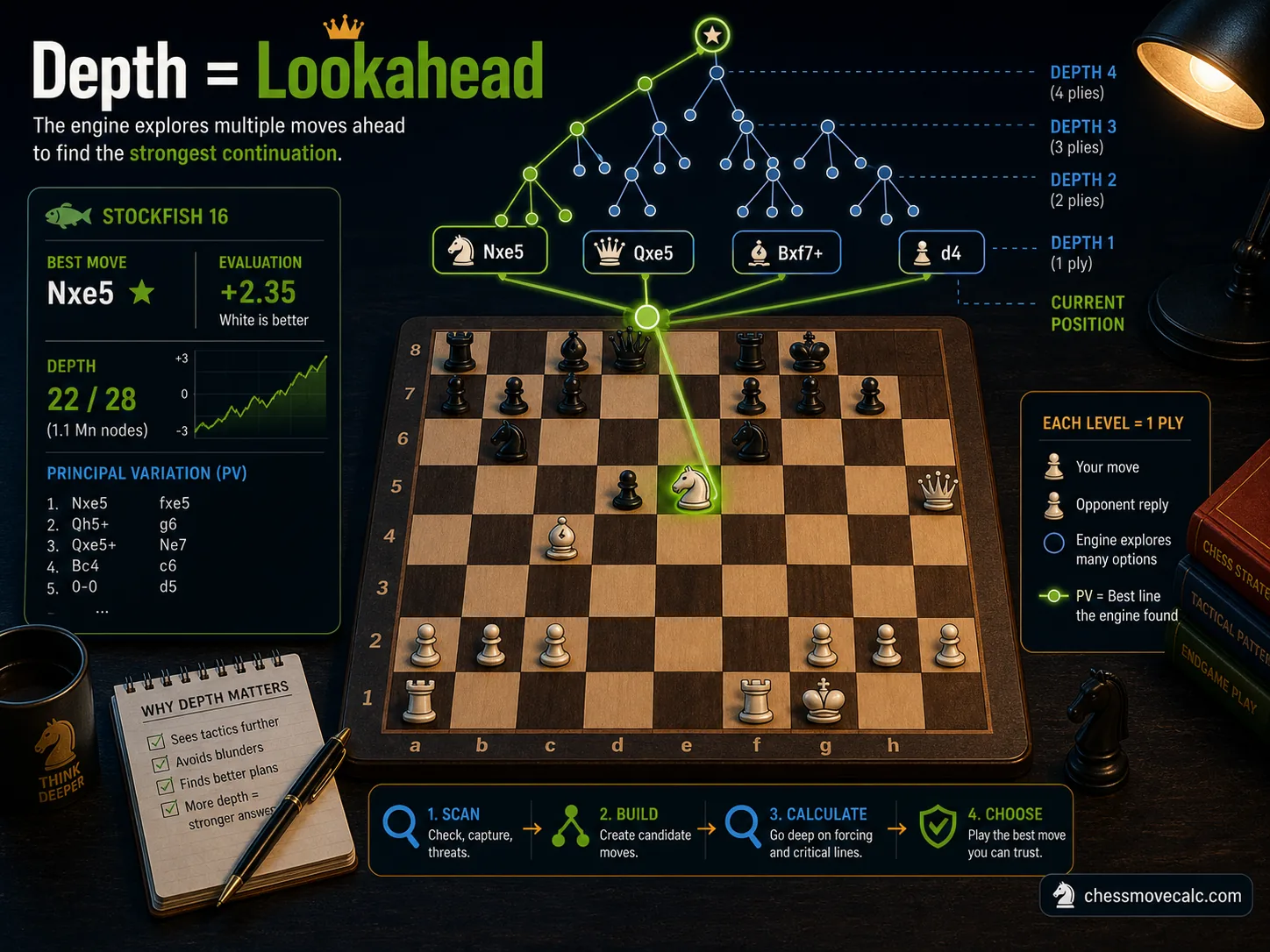
Depth is not a badge of honor by itself. It is a clue about how mature the current search is.
What depth means in engine output
In simple terms, Stockfish depth tells you how far the engine has searched. Many interfaces show depth as a number of ply, not full moves. One ply is one move by one side. So a depth of 20 means the engine has looked roughly 20 half-moves into the tree, though the real search is more nuanced than a clean straight line.
This is where many players make their first mistake. They treat higher depth as if it automatically means certainty. It does not. Depth is useful, but the right question is whether the line is stabilizing. In a quiet position, the best move may remain the same across several depth jumps. In a tactical position, the engine can change its mind because deeper search reveals a hidden defense, a tactic, or a better move order.
Selective search also matters. Engines do not always search every branch equally. They spend more effort on promising lines and prune weaker ones. That is why depth is informative but not perfect. Two positions with the same depth number can still have different levels of reliability. A cramped endgame and a violent middlegame do not behave the same way under search.
Practical takeaway
For amateur analysis, chase stability before you chase huge depth. A move that survives several deeper iterations is usually more useful than a flashy shallow line.
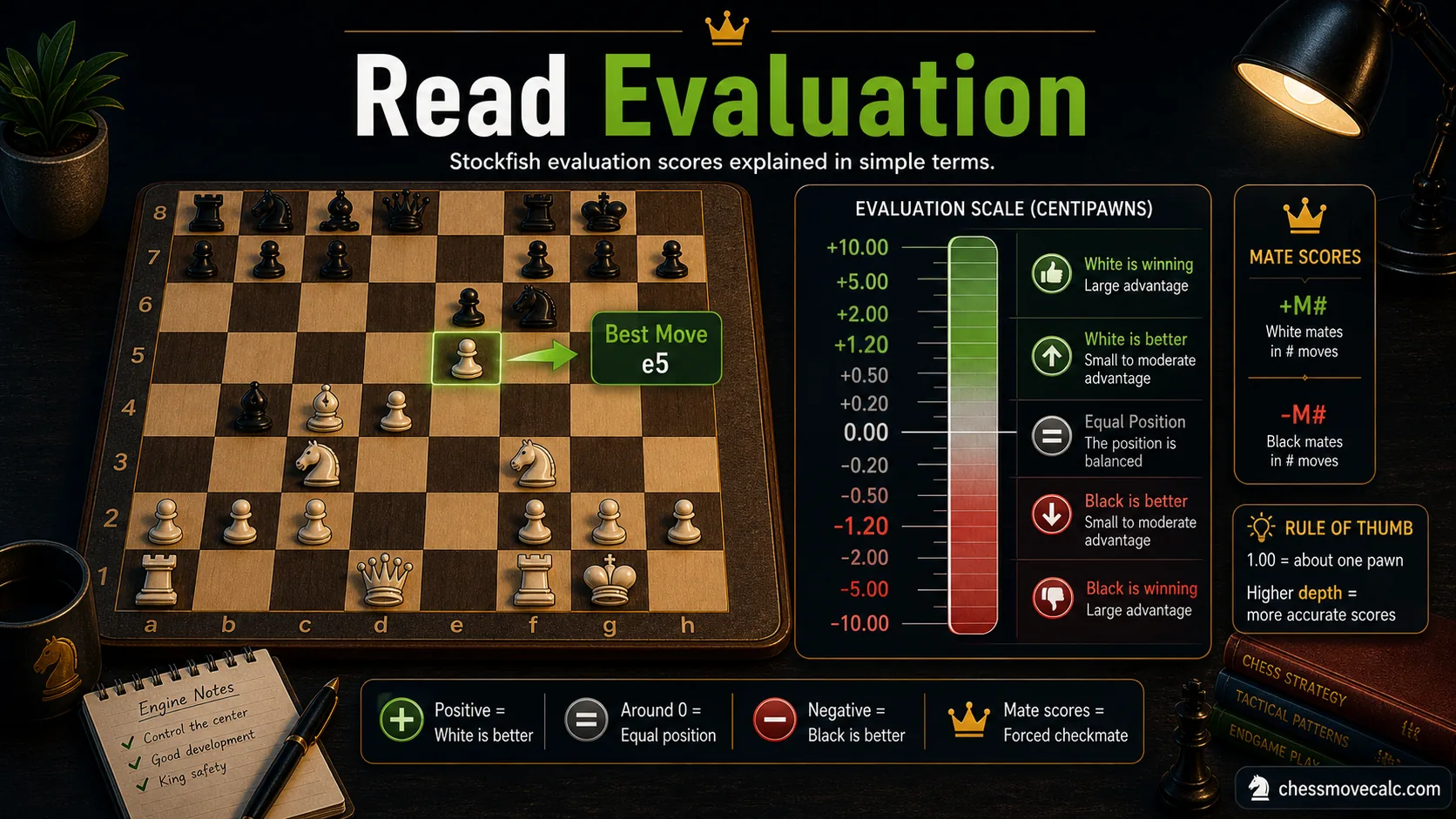
Evaluation scores are estimates of advantage, not promises of easy wins.
What the evaluation score means
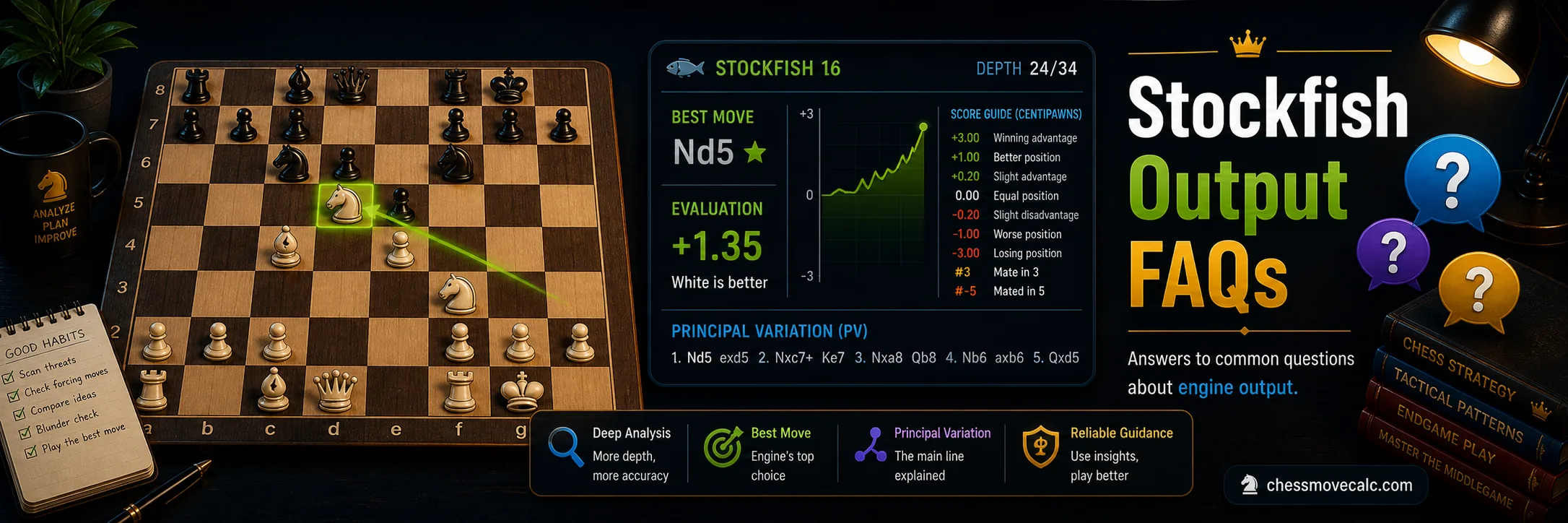
The chess engine evaluation is Stockfish's estimate of who is better in the position. Positive values favor White. Negative values favor Black. The unit is usually centipawns, where 100 centipawns is roughly equal to one pawn of value in engine terms. So +0.50 means White has an estimated half-pawn edge, while -1.20 means Black has an edge a little bigger than a pawn.
But the number is not a literal material count. A score can reflect king safety, activity, space, passed pawns, tactical pressure, or future potential. That is why a position with equal material can still show +1.30. The engine is not claiming an extra pawn exists on the board. It is judging the position as more favorable overall.
Interpretation matters. A score around 0.0 usually means equality, but equality is not the same as simplicity. A +0.4 edge often means a small plus, not a crushing attack. Around +1.5 you are starting to see a clearer strategic or tactical edge. Around +3.0 and beyond, the advantage is often large enough to count as winning if converted accurately. Still, human play matters. Some +0.8 positions are easier to handle than some +1.5 positions, depending on the complexity.
This is why strong players often translate the raw engine number into a plain-English verdict. Instead of obsessing over whether the position is +0.7 or +0.9, they ask a more useful question: does one side have the easier plan, the safer king, or the more active pieces? The evaluation becomes most valuable when it confirms or challenges your human read of the position, not when it replaces judgment entirely.
Equal does not mean easy
A 0.0 evaluation can still hide tactical landmines, unpleasant defense, or a position that is far easier for one side to play practically.
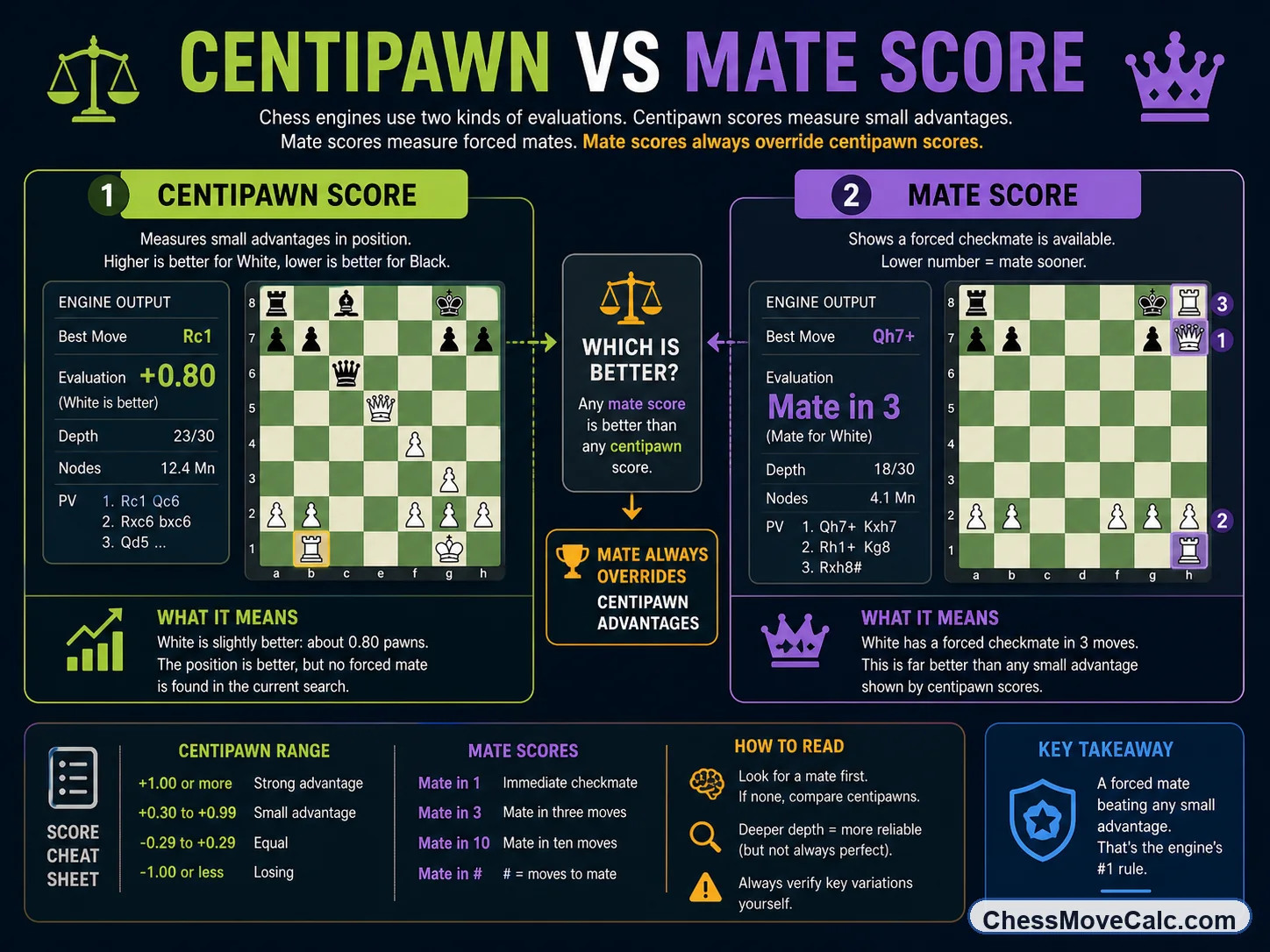
Centipawn scores compare positional edges. Mate scores announce a forced finish.
Mate scores vs centipawn scores
A mate score is different from an ordinary evaluation. If Stockfish shows something like M3, it means the engine sees a forced mate in three moves. If it shows -M5, it means the side currently better is delivering a forced mate in five, from the other side's perspective. This matters because mate scores override small numerical advantages. A line ending in mate is stronger than a line ending in +1.4, even if the centipawn number looks calmer.
New players sometimes misunderstand the mate number as a style rating or as “the engine likes this move more by five points.” It is not that. It is a countdown of forced mate distance. The shorter the number, the closer the forced finish. If the engine says M3, the tactical conclusion is much stronger than any small centipawn debate.
This is also why top moves can flip dramatically during analysis. A move that looks positionally strong at shallow depth may vanish once the engine discovers a forced mating resource in another branch. When mate enters the picture, the evaluation framework changes from “who has the better position?” to “who has a forced tactical end to the game?”
Simple rule
If one line shows a stable mate score and another only shows a modest positional edge, the mate score wins the argument.
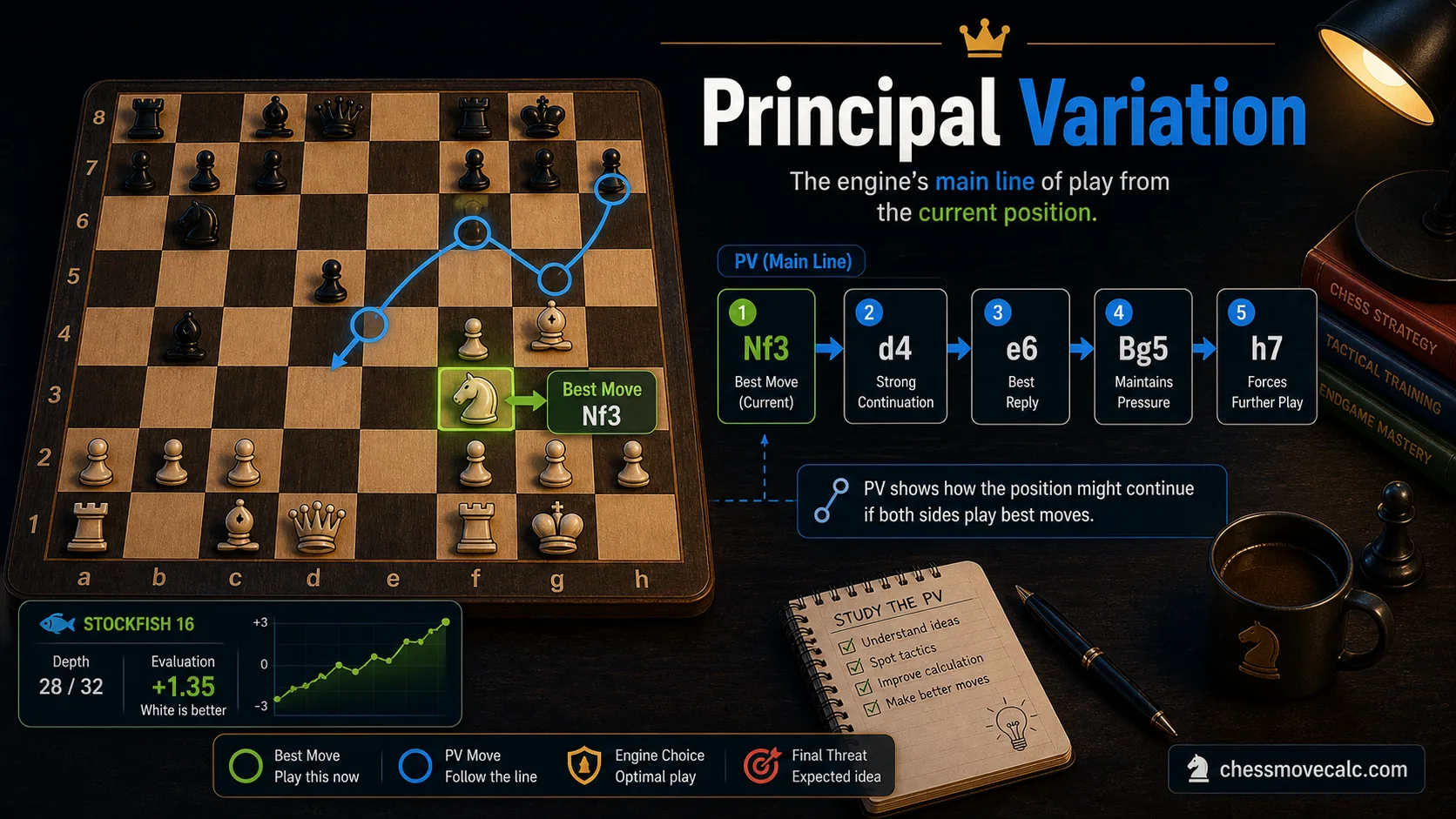
The principal variation is the engine's current favorite continuation, not the only line worth studying.
What principal variation actually tells you
The principal variation, often abbreviated PV, is the engine's current best line from the position. If Stockfish thinks one move is strongest, it will usually show the sequence it expects to follow if both sides continue with top choices. This is powerful because it does more than name a move. It offers the logic chain behind the move.
But the PV is not sacred law. It is the best line according to the engine's current search state. If the depth changes, the PV can change. If the position is extremely sharp, different branches can trade places. Sometimes the PV also looks strange to humans because it includes only-move defenses, cold tactical resources, or non-obvious waiting moves that a person would never guess at first glance.
The right way to use PV is as a study clue. Ask what the line is trying to accomplish. Is it improving king safety, converting a passed pawn, creating a tactical motif, or reducing counterplay? If you only copy the line, you get a solution. If you understand the intention, you get improvement.
In that sense, PV is less like an answer key and more like a map of the engine's current priorities in the position.
That is why strong engine users read the idea of the line first and the move list second.
Understanding beats memorizing, especially in very complex tactical positions overall.
It also helps to compare the PV with your own candidate moves. If the engine's line begins with a move you never considered, do not stop at “I missed it.” Ask what feature of the position made that move possible. Was there an under-defended square, an open file, a quiet prophylactic move, or a tactical resource you screened out too early? PV study becomes especially powerful when it teaches you what you are habitually blind to.
Best use of PV
Use the principal variation to learn the plan behind the move, not just the notation of the move itself.
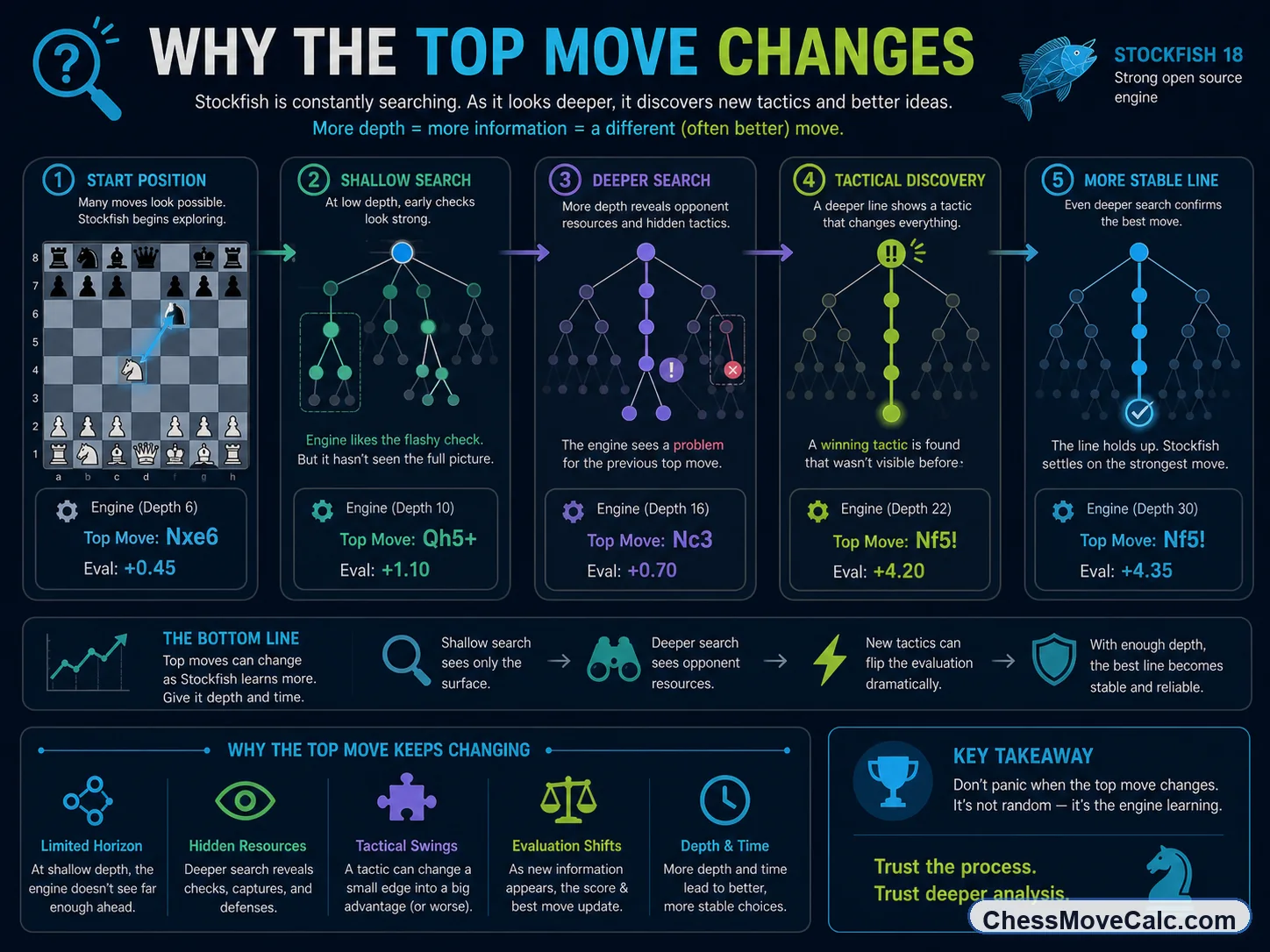
Changing top moves usually mean the engine found a new tactical resource, a better defense, or a more stable continuation.
Why the top move changes while the engine is thinking
If you have ever watched Stockfish think and felt annoyed that the top move kept changing, you are seeing the search process in action. At shallow depth, the engine may prefer one move because the tactical consequences are not yet visible. A few layers later, a hidden defense appears. Then a better move order appears. Then a mating idea or tactical refutation appears. What looks inconsistent is usually just deeper truth being discovered.
This is related to what players often call the horizon effect. If the engine cannot yet see beyond a tactical boundary, it may temporarily like a line that collapses once the horizon moves. More depth helps push the horizon farther away, which often stabilizes the recommendation. That is why users searching for stockfish best move sometimes get frustrated: they assume the first answer is final, when it may only be the first meaningful draft.
This is also a reminder not to compare two engine screenshots taken at random moments and assume one site or tool is “more accurate” just because the top move differs. Often the difference comes from time, depth, hardware, or one interface showing a line before the search has truly settled. If you compare engines fairly, compare them after a similar amount of thinking and with the same position loaded correctly.
The practical lesson is patience. Let the engine search a little, especially in tactical positions. Watch whether the same move keeps returning. A stable top move across several depth increases is a much stronger signal than a move that flashes briefly and disappears.
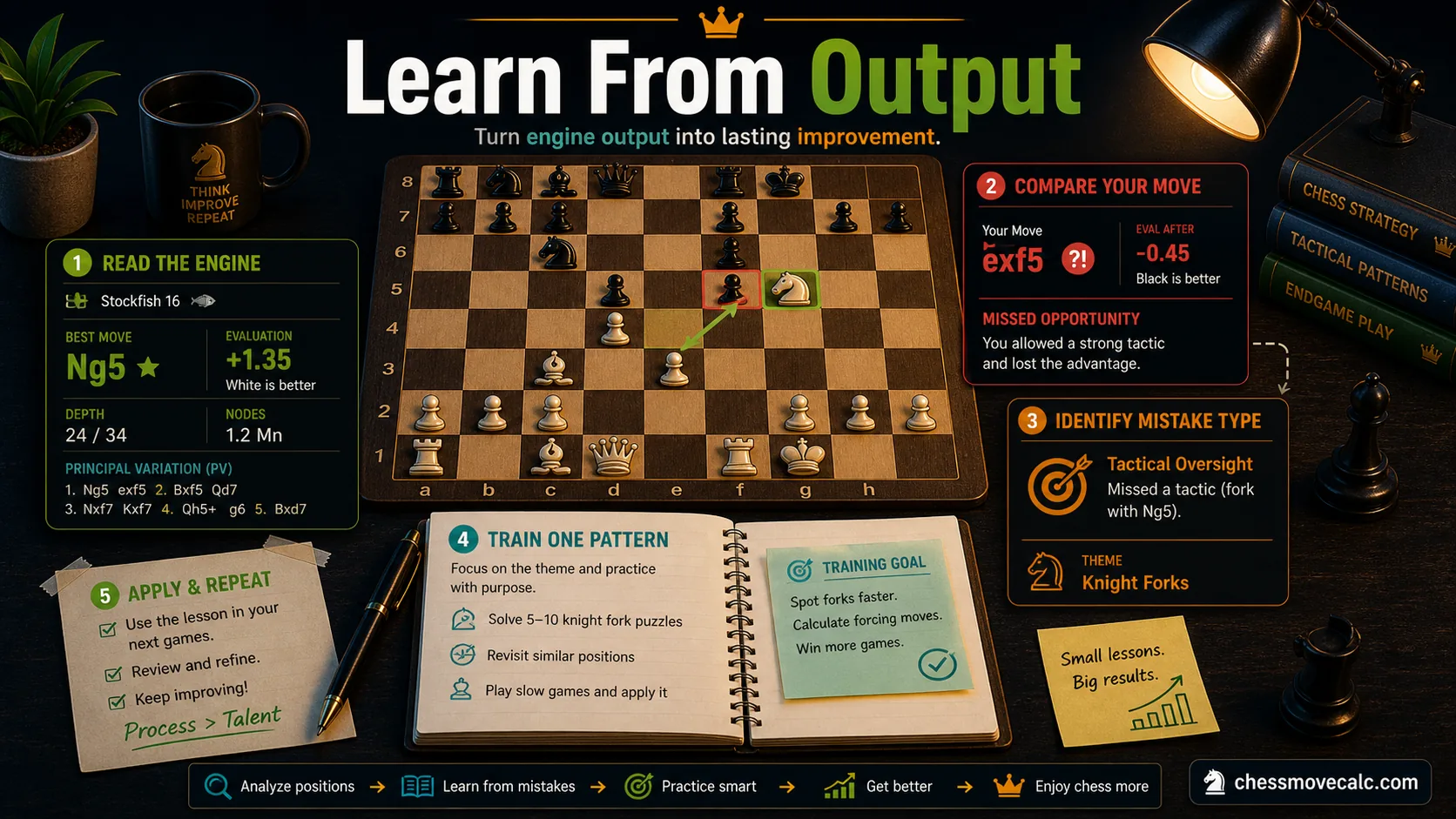
Engine literacy becomes real progress when you compare your reasoning with the engine's reasoning and record the lesson.
How to learn from engine output instead of copying it
The best improvement workflow is simple. First, guess the move yourself. Second, run the engine. Third, compare your idea with the engine's top move. Fourth, identify the real difference: tactical defense, king safety, pawn break, piece activity, or long-term endgame conversion. Fifth, write the lesson in your own words.
This is far more powerful than seeing +0.8 and saying “okay.” Engine output only helps if it changes how you look at positions. Maybe you keep undervaluing passed pawns. Maybe you miss backward tactical resources. Maybe you overreact to tiny eval changes. Once you connect the engine output to recurring human errors, the numbers become educational.
One of the best habits is to save a one-line takeaway after each important engine review. Examples include: “I missed the back-rank weakness because I focused only on material,” “the engine preferred development over pawn grabbing,” or “my attack failed because I never checked the opponent's only defensive resource.” These notes may feel small, but over time they build a personal error database that is far more valuable than scrolling through endless engine lines with no memory attached.
A great follow-up flow is to view the live engine output on the homepage calculator, then connect that with the practical Stockfish workflow guide and manual position analysis for beginners. That sequence prevents passive engine dependence and builds a much stronger foundation.
Stockfish output FAQs
What is a good depth for amateur analysis?
There is no universal number. What matters more is whether the best move and line are stabilizing and whether the position is tactical or quiet.
Is +0.5 a big advantage?
Usually not. It often means a small objective edge rather than a clearly winning position, especially in complex middlegames.
What does M5 mean?
M5 means the engine sees a forced mate in five moves. Mate scores override modest centipawn considerations.
Why does PV sometimes look weird?
Because it reflects the engine's current preferred line, which can include only-move defenses, unusual tactical resources, or lines that shift with more depth.
Should I trust one engine line immediately?
Not always. Let the search mature, especially in tactical positions, and see whether the recommendation remains stable.
How do I use Stockfish output to improve faster?
Guess first, compare second, identify the missed idea, and write the lesson down in plain language so it becomes reusable pattern knowledge.
See depth, eval, and PV on a live position
Load a real position into the solver, let the engine think, and read the output with this guide beside you.