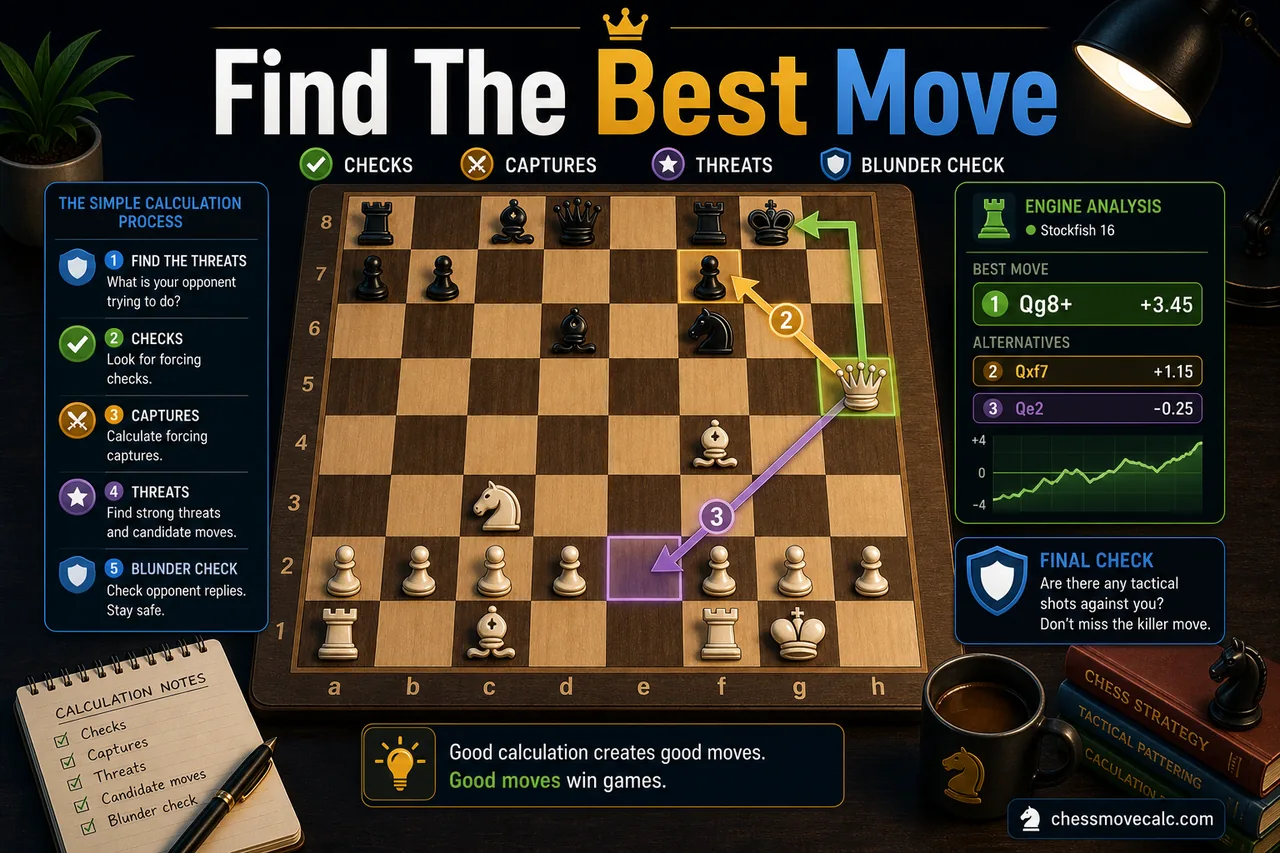
A simple thinking loop beats random calculation. Strong moves come from structure, not from hope.
If you search for the best chess move, you usually want one of two things: either you need help solving a difficult position right now, or you want a better process so you can stop blundering and start finding stronger ideas by yourself. The problem is that most players bounce between two bad habits. They either move too fast and rely on instinct, or they stare at the board too long without a clear calculation plan.
The fix is not magical. It is procedural. The strongest practical approach is to run the same decision framework every time: scan for forcing moves, shortlist candidate moves, compare them through tactical and positional filters, then perform one final safety check before you commit. If you want engine help, use a best chess move calculator after your own thinking, not instead of it.
One-sentence answer
The best way to find the best move in chess is to examine checks, captures, and threats first, then compare two or three candidate moves and finish with a blunder check before verifying the position with an engine.
What “best move” really means in chess
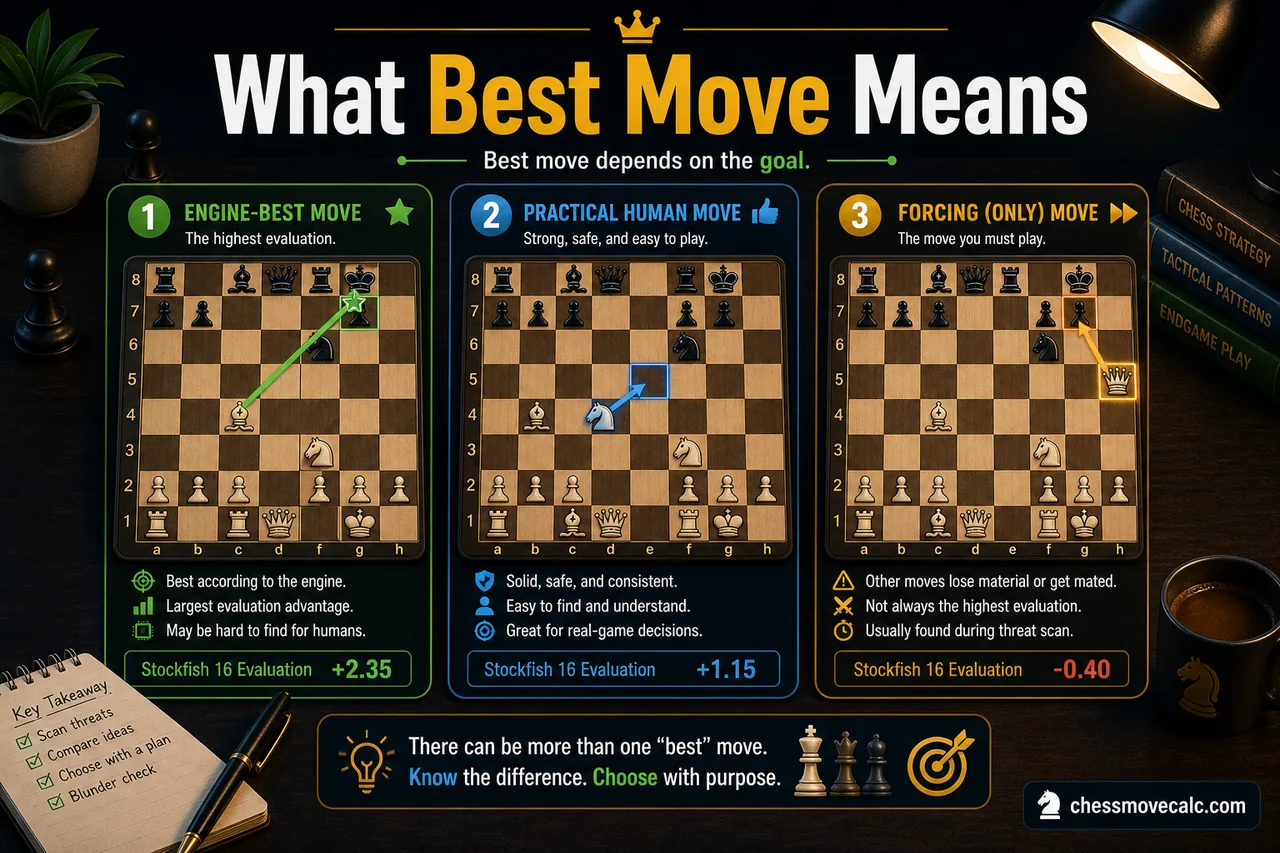
Not every best move is best for the same reason. Context matters.
Players often talk about “the best move” as if every position has one obvious answer. In reality, the phrase can mean three slightly different things. The objective best move is the engine’s top choice in perfect play. The practical best move is the move a human is most likely to calculate and execute correctly. The only move is the move that keeps you alive when every other choice loses immediately.
That distinction matters because amateur players often throw away good practical decisions while chasing engine-like perfection. In a classical training session, it makes sense to push toward the objective best move. In blitz or rapid, a slightly less precise move that is easier to calculate and keeps your king safe may still be your best practical decision.
Practical rule
If two moves are close, prefer the move you understand better, calculate more clearly, and can play without creating fresh tactical weaknesses.
- Objective best move: highest evaluation in perfect play.
- Practical best move: strongest move for your current time control and calculation ability.
- Only move: a defensive resource you must find to avoid immediate damage.
Start with checks, captures, and threats
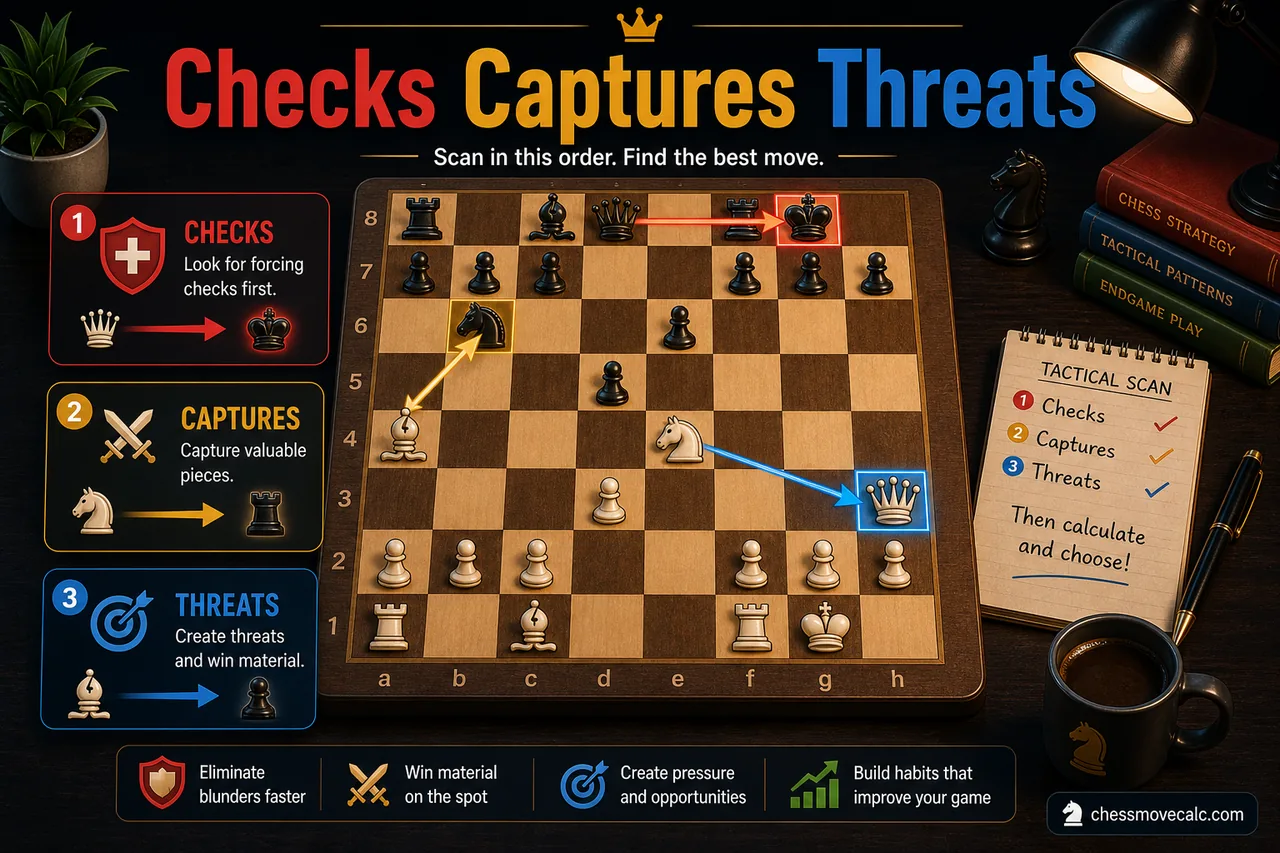
Forcing moves shrink the tree. That makes calculation clearer and faster.
The fastest way to improve your move selection is to stop starting with “pretty” moves and start with forcing ones. Checks, captures, and direct threats matter because they reduce the number of sensible replies. That makes calculation cleaner. When a move gives check, wins material, or creates a dangerous threat, it deserves attention before quiet improvement moves.
This is the core reason many players miss tactics. They immediately look for development, centralization, or a comfortable plan, while the position is screaming for a forcing sequence. The board does not always reward elegance first. Sometimes it rewards urgency.
1 Scan all checks
Ask whether you can check the king, threaten mate, or force a defensive move that improves your position.
2 Scan all captures
Look for hanging pieces, overloaded defenders, and captures that change the structure around the enemy king.
3 Scan direct threats
Include moves that attack a loose piece, create a tactical motif, or set up a threat on the next move.
4 Only then go quiet
If the forcing scan produces nothing good, move on to improving moves like development, restriction, or prophylaxis.
Common beginner leak
Many players say they “didn’t see” the best move when the real issue is that they never looked in the forcing category first. Their search process skipped the most urgent moves on the board.
Build 2 or 3 candidate moves before you calculate deeply
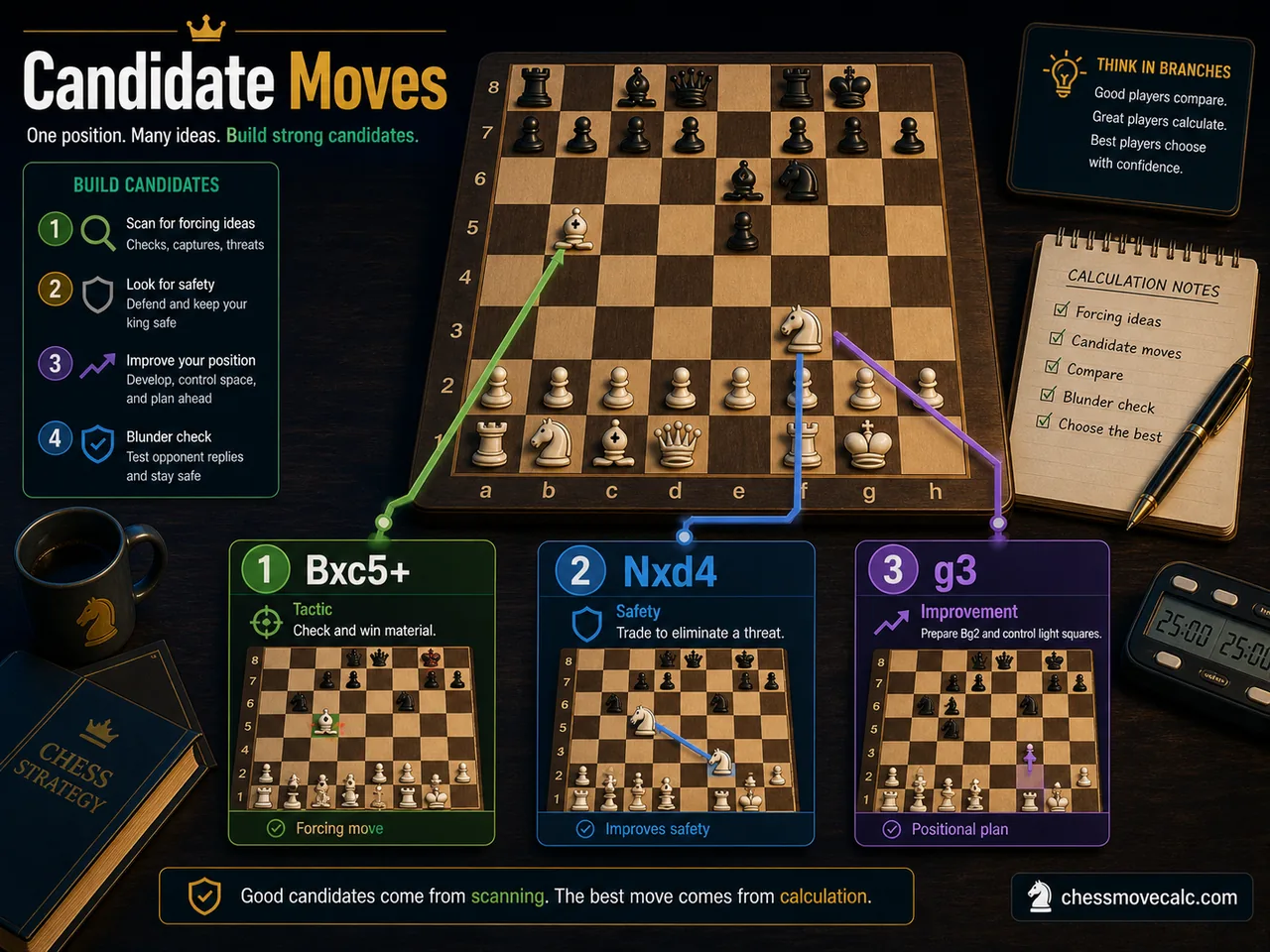
The goal is not to calculate everything. The goal is to compare the right small set of options.
After your forcing scan, build a shortlist. Usually, two or three candidate moves are enough. One candidate creates tunnel vision. Five or six often wastes time. You want a balanced shortlist with different strategic purposes: one tactical move, one defensive move, and one improving move is a strong practical mix.
This habit is important because the first attractive move is not always the best move in chess. Sometimes a flashy tactic fails because of one hidden reply. Sometimes the quiet move is stronger because it improves your position while preventing the opponent’s idea.
- Tactical candidate: wins material, attacks the king, or creates immediate pressure.
- Defensive candidate: neutralizes a threat, protects a weakness, or simplifies into safety.
- Improving candidate: activates a piece, claims space, or upgrades your structure for the next phase.
Fast filter
If a candidate leaves your king weaker, hangs material, or ignores a strong enemy threat, cut it early. Good candidates survive basic reality checks before you invest calculation time.
Compare tactics, king safety, and long-term position
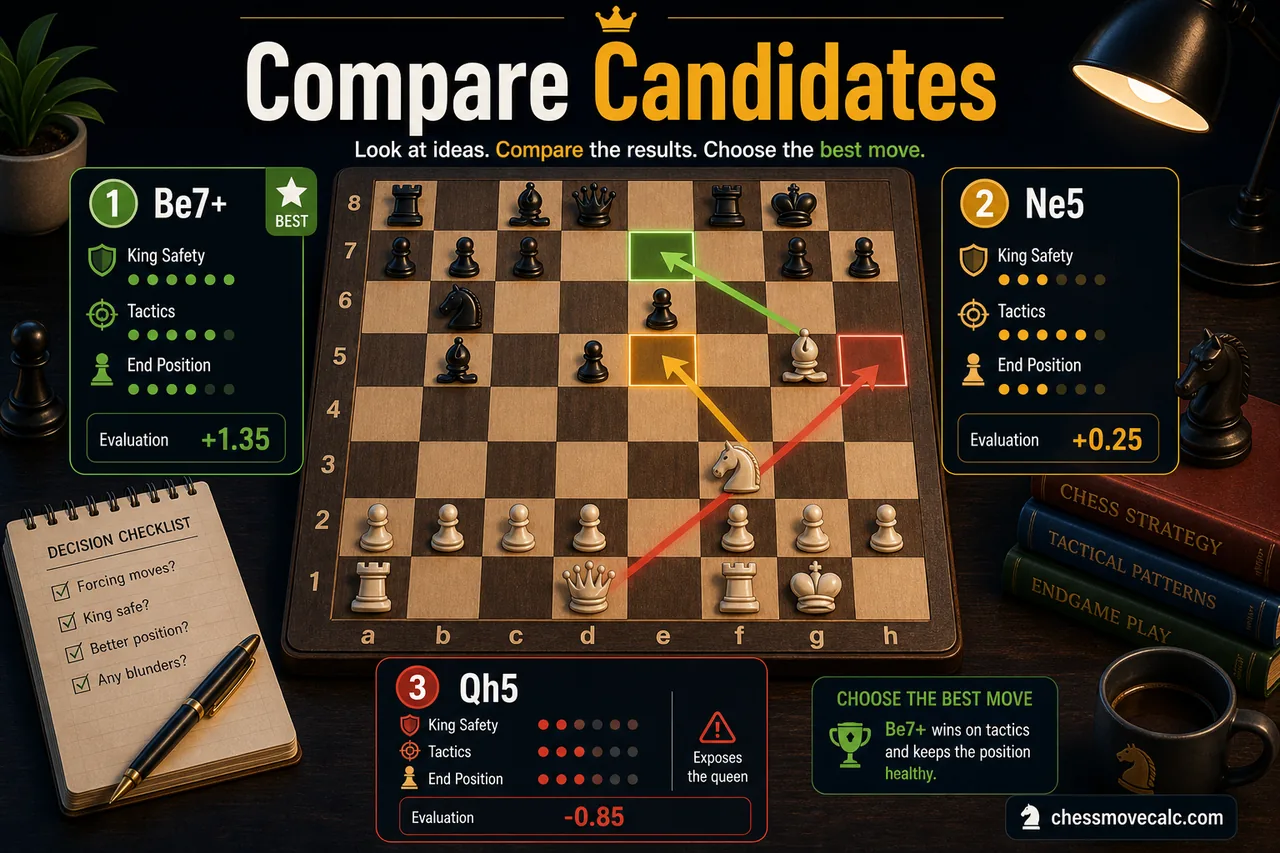
Strong move choice is a comparison problem, not a vibes problem.
Once you have candidates, you need criteria. The easiest way to compare moves is to run them through the same evaluation lens: tactics first, then king safety, then material, then activity, then structure, then initiative. That order is practical because tactical refutations can kill a move instantly, while positional differences usually matter after the tactical smoke clears.
King safety deserves special respect. A move that wins a pawn but opens your king is often worse than a move that keeps the king secure and improves coordination. Club players lose many good positions not because they misunderstood strategy, but because they treated king safety like a secondary factor.
1 Tactics
Does the move win material, miss a tactic, or allow a forcing sequence for the opponent?
2 King safety
Which king becomes easier to attack after the move? This often decides close comparisons.
3 Piece activity
Does the move improve your worst piece, restrict an enemy piece, or seize key files, diagonals, or squares?
4 Structure and initiative
Does the move create weak pawns, or does it let you keep asking questions that the opponent must answer?
Tie-breaker rule
If two moves seem close, choose the one that gives your opponent fewer forcing opportunities and leaves you with easier next moves.
Do the 30-second blunder check before you play
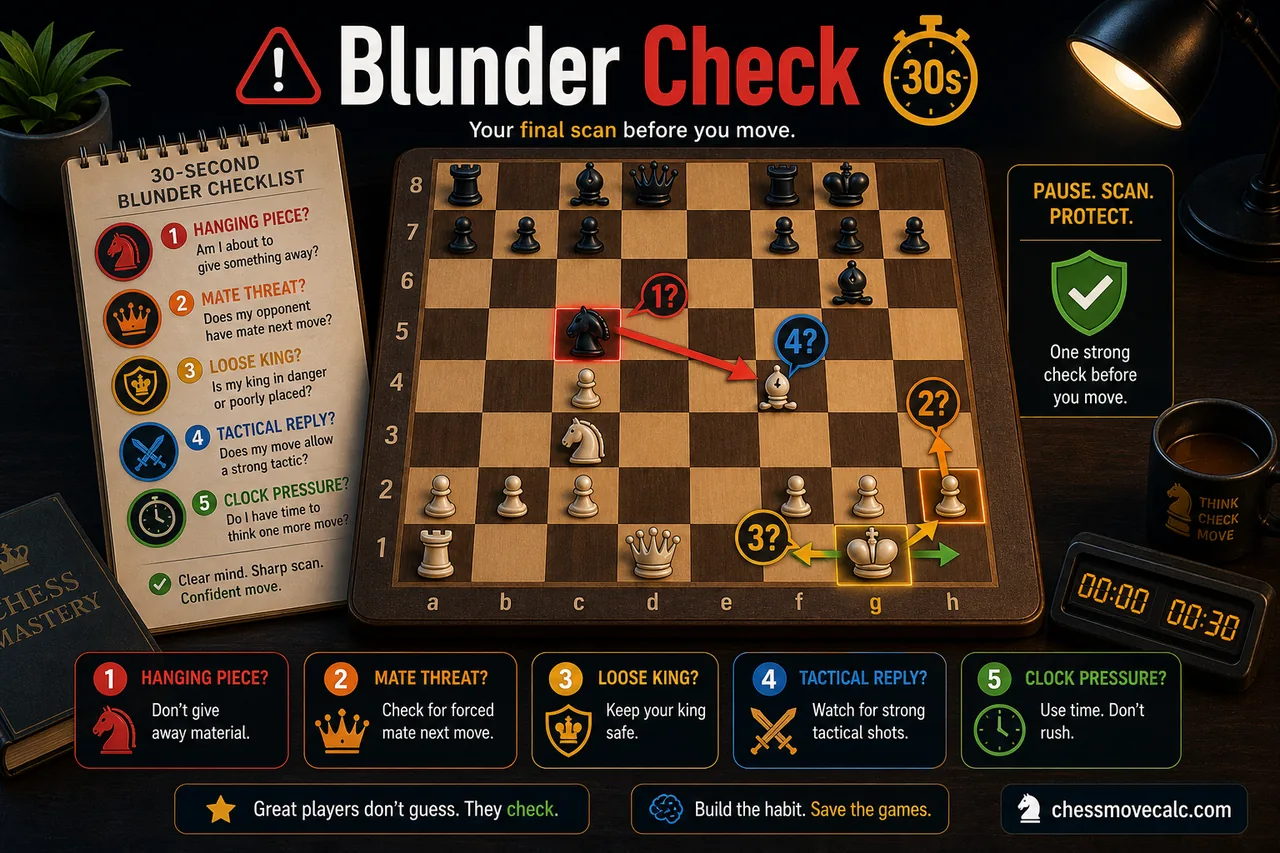
Good calculation is wasted if you skip the last safety check.
This is the habit that separates players who “often had the right idea” from players who actually score points. Before you make the move, stop and ask one brutal question: What can my opponent do immediately after this? You are not trying to discover every line. You are trying to catch the one tactical reply that ruins everything.
Your blunder check should be systematic. Scan hanging pieces. Scan checks against your king. Scan loose back-rank squares. Scan overloaded defenders. Scan simple tactical shots like forks, pins, skewers, and zwischenzugs. This takes less time than recovering from a blunder.
- Hanging piece: Did your move leave a piece or pawn undefended?
- Mate threat: Did you allow a direct attack on your king?
- Back rank issue: Did a rook or queen suddenly gain access?
- Loose king: Did you weaken a critical square around your king?
- Tactical reply: Can your opponent refute your move with one forcing sequence?
Why this matters so much
Many blunders happen after a player already found a strong idea. The error is not in the idea itself. The error is failing to ask what the opponent gets in return.
Use a best chess move calculator the right way
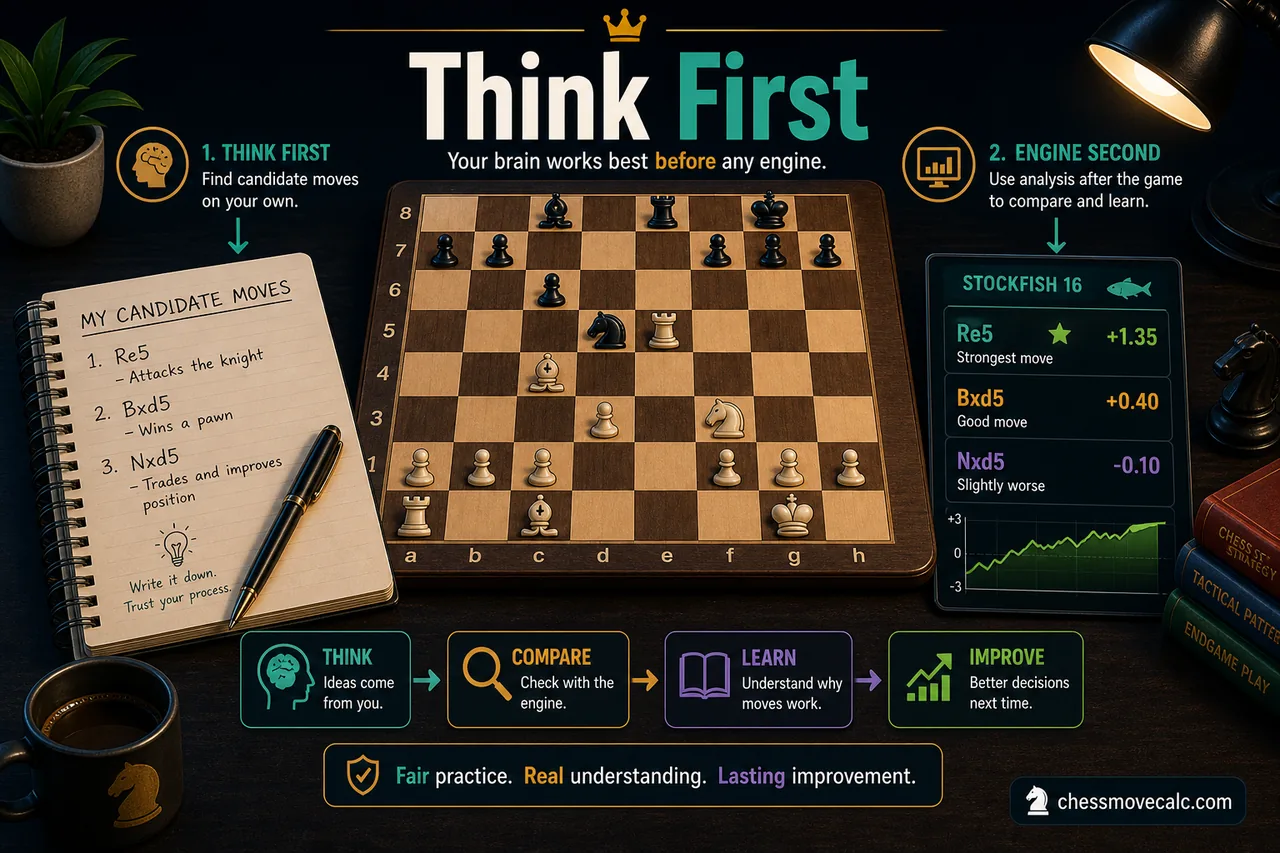
The engine is a teacher when it comes second. It becomes a crutch when it comes first.
A best chess move calculator is incredibly useful, but only if you use it in the right order. If you check the engine before you think, you train dependency. If you think first and verify second, you train pattern recognition, discipline, and evaluation. That is why the best workflow is simple: solve the position yourself, record your move, and then compare it with the engine line.
When the engine disagrees with you, do not just memorize the move. Ask why your move failed. Did you miss a forcing move? Did you misjudge king safety? Did you overvalue material and undervalue initiative? That short review turns a one-off engine answer into a long-term lesson.
Smart engine workflow
Try the position first, then verify with our Chess Next Move Solver. After that, review deeper with our guide on how to analyze chess games so you improve instead of just copying lines.
If you want more tools around this process, browse our full chess tools collection. The strongest improvement loop is not “find the engine move.” It is “understand why the engine move is better than mine.”
Worked example: how to find the best move in a real position
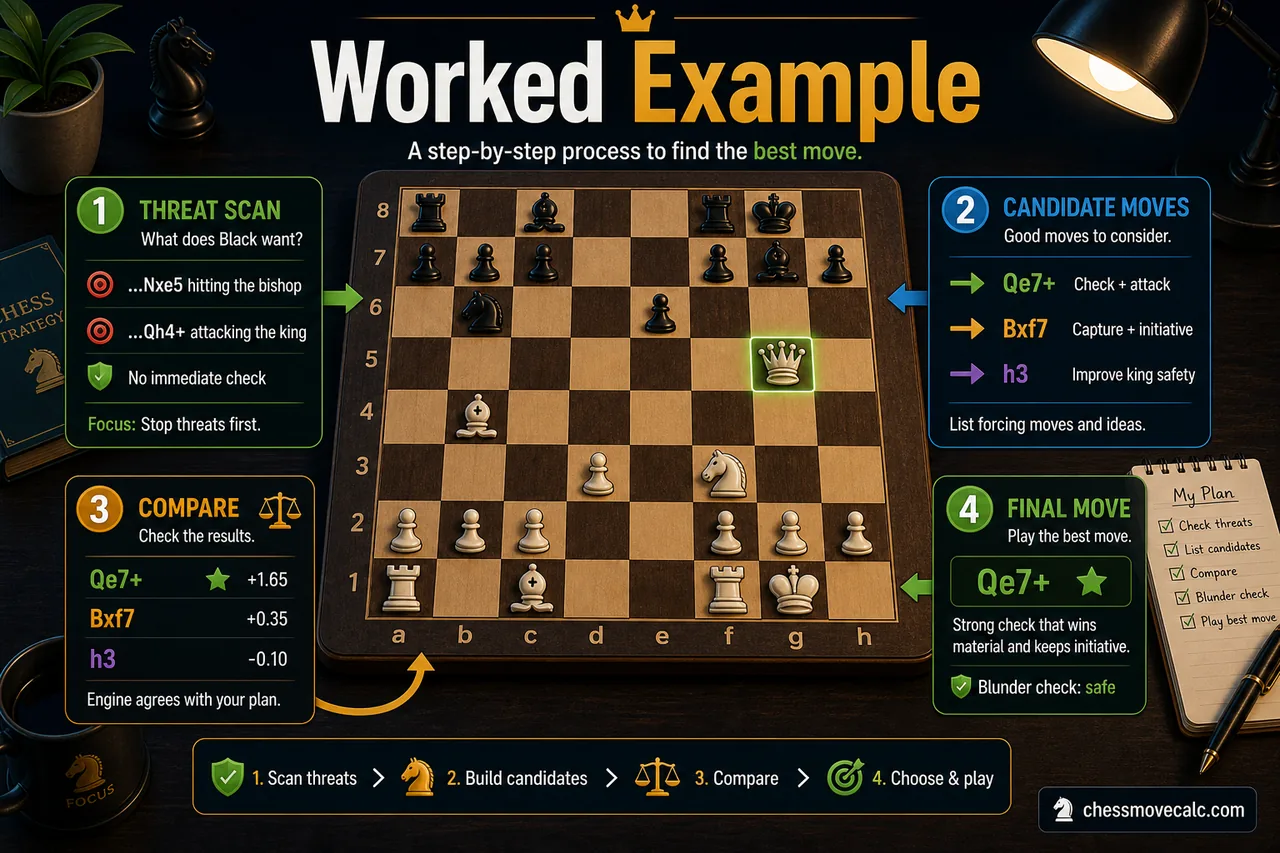
The strongest move often becomes obvious only after weaker candidates are eliminated for good reasons.
Imagine a middlegame where your pieces are active, the enemy king is slightly exposed, and you notice a tactical possibility near the center. A weaker player may jump at the first flashy move. A stronger practical player runs the process.
Step-by-step example thinking
First, you scan forcing moves and notice a check-like attacking resource around the enemy king. Then you shortlist three candidates: a direct attacking move, a material grab, and a central improving move. Next, you compare them. The material grab looks tempting, but it reduces your initiative. The quiet improving move is playable, but it lets the opponent regroup. The attacking move keeps the king under stress and creates the fewest comfortable replies.
In the example above, Bxe7+ wins the comparison not because it looks spectacular, but because it combines forcing play, king pressure, and clean calculation. That is the bigger lesson. The best move often survives because the other candidates fail specific tests, not because it “looks nice.”
Training takeaway
When you study your own games, do not just ask “what was the best move?” Ask “what candidates did I consider, and what filter should have eliminated the weaker ones?” That is how move-finding skill compounds.
Best move FAQs
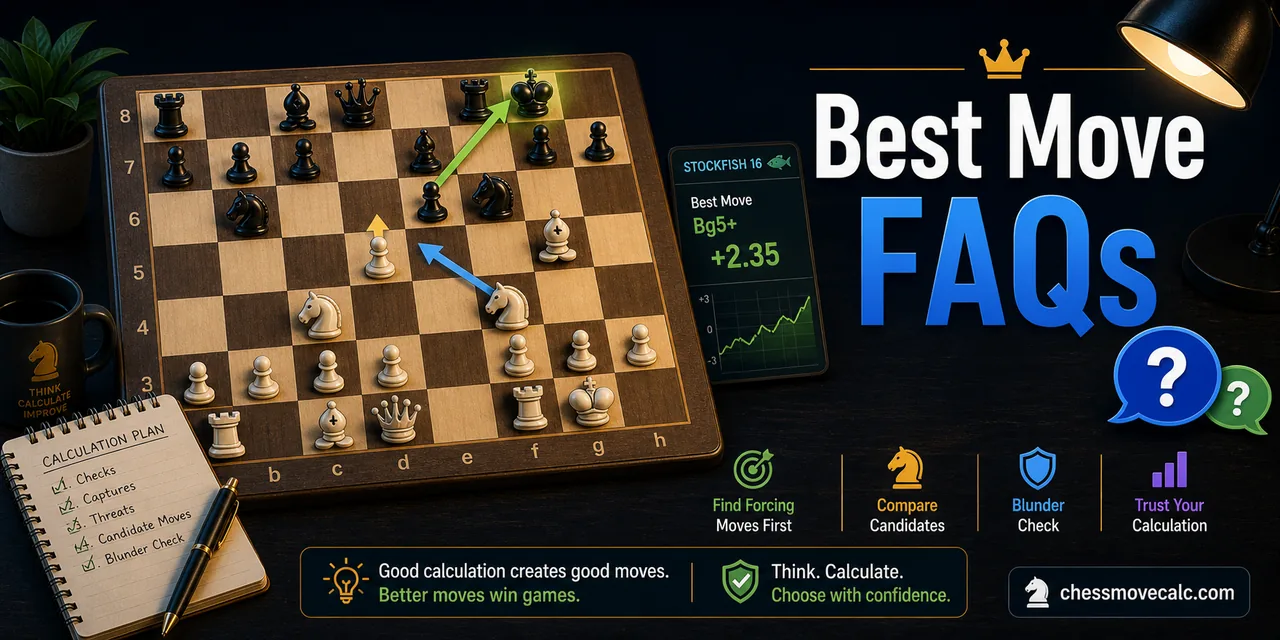
What is the best way to find the best move in chess?
Use a process: forcing moves first, then candidate moves, then comparison, then a blunder check. That structure is more reliable than intuition alone.
Should I always trust the engine's top line?
Trust it as a verification tool, but study the reason behind it. An engine line is only truly useful when you understand the tactical or positional point that makes it strong.
How many candidate moves should I calculate?
Two or three is usually the sweet spot for practical chess. That gives you enough comparison without drowning in branches.
Why do I miss the best move even when I feel I calculated a lot?
Usually because the search started in the wrong place. If you skip checks, captures, threats, or the final opponent reply scan, you can calculate a lot and still miss the critical point.
Is the best move always the most aggressive move?
No. Sometimes the best move is a calm defensive move, a simplification, or a prophylactic move that stops the opponent's idea before it starts.
Can a chess move finder help me improve if I use it after the game?
Absolutely. Post-game verification is one of the best uses of an engine because it helps you connect your calculation mistakes to concrete lessons.
Try the process on your own positions
Use the framework from this article on a position from your last game, then verify it with engine analysis. The goal is not just to find a better move today. It is to build a move-finding habit that keeps paying off.