Calculate a forcing move: Fool’s Mate
This position follows 1. f3 e5 2. g4. Black to move has 2...Qh4#. The diagonal h4–g3–f2–e1 is open. White cannot capture the queen, block that diagonal, or move the king to a safe square.
Use checks, captures, and threats to generate candidates. Here a check is decisive, but in other positions a check may simply lose a piece. Always test the opponent’s legal replies.
Load this exact position:
rnbqkbnr/pppp1ppp/8/4p3/6P1/5P2/PPPPP2P/RNBQKBNR b KQkq g3 0 2A real system for choosing your next move
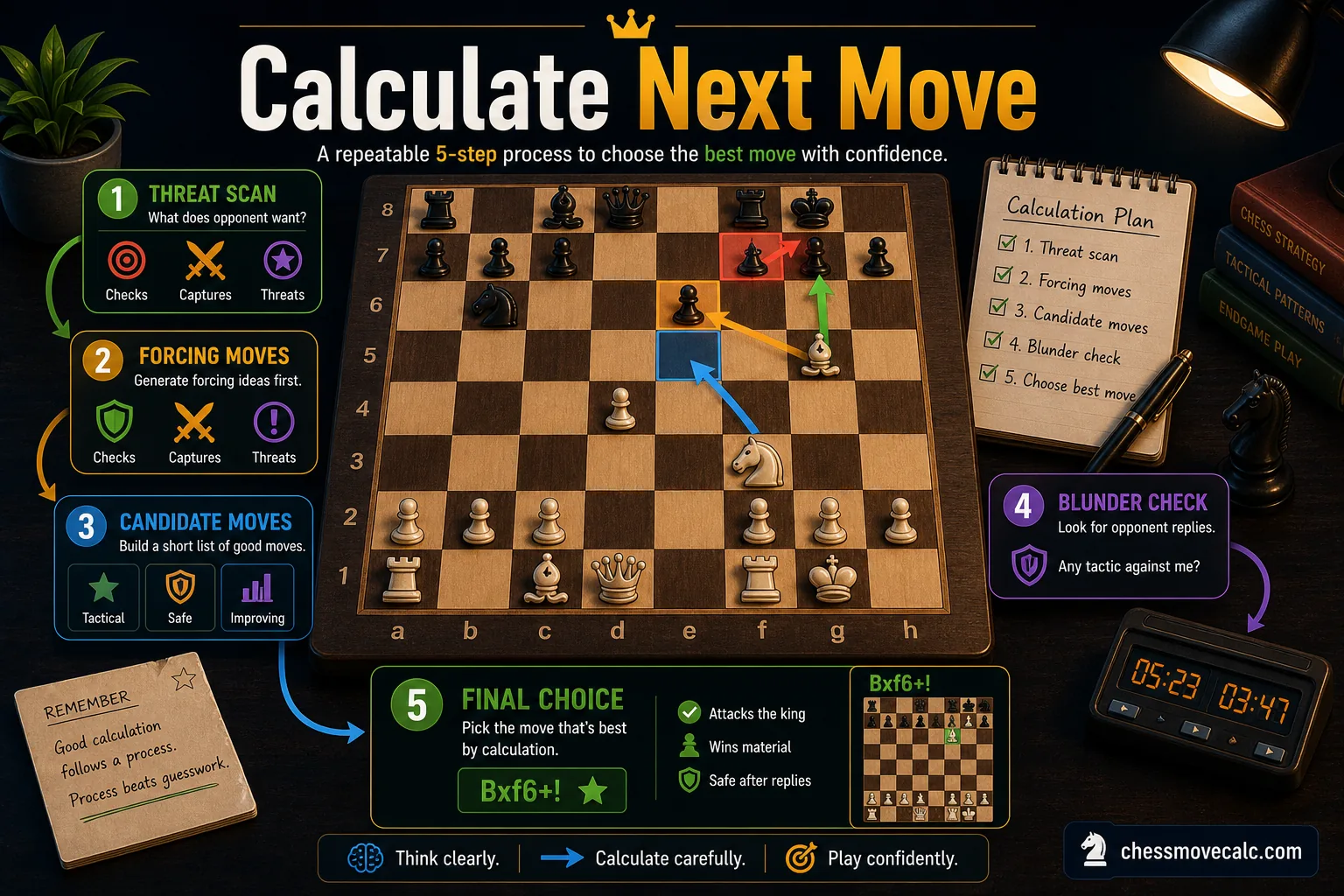
The strongest next-move process is simple: understand the threat, search forcing moves, compare candidates, then blunder-check.
To calculate your next chess move, first identify your opponent’s threat. Then list checks, captures, and direct threats for your side. Choose two or three realistic candidates and calculate the opponent’s strongest reply to each. A next chess move calculator helps check that work after you have formed your own answer.
That gap matters because practical chess is not the same as engine chess. An engine such as Stockfish can calculate millions of nodes, return a centipawn evaluation, and show a principal variation. A human player needs a shorter loop. You need to know what deserves attention first, which candidate moves are real, when you have calculated enough, and how to avoid the one-move tactical refutation that ruins the whole effort.
Work one move at a time: name the threat, choose candidates, test replies, and make a final blunder check. The best chess move guide explains how positional factors help choose between candidates. Use the chess next move calculator to compare the resulting lines and investigate a reply you missed.
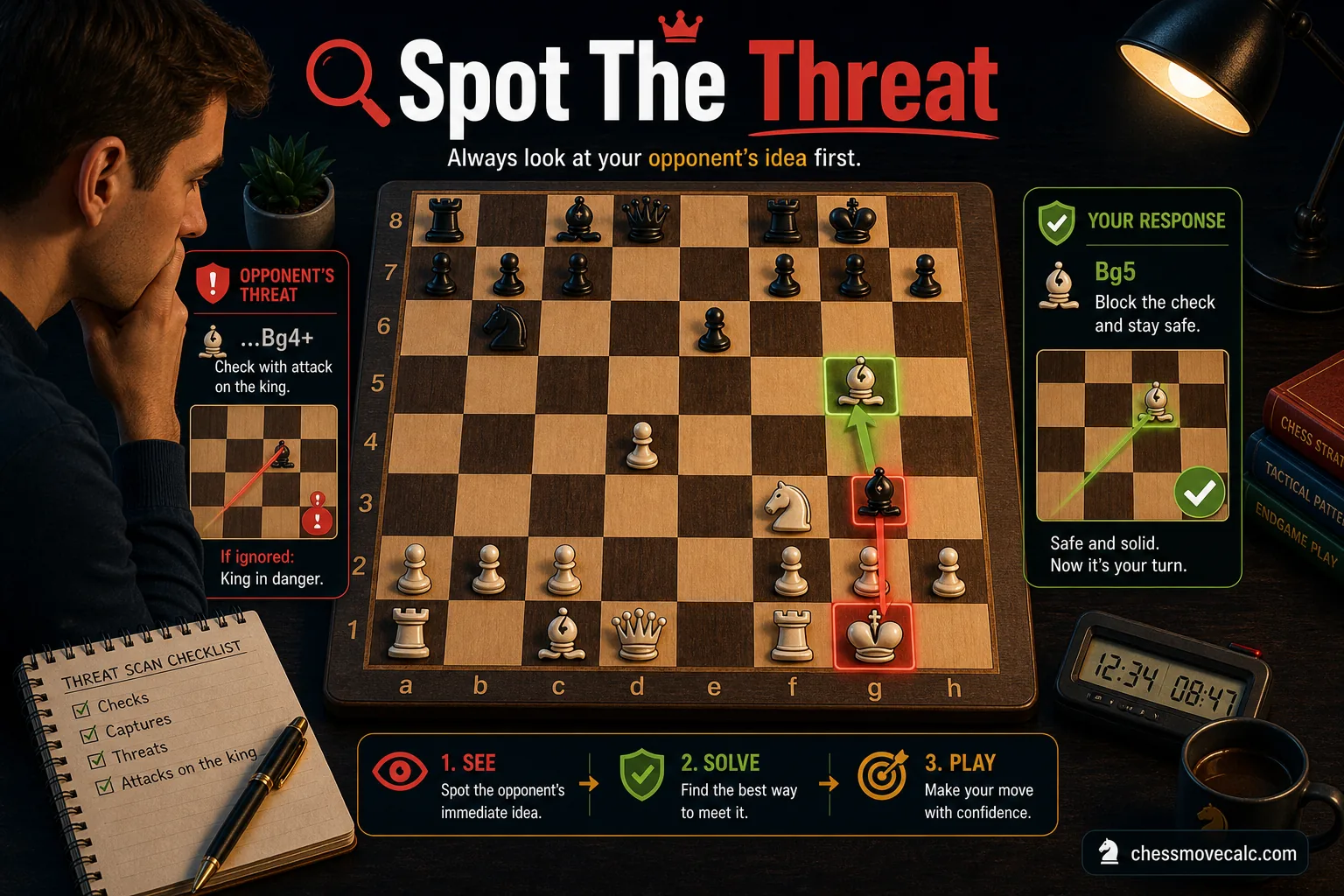
If you do not understand the opponent's idea, you are not really calculating the next move yet.
Start by asking what your opponent wants
The biggest next-move mistake is selfish calculation. Many players see a tempting attacking pattern, start calculating their own plan, and forget that the opponent also gets a move. That is why the strongest calculation habit begins with one question: what is my opponent threatening if I do nothing?
This is not just defensive chess. It is efficient chess. When you identify the opponent's immediate threat, you instantly remove bad candidate moves. Maybe your queen-side expansion looked attractive, but it fails to a back-rank tactic. Maybe your quiet improving move loses a pawn because a capture was hanging. Maybe you were about to attack on the king side while your own king was exposed to a forcing check sequence. Threat-first thinking narrows the tree before the tree gets out of control.
In practical terms, scan for checks against your king, direct attacks on unprotected pieces, mating nets, discovered attacks, tactical pressure on pinned pieces, and simple improvement moves that create a threat next turn. A good rule is to say the threat out loud in plain language: “If I pass, they play ...Qh2 mate,” or “If I ignore this, they win my rook on e1.” Once you can name the threat, your next move choices become much clearer.
Fast self-talk that works
Before calculating your move, say: “What is their best reply if I make a random move?” That single sentence prevents countless blunders.
- Identify whether the threat is tactical, positional, or only cosmetic.
- Note which of your pieces are loose, pinned, overloaded, or short on defenders.
- Eliminate any candidate move that loses to the threat without compensation.
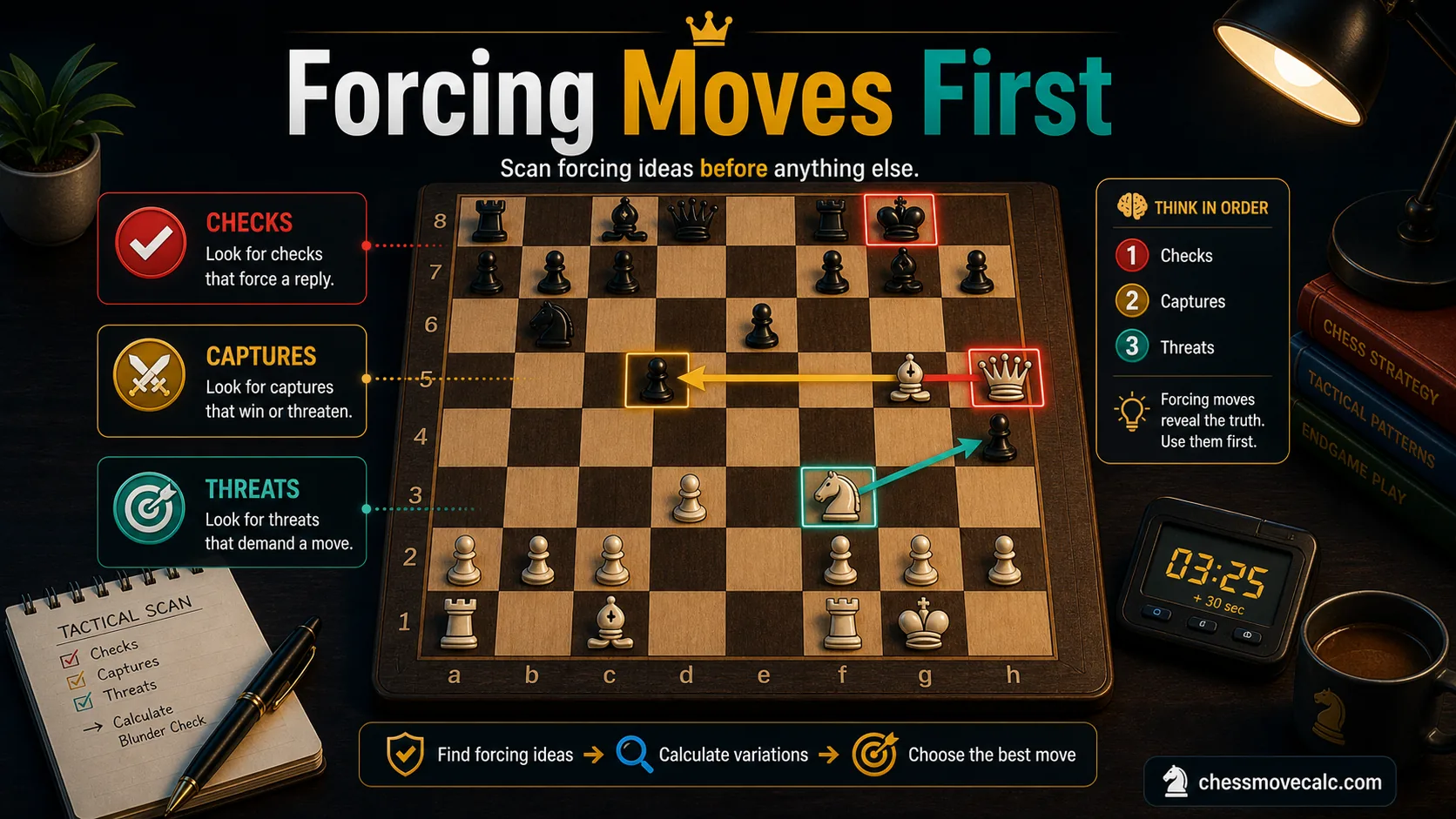
Checks, captures, and threats are forcing moves because they demand an answer and expose the tactical truth of the position.
Calculate checks, captures, and threats before quiet moves
Once you understand the opponent's idea, the next step is the classic forcing move scan: checks, captures, and threats. This works because forcing moves compress the position. They reduce the opponent's reply set, which makes calculation more accurate and less expensive. That is why nearly every good next move calculator chess workflow begins with tactical forcing options before it settles into deeper evaluation.
Start with legal checks. Not because checks are always best, but because they are the easiest moves to verify quickly. A check may produce mate, win material, force the king into the open, or simply show you that the attack is not real. Then scan captures. Captures often reveal hanging pieces, overloaded defenders, tactical exchanges, and whether a position is ripe for simplification. After that, examine direct threats such as attacking a major piece, threatening mate, or creating a decisive passed pawn.
Quiet moves still matter. In strategic positions, the right next move may be a king improvement, a prophylactic pawn move, or a piece reroute. But quiet moves should usually enter the conversation only after forcing options have been checked. Otherwise you risk spending time polishing a strategic move in a position where tactics already decide everything.
Tactical motifs to keep in memory
As you scan forcing moves, actively look for forks, pins, skewers, discovered attacks, deflections, back-rank themes, and removal of the defender.
1 Scan checks first
Check whether any immediate king attack forces a concession, a material win, or a clear evaluation swing.
2 Compare captures
Ask which captures change the balance of defenders, open lines, or leave the opponent with only one clean reply.
3 Test direct threats
Threats that force defense next move often outperform quiet improvement because they seize the initiative.
4 Quiet moves last
If no forcing line solves the position, you can trust a quieter candidate more because tactics have already been cleared.
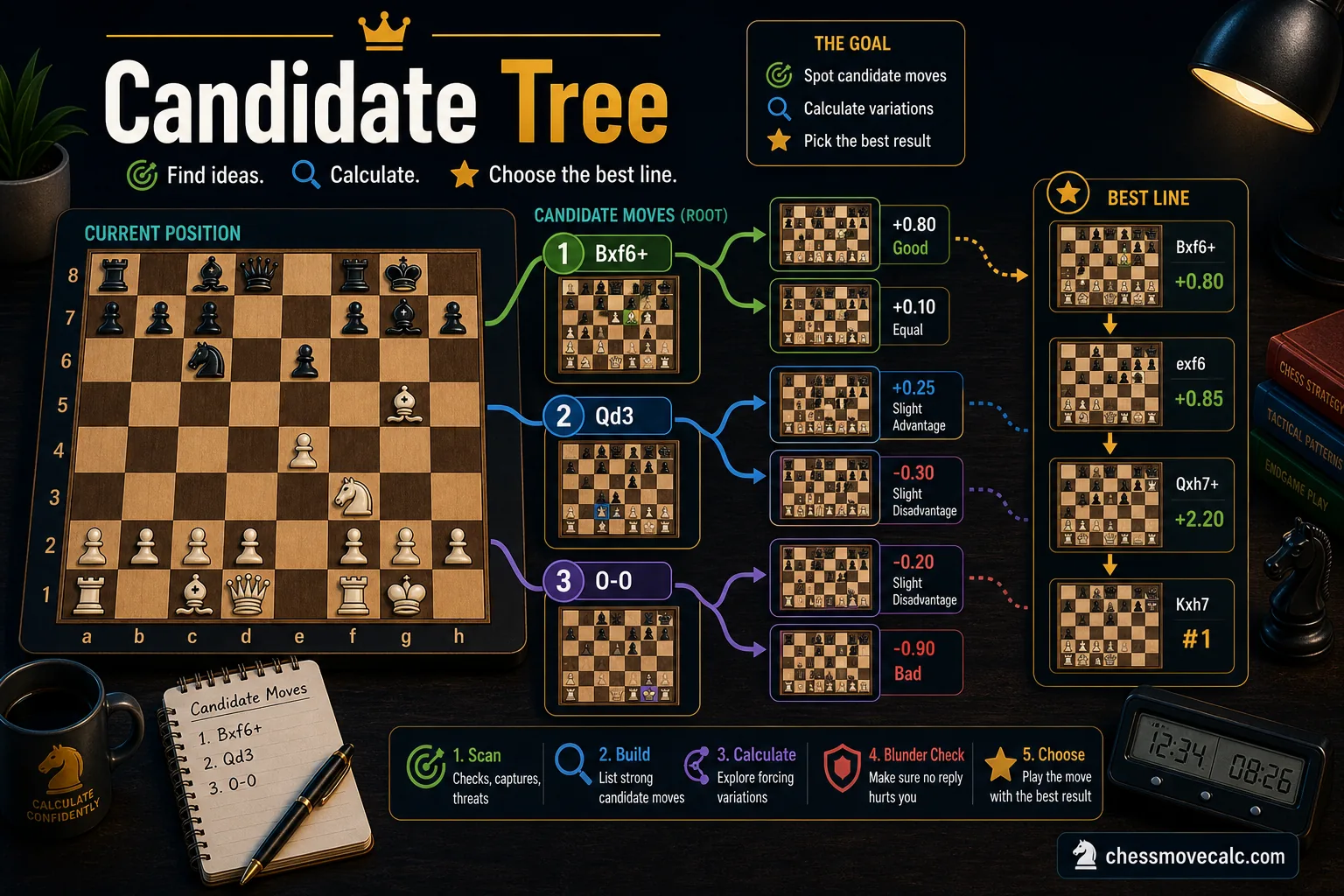
The point of a candidate tree is not to calculate everything. It is to compare only the moves that deserve your clock.
Build a candidate-move tree without overcalculating
A common beginner mistake is trying to calculate every legal move. That is not disciplined calculation. That is panic. Strong calculation relies on candidate moves: two or three realistic choices that survive the threat scan and the forcing-move scan. Once you have that shortlist, you can invest real attention without drowning in branches.
A good candidate move set usually contains variety. One move may be tactical and forcing. One may be solid and defensive. One may be a positional improvement. This mix prevents tunnel vision. If all of your candidates are the same type of move, you may already be missing the real idea in the position. When players say they “calculated a lot” but still found the wrong move, the real issue is often that they only calculated one family of moves.
Depth matters, but practical depth matters more. In a forcing tactical line, you may need to see five or six ply clearly. In a quieter middlegame, two or three moves deep may be enough if the strategic picture is stable. Your goal is not infinite depth. Your goal is reliable comparison. That is also why engine language like principal variation is useful only after you already know what your own candidates were. Otherwise you are just consuming answers, not building skill.
Overcalculation is a clock leak
If you keep expanding branches that no longer look better than your top candidate, stop. Good pruning is part of good chess.
- Keep only moves that survive the opponent-threat test.
- Prefer candidates that solve a problem or create a concrete new question for the opponent.
- Record your two best candidate moves before using any engine or calculator review.
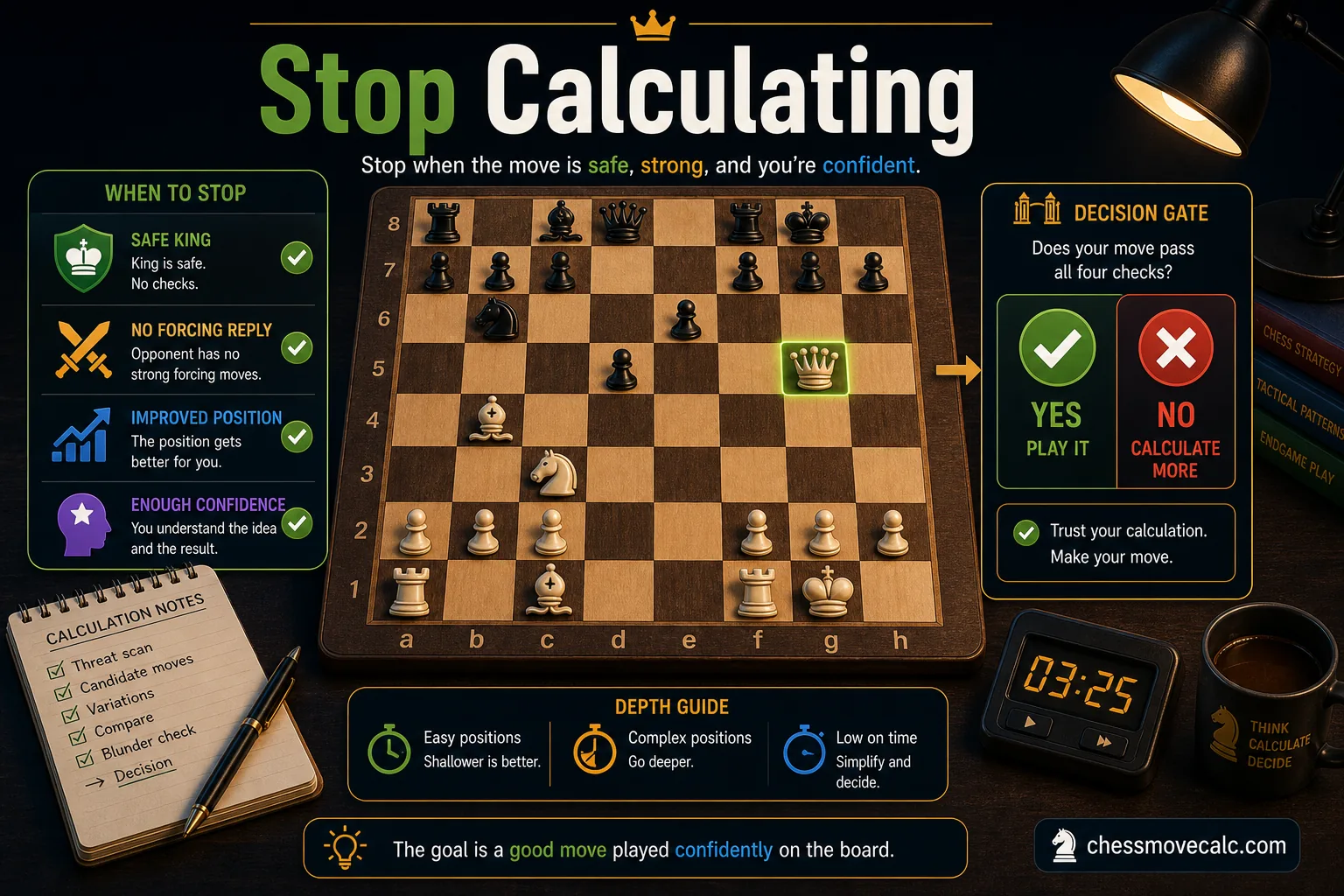
You do not need perfect certainty. You need enough clarity to choose the best practical move within the time control.
How to know when you have calculated enough
Many players are not weak because they cannot calculate. They are weak because they do not know when to stop. In chess, perfect knowledge is impossible. The real skill is recognizing when the line is resolved enough to make a good practical decision. This is where next move calculation becomes a time-management skill.
There are four strong stopping signals. First, the line becomes forced. If both sides only have one or two sensible moves, you can trust the branch more than a speculative one. Second, the evaluation becomes stable. Even if you cannot see every detail, you know one candidate consistently wins material, keeps your king safer, or reaches a superior endgame. Third, the same conclusion keeps appearing from multiple move orders. That repetition is often enough confirmation. Fourth, the clock itself matters. A move that is 0.20 stronger in engine terms is often worse in human terms if it takes five more minutes to verify and leaves you no time for the rest of the game.
This is why “calculate until you know everything” is bad advice. Better advice is: calculate until the comparison is clear. If Candidate A always gives the opponent counterplay, Candidate B keeps your king safe and wins a pawn, and Candidate C is hard to evaluate, you may already know enough. The strongest move in practical chess is often the move with the best combination of objective value, clarity, and ease of execution.
Time control changes depth
In blitz, favor shorter forcing lines and safer evaluations. In rapid and classical, invest more time in candidate comparison before committing.
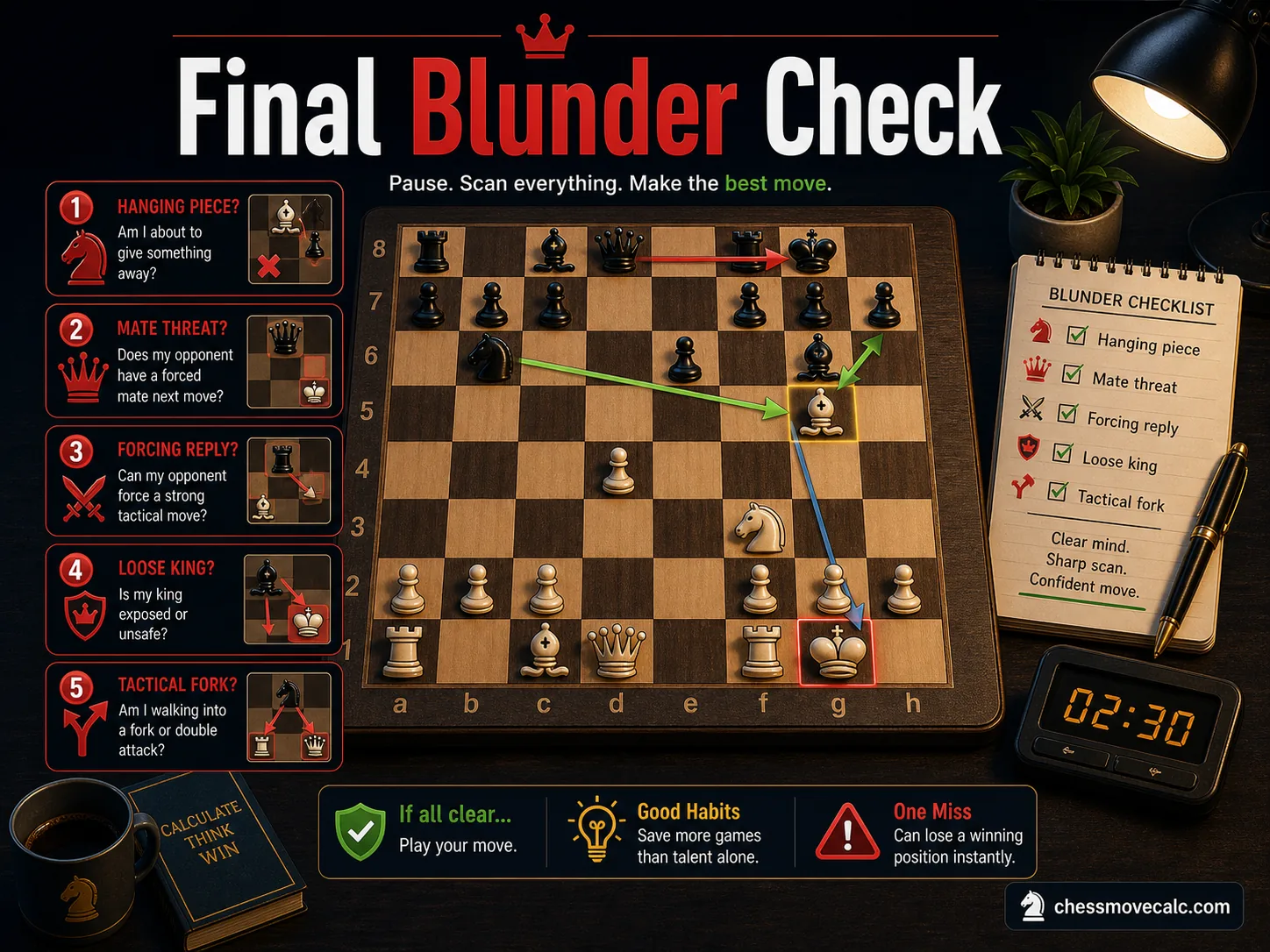
The final blunder check is not glamorous, but it converts good ideas into actual points.
The final blunder-check that saves games
Before you move, pause for one last tactical audit. This step is so important that it deserves its own identity. Many players do solid work, find a strong candidate, and then lose because they never asked one final question: what is the opponent's strongest reply after my move?
Your blunder check should cover five areas. Are you hanging a piece? Are you walking into a mate threat or a back-rank issue? Does your move allow a zwischenzug, a tactical in-between move that changes the sequence? Does the opponent gain a discovered attack or skewer? Did you accidentally change the side-to-move logic in your head and analyze the wrong player’s turn? That last error is more common than most players admit, especially when visualizing a long line.
Online tools and engines catch many of these mistakes instantly, which is why they are useful after you think for yourself. But if you want practical strength, you cannot outsource the blunder check entirely. You want the habit inside your own process so it works whether you are solving a puzzle, playing on a live board, or using a chess calculator next move tool only after the position is already over.
The 10-second reset
Visualize your chosen move on the board, switch perspective, and ask: “What would they play instantly if they had my position now?”
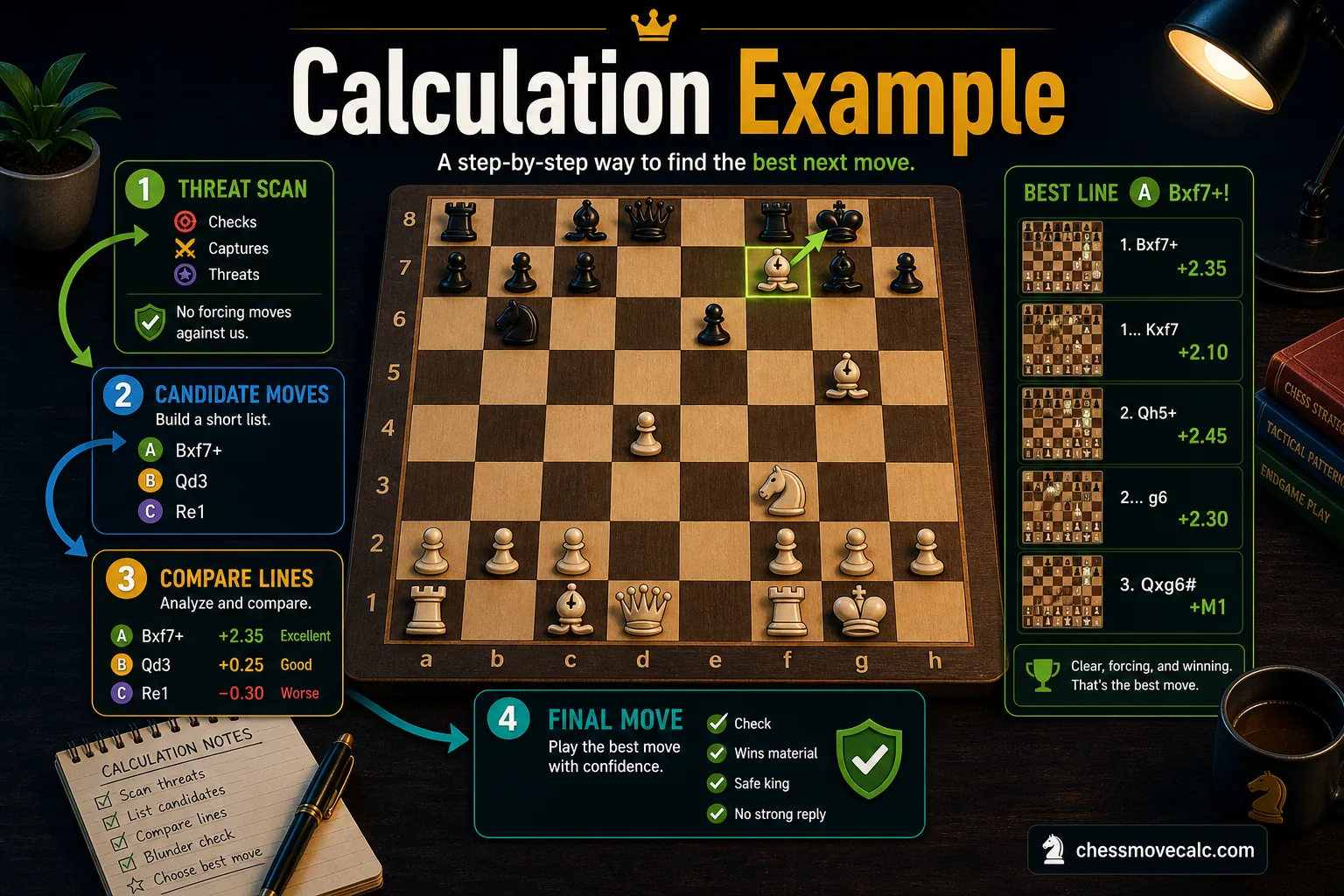
A worked example shows how good next-move calculation narrows the choice instead of chasing every possible line.
Example walkthrough from idea to final move
Imagine a middlegame where White has active pieces pointed toward the black king, but Black also has counterplay on the open file. A weaker player might jump straight to the first attacking move that looks dangerous. A stronger player will run the process. First: what is Black threatening? Maybe the rook invasion or queen pressure on h2. Second: what are White’s forcing options? In a position like this, checks and direct attacks matter most because they decide whether the initiative is real.
Suppose your candidate list becomes Bxf7+, a queen move that threatens mate but allows defense, and a quiet rook lift that improves pressure. The check gets priority because it is forcing. You calculate the king response, then whether the follow-up keeps momentum or only burns material. The queen move looks flashy, but if Black can calmly defend and keep the extra tempo, it falls in value. The rook lift might be strong strategically, but if the position is tactically hot, it may simply be too slow.
This is where comparison matters. The best practical next move is not “the move that looks most aggressive.” It is the move whose line survives the opponent's best defense. If Bxf7+ keeps forcing moves alive, disrupts king safety, and still passes the final blunder check, it becomes the leading candidate. If it fizzles after accurate defense, then the quieter move may actually be stronger. The point is not memorizing one tactic. The point is learning the logic that produced the move.
What the example teaches
- Forcing moves earn the first calculation because they reveal the tactical truth fast.
- Good next-move calculation rejects attractive moves that do not survive the opponent's best reply.
- The final choice is the move with the best mix of objective value, practical clarity, and king safety.
If you want more examples built around the broader question of choosing the strongest move in any position, continue with our best chess move guide. It pairs well with this article because the first post covers broad evaluation, while this one focuses tightly on the next move chess calculation loop.
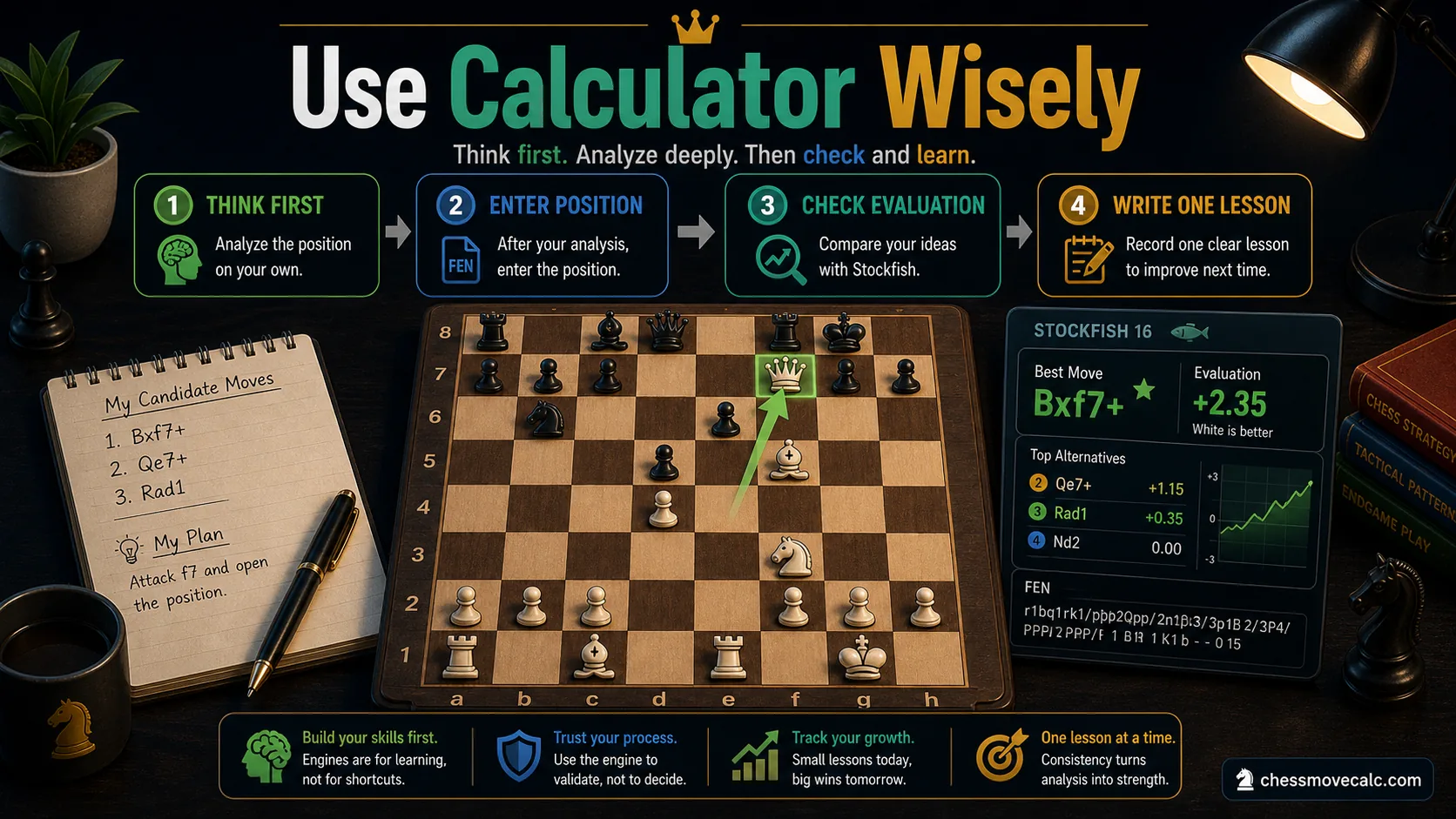
Use the engine as feedback, not as a substitute for your own calculation.
How to use a calculator after you think for yourself
A chess next move calculator is most valuable after you have already done your own work. First, set up the board or paste the FEN. Second, write down the move you would play and one alternative candidate. Third, run the engine. Fourth, compare your move with the engine's top move, evaluation, and principal variation. Fifth, write the lesson in plain language: “I ignored the opponent's back-rank tactic,” or “I chose a safe move when a forcing move won material.”
This turns engine review into training instead of passive consumption. It also aligns perfectly with the intent behind users searching for stockfish next move, find next move chess, and next move calculator chess. The calculator gives the answer. Your notes give the improvement. Over time, that feedback loop becomes pattern recognition. You start seeing why the engine prefers one move, not just which move it prefers.
For position work, use the homepage next chess move calculator. For full-game learning, follow up with our guide on how to analyze chess games. And if you want practical reps after studying, play a few training games on Play Chess Unblocked and test whether your calculation loop holds up under time pressure.
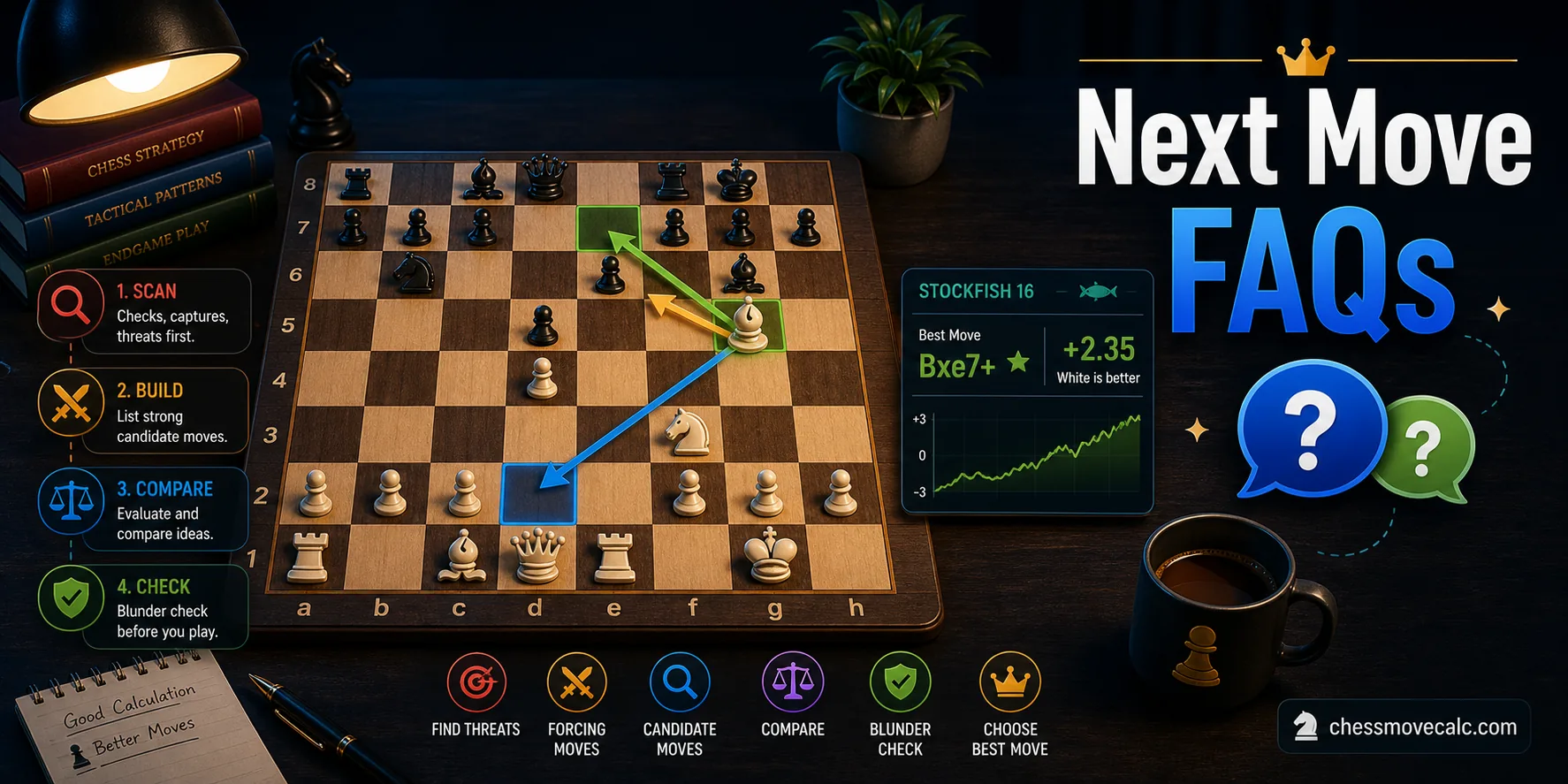
Next move FAQs
How do I calculate the next move in chess faster?
Use the same order every time: opponent threat, checks, captures, threats, candidate moves, then blunder check. Speed comes from structure, not from rushing.
Should I look at checks before anything else?
Usually yes, as long as you also compare captures and direct threats. The point is to scan forcing ideas before quiet moves so you do not miss tactical opportunities or refutations.
How many candidate moves should I consider?
Two or three is the sweet spot for most players. One move leads to tunnel vision, while too many candidates often wastes time and reduces clarity.
Why do I calculate correctly and still choose the wrong move?
You may be stopping at the first line that looks good, failing to compare candidates honestly, or skipping the final blunder check. Practical choice is part of calculation too.
Is the next best move always tactical?
No. Tactics must be checked first because they are forcing, but many positions end with a positional move once the tactical dust settles.
Can I train move calculation without a coach?
Yes. Solve positions alone, write down your candidate moves, compare them with an engine afterward, and track the reasons your move differed from the best line.
Try the next-move process on your own position
Set up your board, think first, then test your line with the ChessMoveCalc solver. That is the fastest way to turn this article into actual playing strength.