Conversion is easier when you think in jobs, not in file names
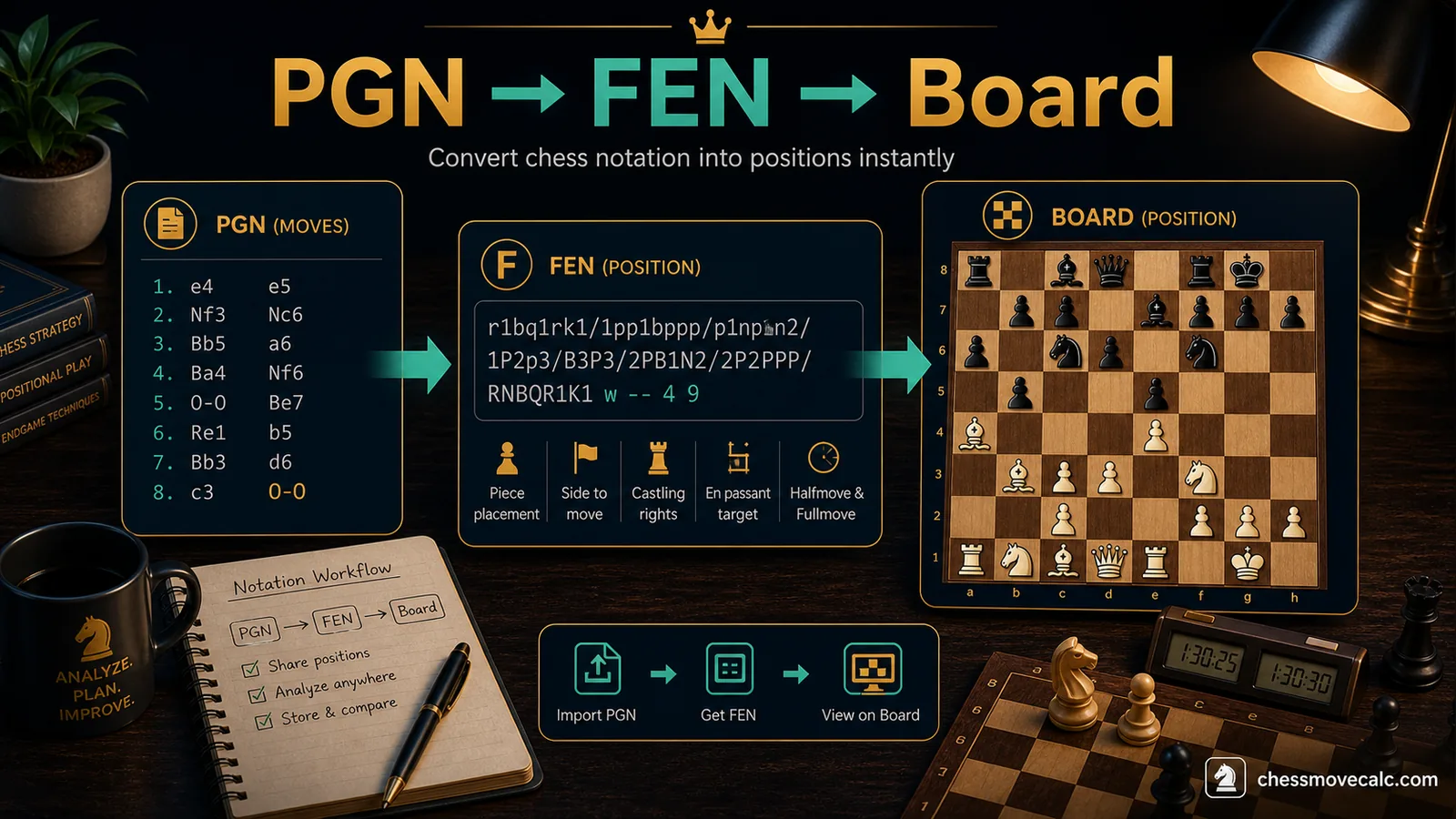
PGN to FEN is usually an extraction task, not a rewrite-the-whole-game task.
A lot of conversion frustration comes from treating PGN, FEN, and notation as three competing file types. They are not competing. They are three tools for different jobs. PGN stores the full journey, FEN stores one exact stop along the way, and algebraic notation is the readable language that most move lists use.
Once you see that relationship, conversion becomes less mysterious. PGN to FEN means extracting one position from a full game. FEN to board means loading one exact state so you can analyze it. Notation to position means turning a move list into something visible and trustworthy.
This guide is intentionally practical. It complements FEN vs PGN in Chess, which explains the difference, and it complements the ChessMoveCalc converter, which helps you test the workflow live. Here the goal is to make conversion less error-prone.
If you build the right sequence, you waste less time, avoid malformed inputs, and reach analysis much faster.
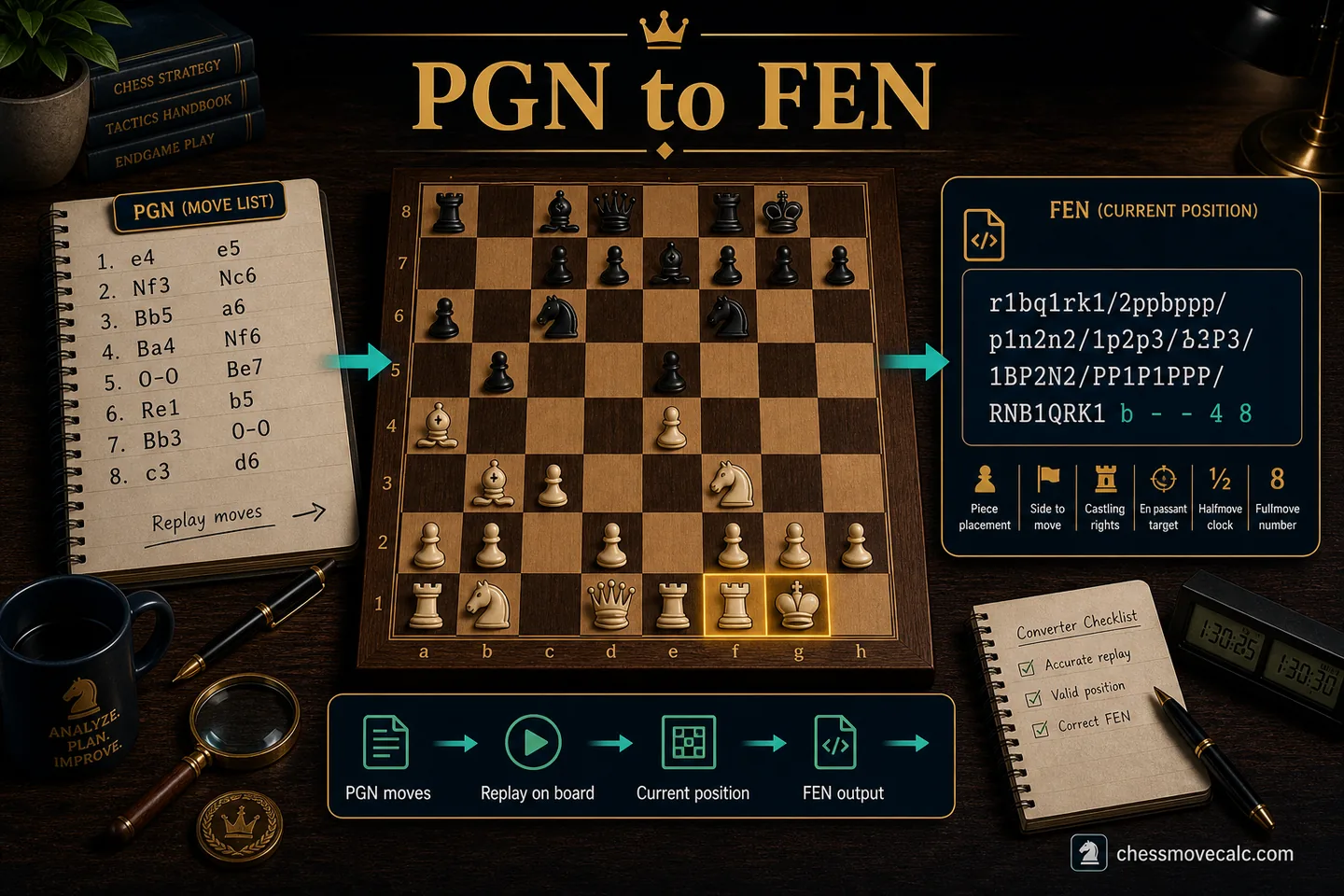
Convert PGN to FEN for one critical position
The cleanest conversion path is to load the game first and isolate the exact moment you care about. Load the PGN into a board or converter before doing anything else. Advance to the exact move where analysis should begin.
In practice, the strongest habit is to keep the workflow simple. Export or copy the resulting position as FEN. Verify the board before you trust the engine output.
- Load the PGN into a board or converter before doing anything else.
- Advance to the exact move where analysis should begin.
- Export or copy the resulting position as FEN.
- Verify the board before you trust the engine output.
Best use case
Use PGN to find the moment, then FEN to isolate it for repeated analysis.
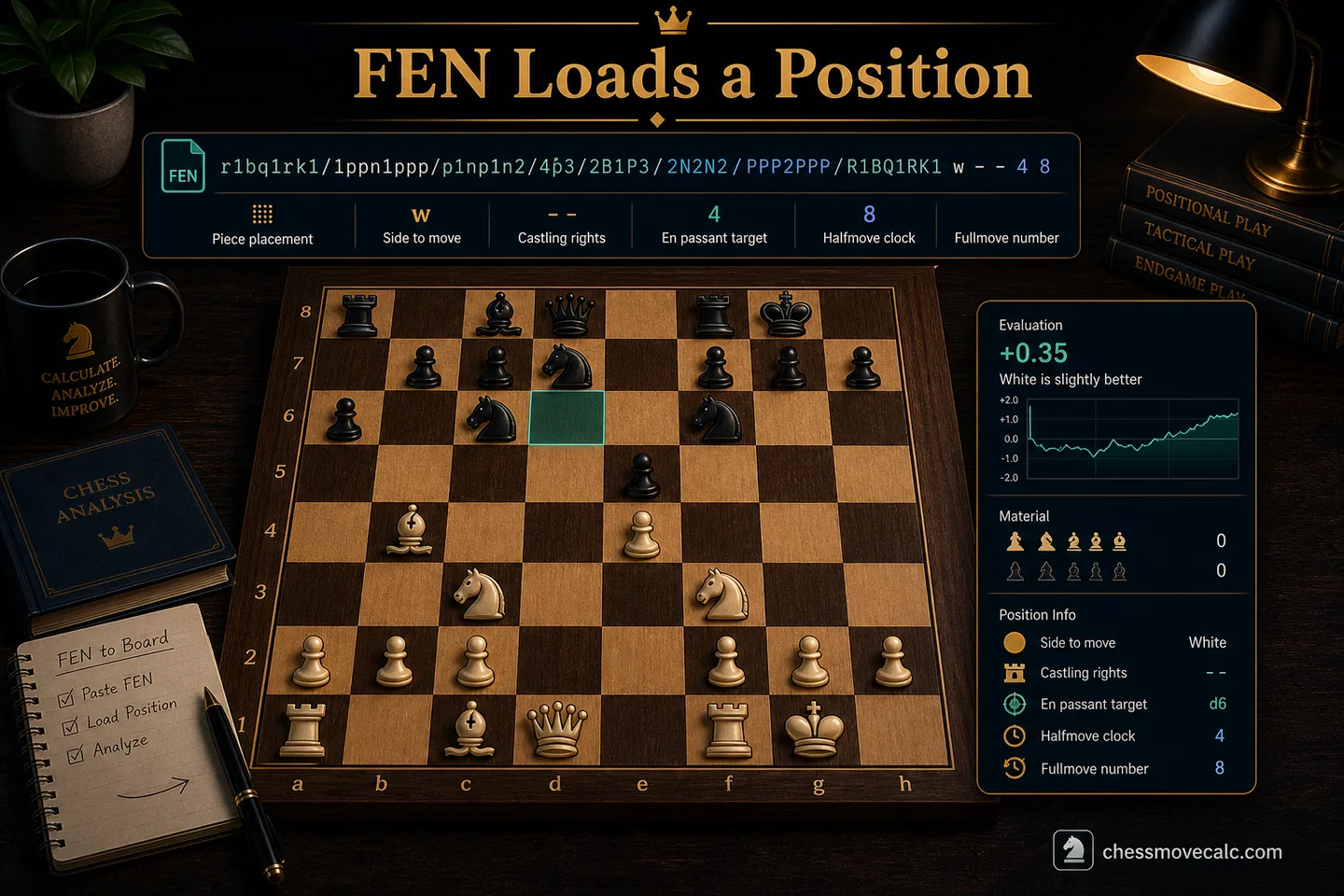
A good conversion flow turns a raw FEN string into a position you can inspect immediately.
Convert FEN into a visual board and engine-ready position
A FEN only becomes useful after you can see the board it describes and confirm that it matches your intent. Paste the FEN into a board before doing deeper analysis. Check the side to move, castling rights, en passant field, halfmove clock, and fullmove number immediately.
In practice, the strongest habit is to keep the workflow simple. Confirm castling rights and en passant details if they matter. Only then compare your move ideas with the engine.
- Paste the FEN into a board before doing deeper analysis.
- Check the side to move, castling rights, en passant field, halfmove clock, and fullmove number immediately.
- Confirm castling rights and en passant details if they matter.
- Only then compare your move ideas with the engine.
Easy mistake
If the board looks even slightly wrong, stop there. Do not analyze a position you have not visually verified.
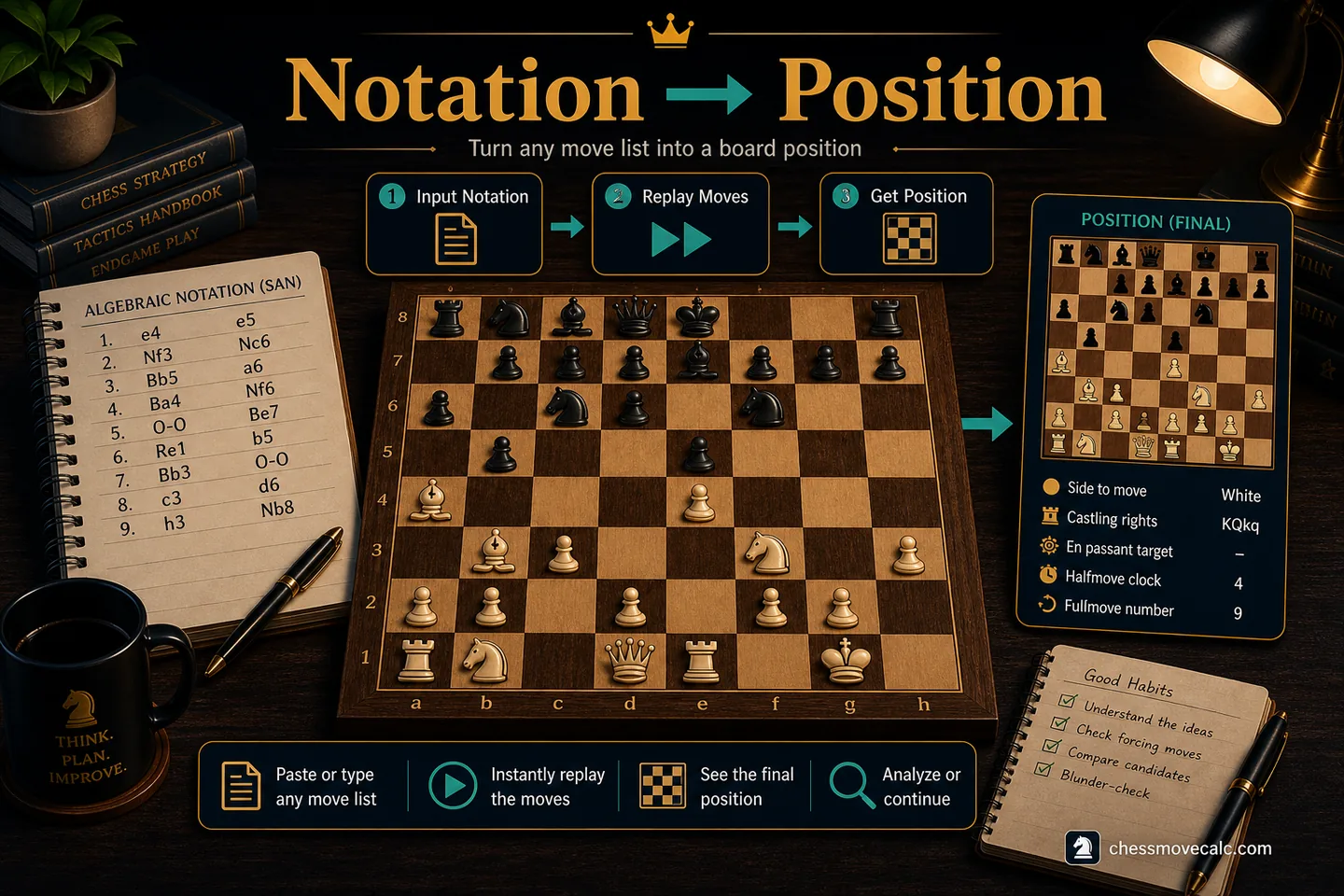
Readable notation is great for humans, but you still need a board if you want fast visual confirmation.
Convert algebraic moves into something you can analyze
Many players start from a short move list rather than a PGN file or a FEN string. Move lists are readable, but boards are safer for verification. Use a converter when you only have SAN or algebraic moves.
In practice, the strongest habit is to keep the workflow simple. Replay the moves and confirm the final square relationships. If a move fails, inspect notation ambiguity before blaming the board. If reading move strings still feels slow, pair this page with the notation reading guide so the final board is easier to verify on sight.
- Move lists are readable, but boards are safer for verification.
- Use a converter when you only have SAN or algebraic moves.
- Replay the moves and confirm the final square relationships.
- If a move fails, inspect notation ambiguity before blaming the board.
Why this matters
Conversion is not only about changing format. It is about making the input easier to trust.
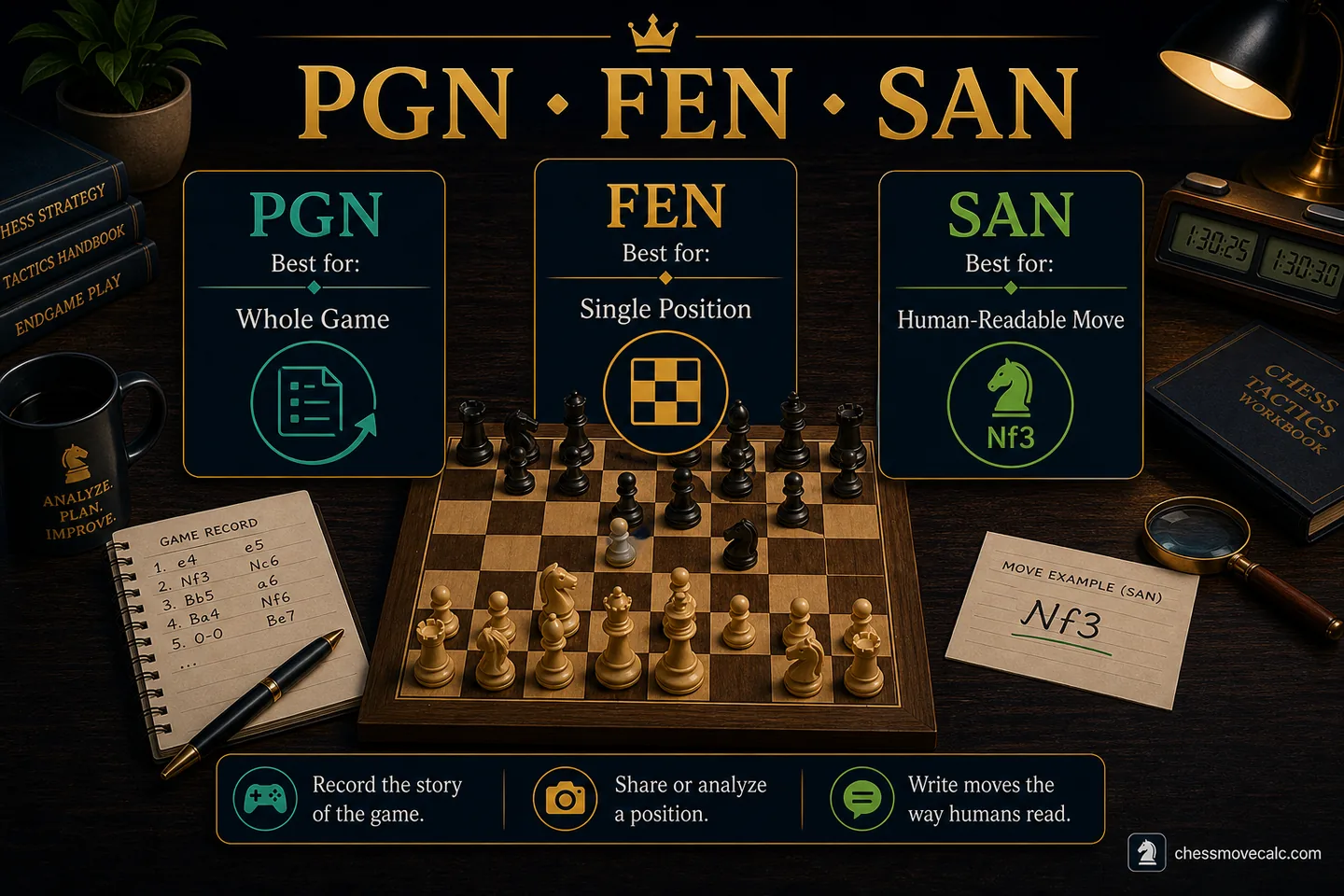
The fastest workflow usually starts by picking the right format before you paste anything.
When each format is the best choice
Most conversion pain disappears when you pick the destination format based on the next task instead of habit. PGN is strongest for archives, review, and annotated study. FEN is strongest for exact-position analysis and sharing.
In practice, the strongest habit is to keep the workflow simple. SAN is strongest for readable move communication. Most real workflows use more than one format at different stages.
- PGN is strongest for archives, review, and annotated study.
- FEN is strongest for exact-position analysis and sharing.
- SAN is strongest for readable move communication.
- Most real workflows use more than one format at different stages.
Fast decision rule
Ask what your next action is: replay a game, inspect one board, or read a move list. The answer tells you the right format.
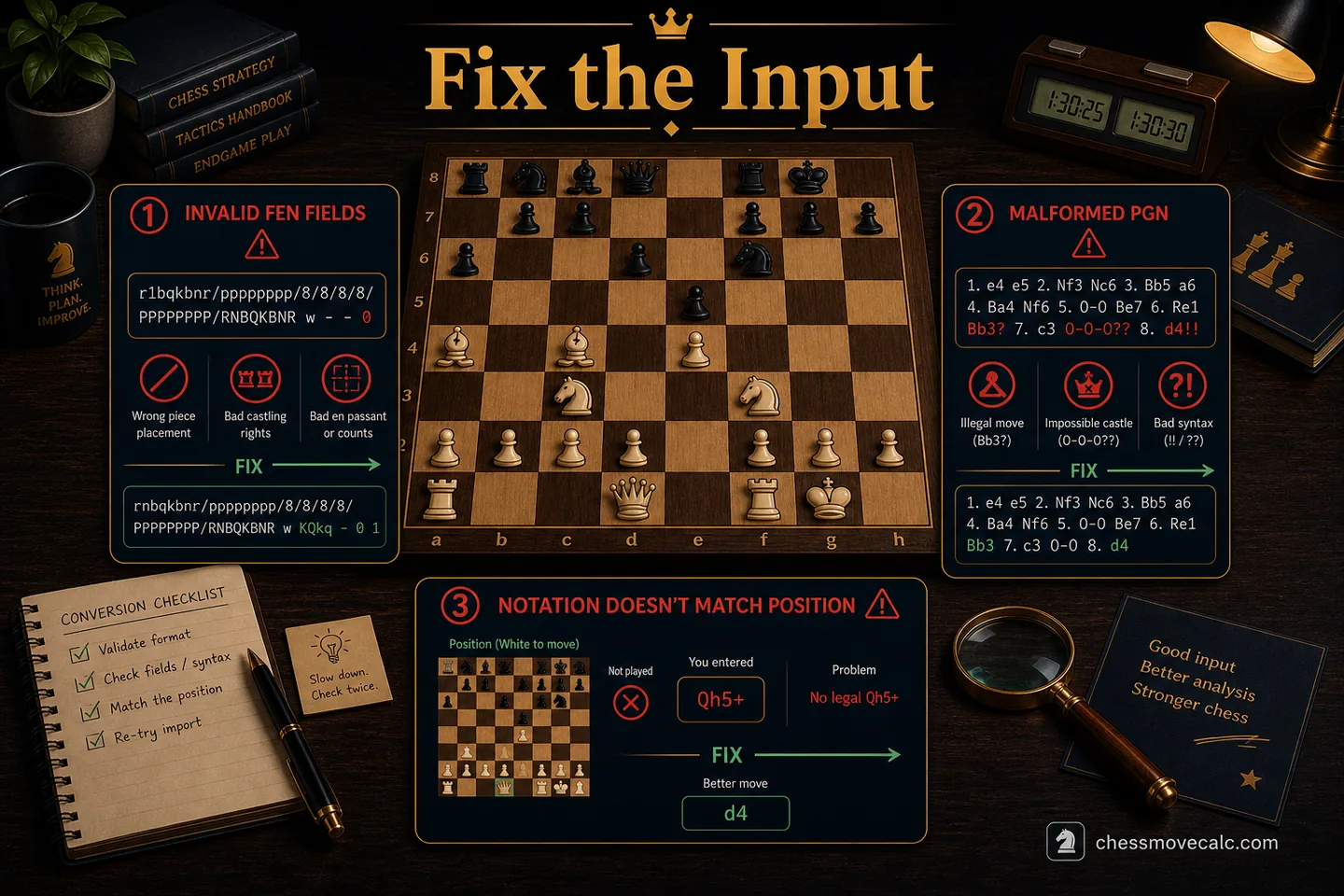
Most broken conversions come from a few repeatable mistakes, which means they are fixable once you know where to look.
Common conversion errors and how to fix them
Bad conversions usually come from missing fields, malformed notation, or skipping visual verification. If the board is wrong, check FEN fields before anything else. If moves fail, inspect notation spelling, capture markers, promotion text, checkmate symbols, and ambiguity.
In practice, the strongest habit is to keep the workflow simple. If the game imports oddly, check PGN headers and move order. Always debug the visible result before chasing deeper technical causes.
- If the board is wrong, check FEN fields before anything else.
- If moves fail, inspect notation spelling, capture markers, promotion text, checkmate symbols, and ambiguity.
- If the game imports oddly, check PGN headers and move order.
- Always debug the visible result before chasing deeper technical causes.
Do not skip verification
A converter that accepts bad input is not helping you. The visible board is the fastest sanity check you have.
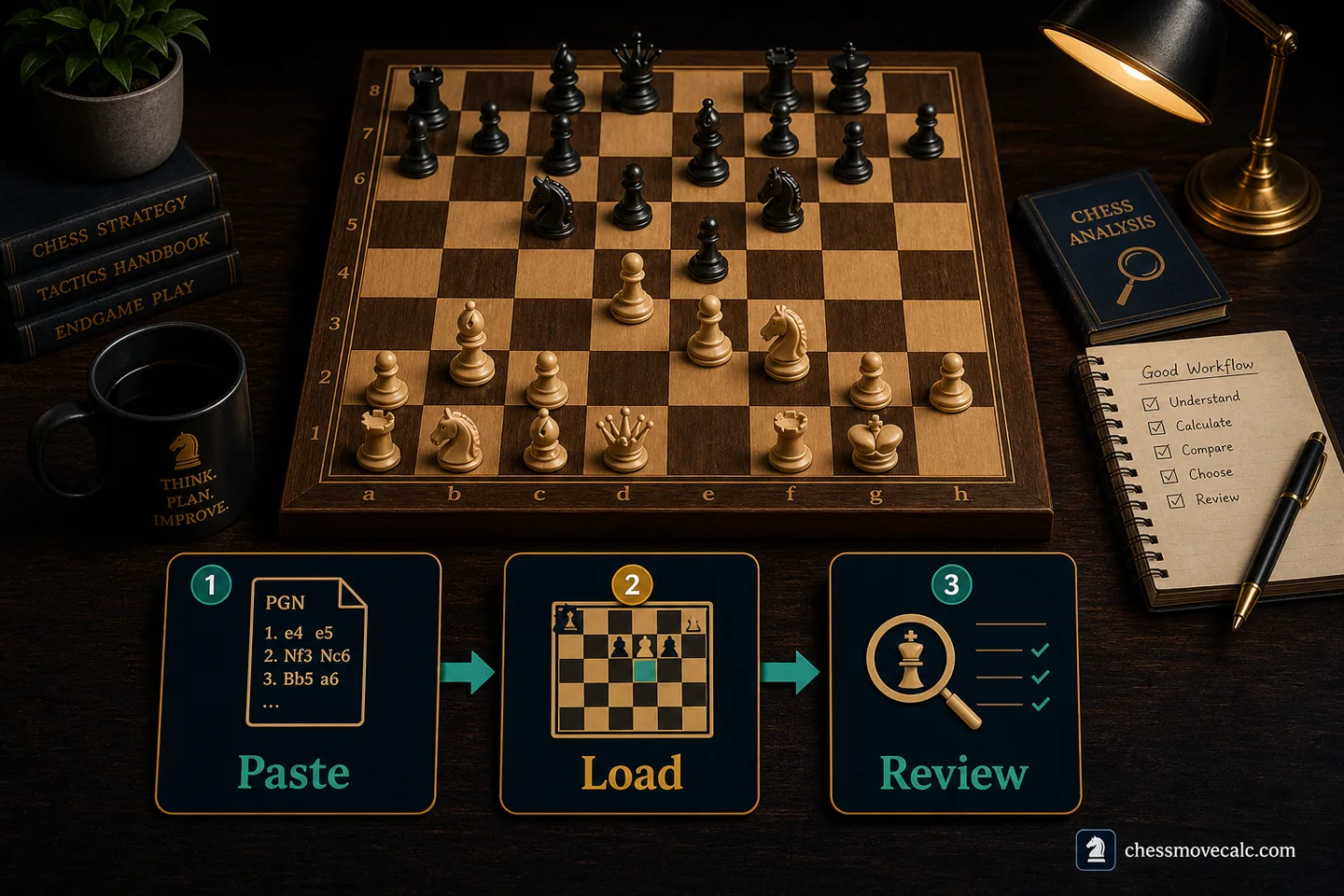
The site works best when you use the converter and analysis pages as one connected system.
Best workflow inside ChessMoveCalc
The real goal is not just to swap text formats but to move from raw input to a board you trust and then into useful analysis. Start from the format you already have, not the one you wish you had. Use the converter to make the board visible as early as possible.
In practice, the strongest habit is to keep the workflow simple. Route exact positions into FEN workflows and move-finding tools. Let format conversion support analysis instead of replacing it.
- Start from the format you already have, not the one you wish you had.
- Use the converter to make the board visible as early as possible.
- Route exact positions into FEN workflows and move-finding tools.
- Let format conversion support analysis instead of replacing it.
Better sequence
Convert first, verify second, analyze third. That order prevents a surprising number of wasted sessions.
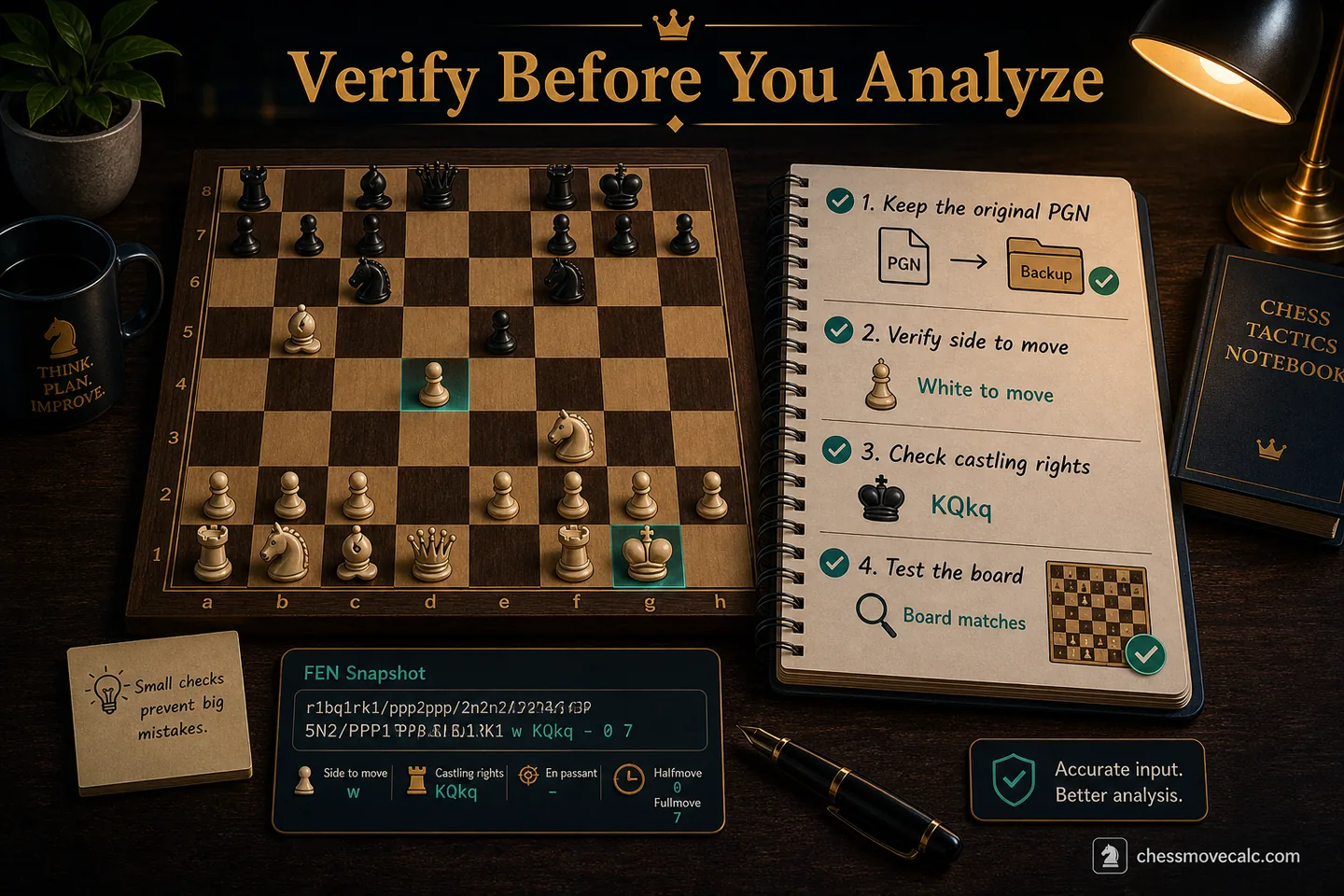
Most conversion errors are workflow errors before they are technical errors.
Safe conversion habits that save time and prevent broken imports
Conversion gets smoother when you treat verification as part of the workflow instead of as an optional cleanup step. A visible board should appear early in the process so you can catch errors before analysis begins. Short notation strings are easier to trust after they have been replayed into a real position.
PGN extraction is safer when you isolate the exact move number you care about instead of exporting blindly. FEN imports are safer when side to move and special rights are checked before engine use.
A stronger habit is to ask what decision this concept should improve the very next time it appears. The best converter workflow always ends with a sanity check, not with blind faith in the pasted text. That habit saves more time than constantly switching tools whenever one import looks strange.
That bridge is often the missing ingredient between reading an article once and truly keeping the lesson when the position becomes real.
- A visible board should appear early in the process so you can catch errors before analysis begins.
- Short notation strings are easier to trust after they have been replayed into a real position.
- PGN extraction is safer when you isolate the exact move number you care about instead of exporting blindly.
- FEN imports are safer when side to move and special rights are checked before engine use.
- The best converter workflow always ends with a sanity check, not with blind faith in the pasted text.
- That habit saves more time than constantly switching tools whenever one import looks strange.
Practical takeaway
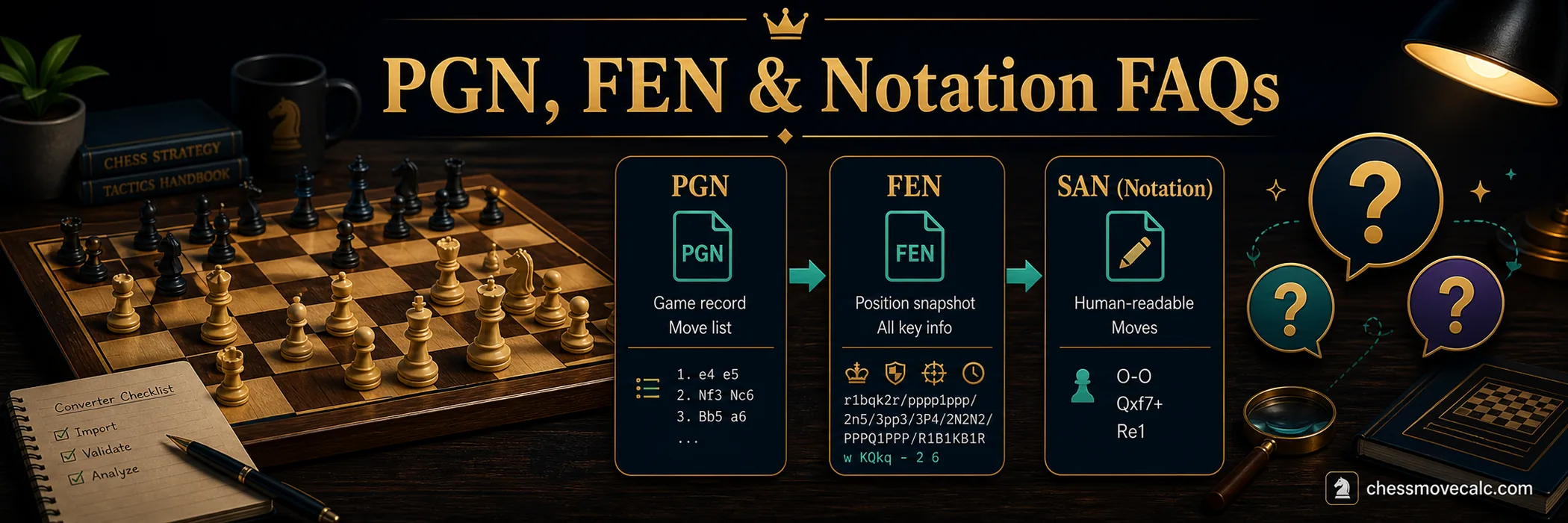
How to Convert PGN, FEN, and Chess Notation FAQs
What is the easiest way to convert PGN to FEN?
Load the PGN, advance to the position you want, and export that exact board as FEN.
Can I turn one FEN into a full PGN?
Not by itself. A FEN can describe a position, but it does not contain the full move history needed for a complete PGN.
What does SAN mean in chess conversion?
SAN means Standard Algebraic Notation, the readable move language used in most chess records and lessons.
Why does my FEN produce the wrong best move?
The most common causes are the wrong side to move, bad castling rights, or another field that does not match the intended board state.
Should I convert notation to a board before analysis?
Yes. A visible board helps you catch errors and makes engine comparison much safer.
Which ChessMoveCalc page should I start with?
Start with the notation converter if you have move text, and start with the FEN workflow if you already have a position string.
Convert a real position and verify it visually
Move from notation, PGN, or FEN into a board you trust before you start deeper analysis.