Reading notation is a decoding skill, and decoding skills improve with repetition
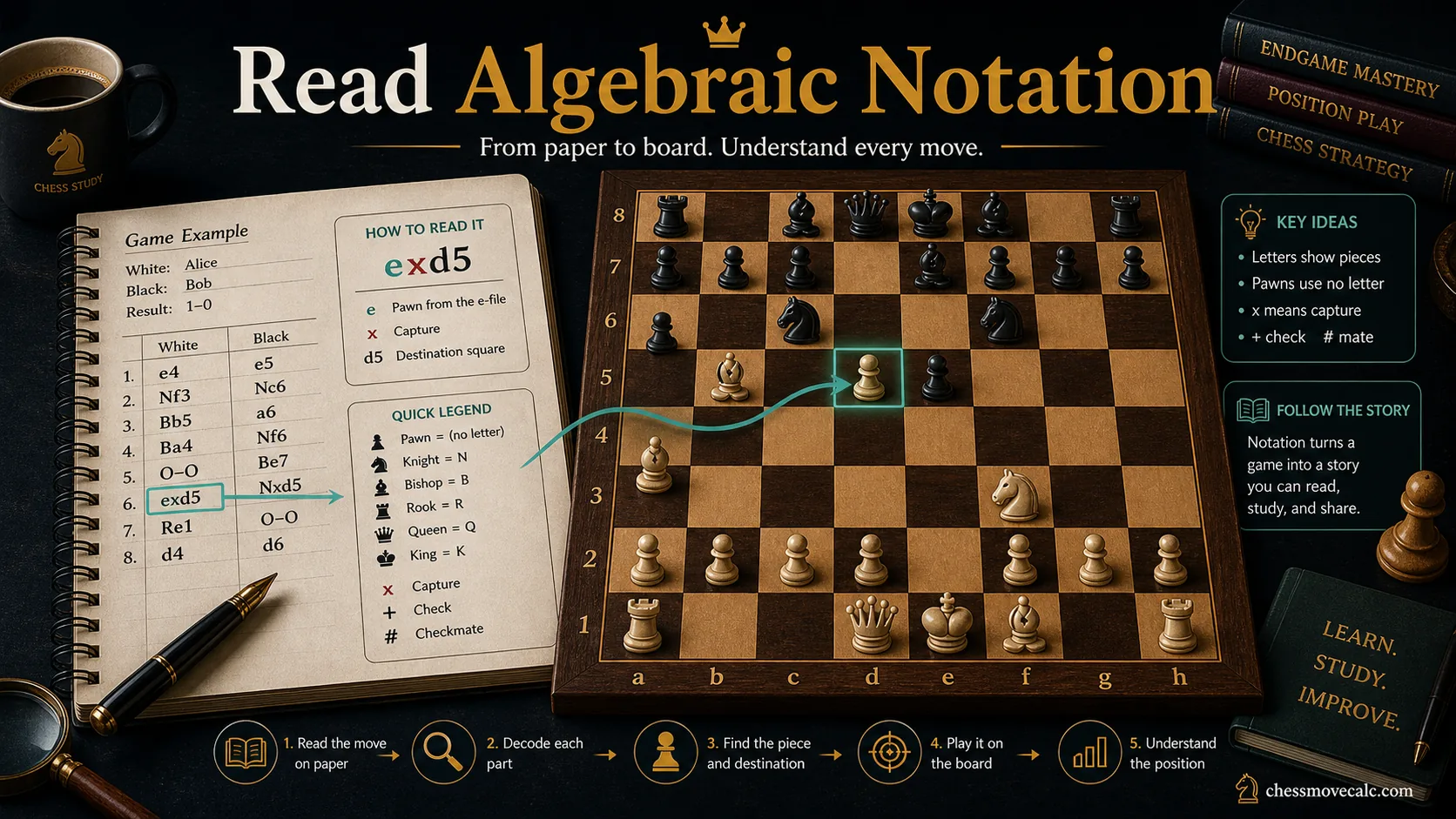
This page is built like a reading lesson: short patterns, clear examples, then simple drills.
Many players say they “kind of know notation” but still freeze when they see a move list. That usually means they learned a few definitions without ever turning those definitions into a reading habit. The goal of this page is to fix that gap.
To read algebraic chess notation, identify the piece, look for a capture marker, and find the destination square. For example, Nxe5+ means a knight captures on e5 and gives check. Use the position to identify which knight can legally make that move. The complete notation guide covers the wider system.
We will move in a practical order: coordinates first, then piece letters and pawn moves, then captures and checks, then disambiguation, then the special cases that scare beginners most, and finally a short set of drills. By the end, move strings should feel a lot less like code and a lot more like compressed English.
Keep a real board nearby if you can. Reading notation becomes much easier when every move translates into a physical square on an actual board. If you need broader context first, use the main notation guide. If you need a faster symbol lookup later, use the symbols guide.
The key mindset here is repetition without overload. You do not need fifty exceptions on day one. You need a dependable way to read the next move in front of you. Once that becomes automatic, the uncommon cases stop feeling scary because they are layered on top of a system you already trust.
That is why this page is deliberately example-heavy. Reading notation improves when your eyes keep seeing the same patterns attached to real squares and real moves, not when you stare at abstract rules in isolation.
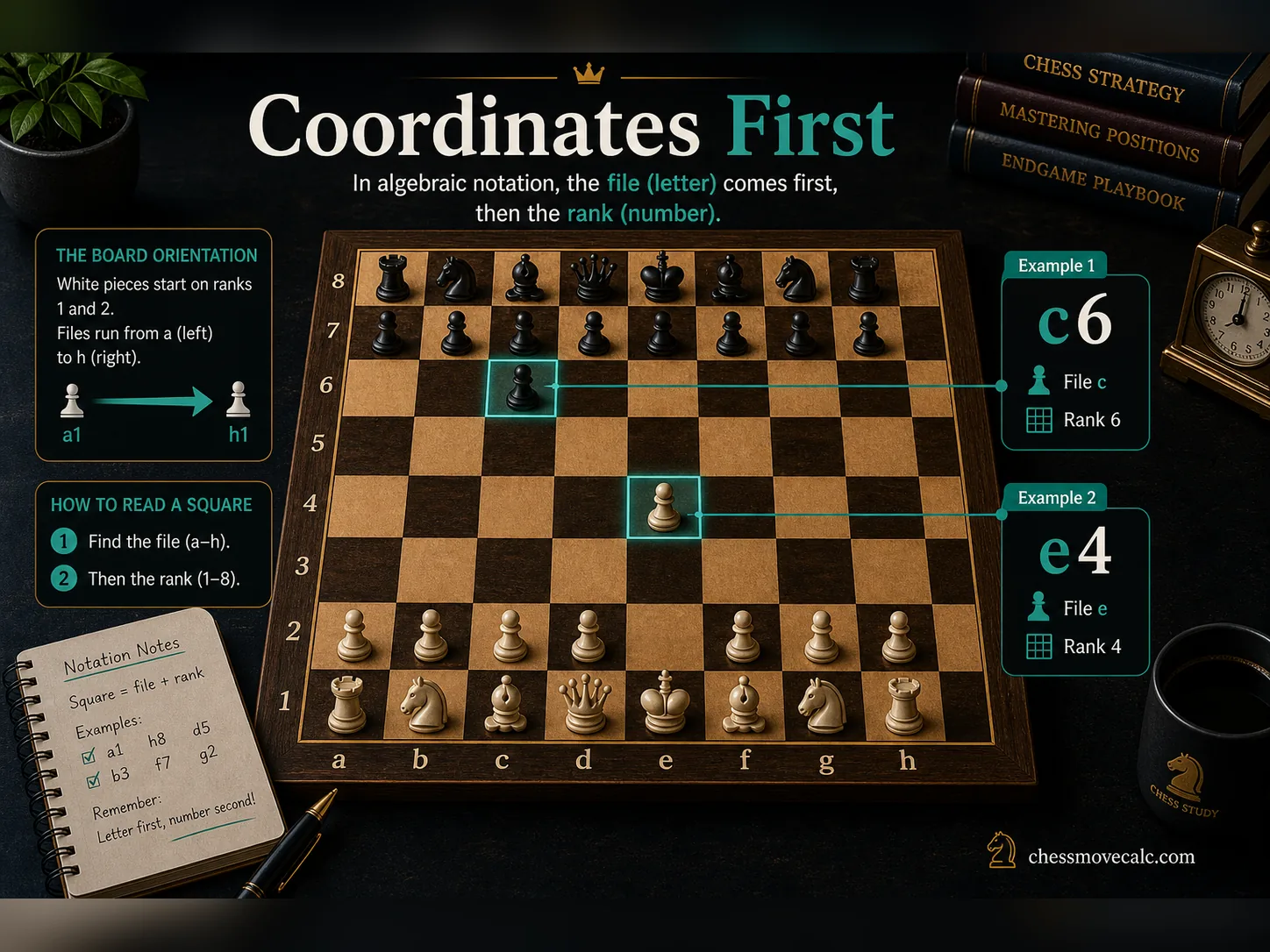
If square names are automatic for you, notation becomes dramatically easier to read.
Learn the board coordinates before anything else
Files run from a to h. Ranks run from 1 to 8. Together they produce square names such as e4, c6, and h7.
Most moves end with one of those square names, which is why coordinates are the real foundation of reading notation.
If someone writes Qh5, you should instantly know the queen ends up on h5. If someone writes Nc3, you should know the knight lands on c3.
Without that coordinate reflex, even simple moves feel slow. With it, your brain can spend its time on meaning instead of translation.
The fastest way to build this is to point to random squares on a board and say their names out loud. That sounds basic, but it works. The better your square recognition, the easier every other notation rule becomes.
If coordinates still feel shaky, slow down here instead of rushing ahead. Many notation problems that look like “I do not understand chess symbols” are really coordinate problems in disguise. Once the board grid is automatic, the rest of the notation starts attaching itself to something concrete.
A good self-test is to call out random destination squares and point to them instantly. If you can do that with confidence,
moves like Qh5 and Nc3 stop feeling mysterious before you even analyze the rest of the notation.
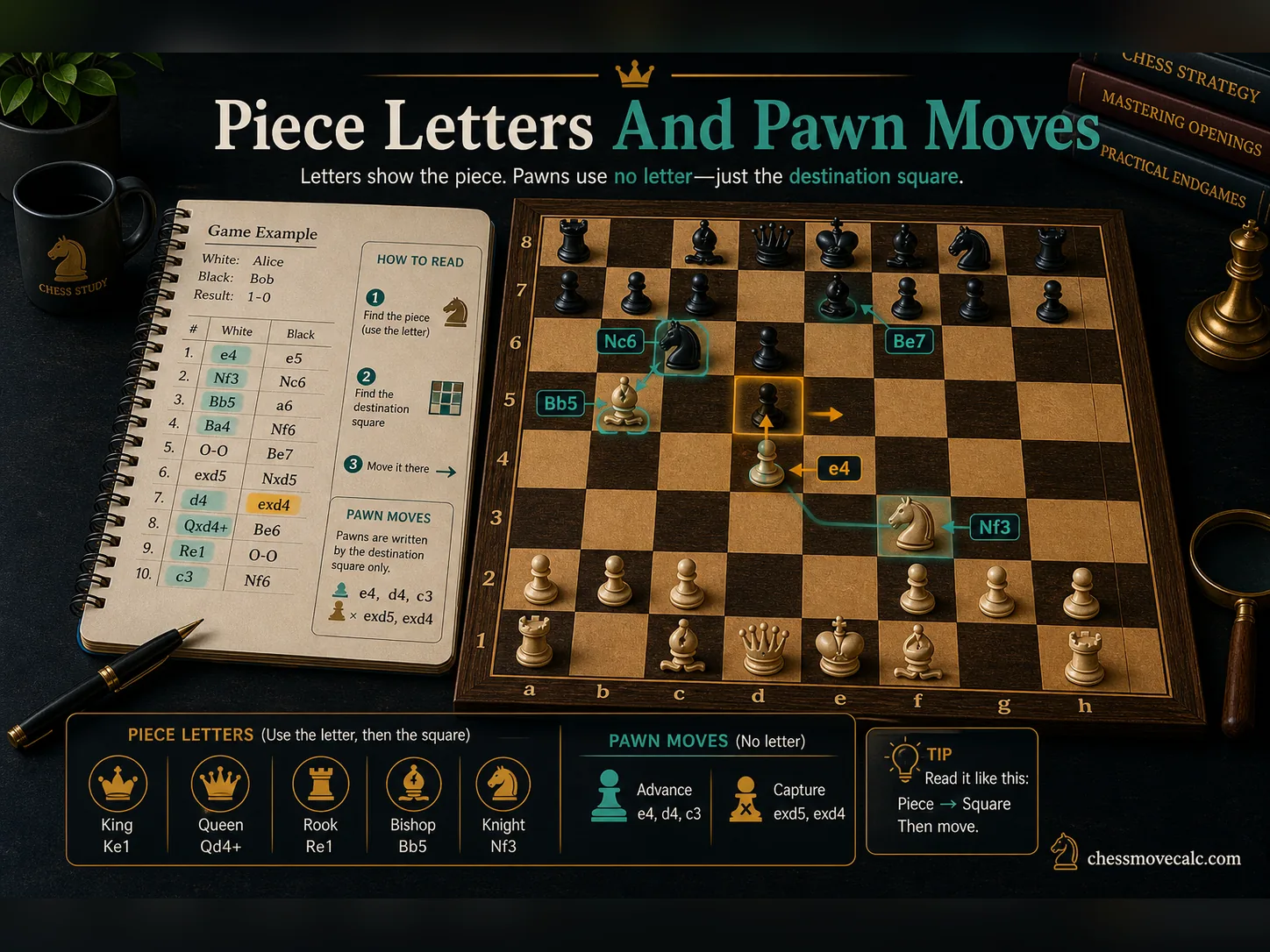
Once you know the piece letters, a move like Nf3 becomes almost self-explanatory.
Decode piece letters and pawn moves
The king is K, queen is Q, rook is R, bishop is B, and knight is N.
So Nf3 means a knight moved to f3, while Bb5 means a bishop moved to b5.
Pawns usually have no letter. So e4 means a pawn moved to e4. This is the rule that makes move lists look uneven to beginners,
but once you know it, the inconsistency disappears. No starting letter normally means pawn.
When you read notation, try to parse in two steps: piece first, destination second. If there is no piece letter, assume pawn unless another special symbol tells you otherwise.
This is also where spoken decoding helps. Say Nf3 as “knight to f3.” Say e4 as “pawn to e4.”
The more often you convert symbols into a short verbal sentence, the faster reading becomes. You are training pattern recognition, not memorizing trivia.
That may sound almost too simple, but it works. Many players can recite the rules of notation without being able to read a move list smoothly. Spoken translation turns passive knowledge into active reading skill.
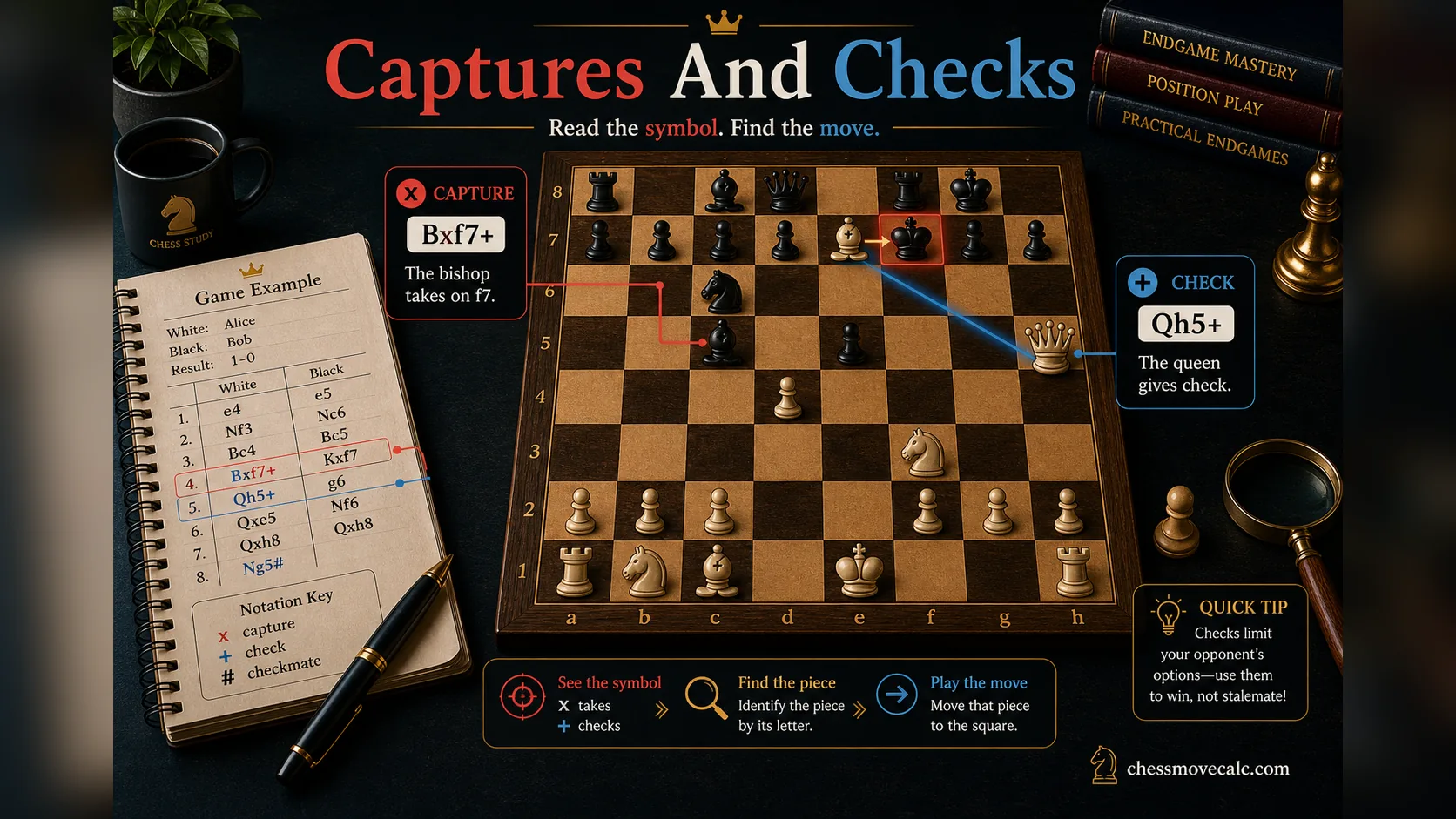
Reading gets easier when you treat symbols like verbs: x means takes, + means check, # means mate.
How to read captures, checks, and checkmate
The letter x marks a capture. Bxe5 means a bishop captured something on e5. If a queen captures on h7,
you might see Qxh7. When a pawn captures, the notation begins with its file. So exd5 means the pawn from the e-file captured on d5.
The plus sign + means check. Qh7+ tells you the queen moved to h7 and attacked the king. The symbol # means checkmate,
so Qh7# ends the game. These are some of the easiest symbols to remember because they describe a direct tactical result.
The reading trick is to say the move in words. Bxe5 becomes “bishop takes on e5.” Qh7+ becomes “queen to h7 check.”
Speaking the move out loud trains fluency faster than silently staring at the characters.
A useful extra habit is to notice the tactical weight of the symbol. A plain move, a capture, a checking move, and a mating move do not just look different in notation. They usually represent different levels of urgency on the board. So while this page is about reading, good reading also sharpens your tactical attention.
That is one hidden benefit of notation practice. The better you read tactical markers, the faster your post-game analysis gets, because you can spot where the forcing moments happened instead of treating every move as equally quiet.
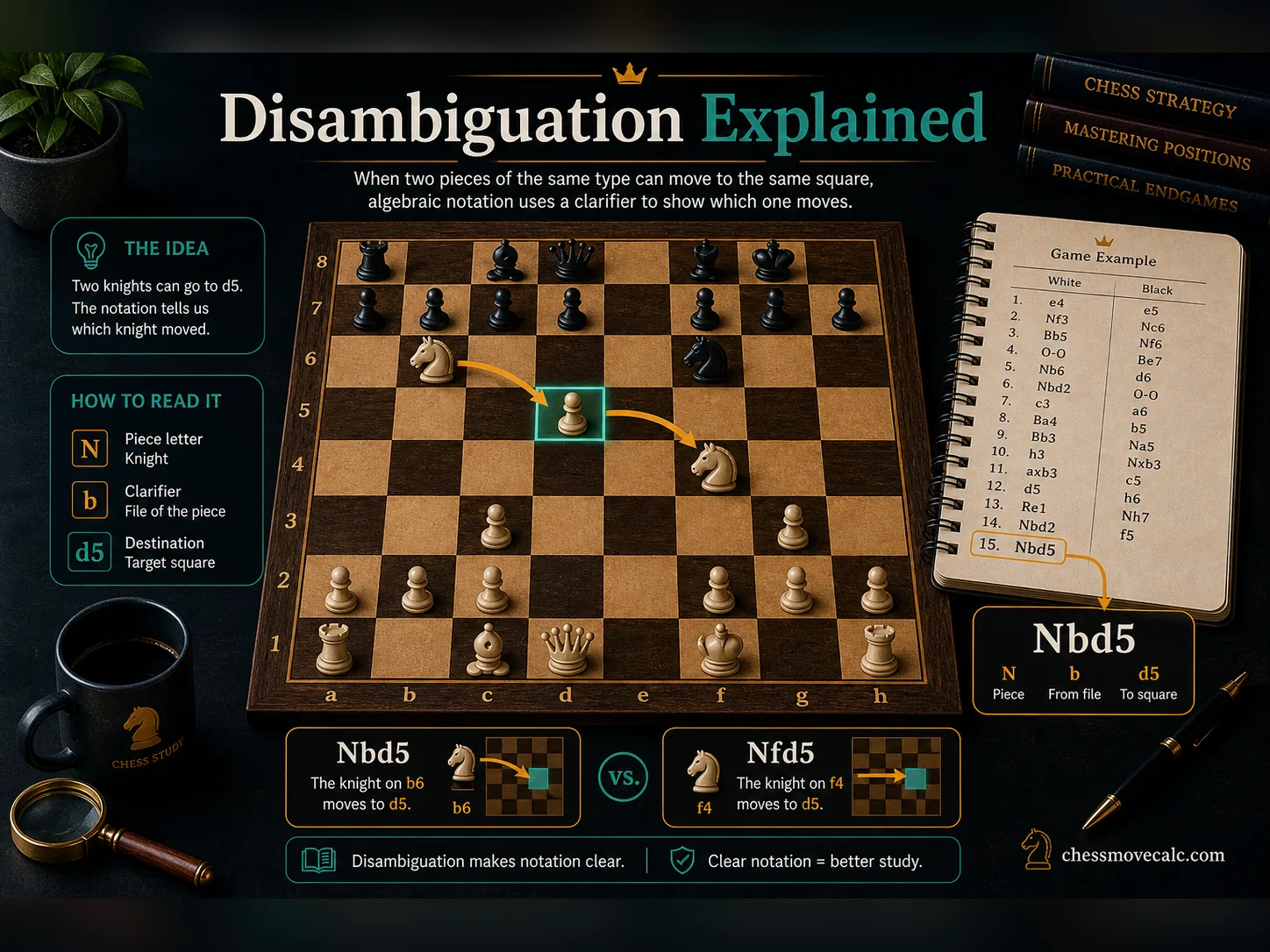
Disambiguation sounds technical, but it only exists to answer one question: which identical piece moved?
How disambiguation works when two pieces can move to the same square
Sometimes two identical pieces can legally move to the same destination. In that case notation adds extra information so the reader knows which piece moved.
For example, if two knights can go to d2, the move might be written Nbd2 or Nfd2, naming the file of the correct knight.
Rooks can use the same principle. If both rooks can reach e2, a move might look like R1e2 or Rae2,
depending on what information is needed to separate them clearly. Beginners often see these moves and think a new secret rule appeared.
It is actually a very practical clarification rule.
The easiest way to read disambiguation is to break it into chunks. In Nbd2, the piece is a knight, the extra letter tells you which knight, and the destination is d2.
Once you split the move this way, the pattern stops feeling advanced.
Most beginners only need to recognize the idea, not memorize every possible form immediately. The core question never changes: when two identical pieces could make the move, what extra clue did the notation add so the reader can identify the right one? That clue may be a file, a rank, or sometimes both.
Once you ask that question, disambiguation becomes much less intimidating. The notation is not becoming more complicated for no reason. It is simply preventing the reader from guessing between two legal sources.
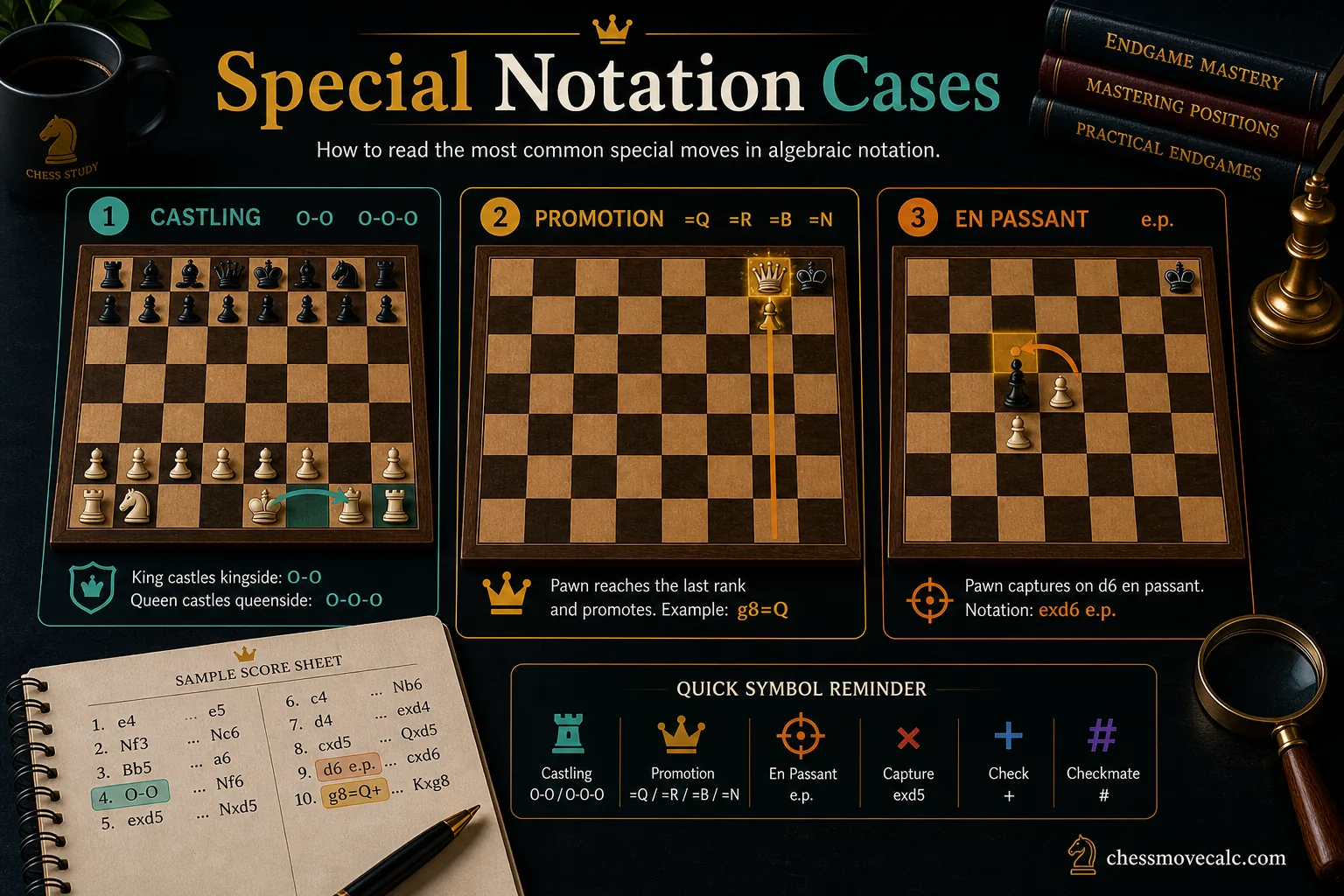
Castling, promotion, and en passant look special because they are special, but the notation for them is still consistent.
How to read castling, promotion, and en passant
Castling is written O-O for kingside and O-O-O for queenside. Read them simply as kingside castle and queenside castle.
Promotion uses an equals sign, so e8=Q means a pawn reached e8 and promoted to a queen.
En passant usually looks like a normal pawn capture in notation, although some texts may add e.p. for clarification.
The important thing is that the move still points to the destination square like other captures. Once you know the board position, the move becomes understandable.
These are the moves beginners often worry about most, but they are not the hardest part of reading notation. They are just the least common. The real challenge is building fast recognition of the everyday patterns, because those appear in every single game.
That is why you should not let special cases dominate your practice too early. Learn them well enough to recognize them, but spend most of your time on ordinary moves, captures, and checks. Fluency grows from common patterns repeated many times.
When one of these rare forms appears in a real score, slow down and translate it fully. “Promote to a queen on e8.” “Castle queenside.” Full translation is the fastest way to make special notation stop feeling special.
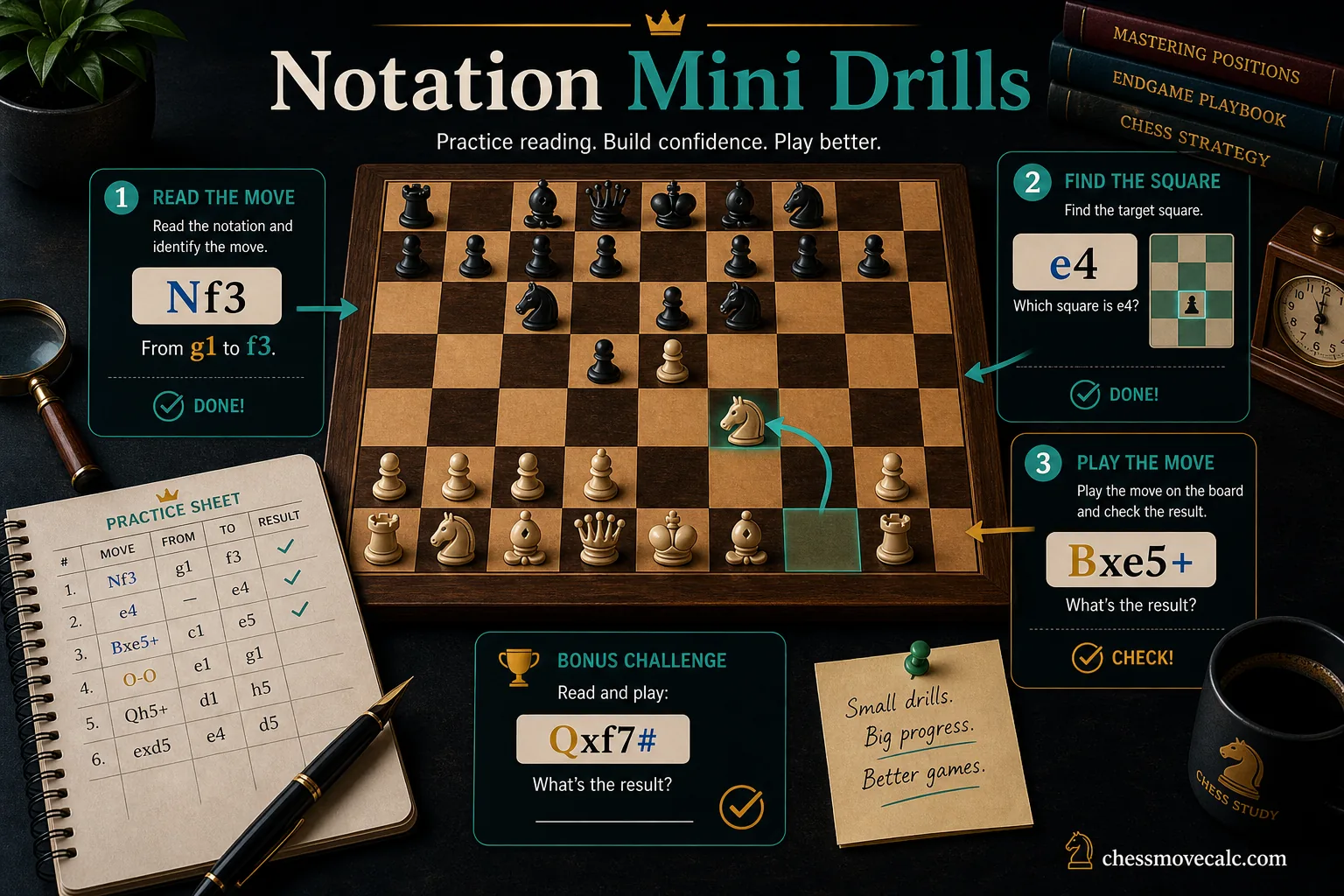
Short drills are where passive understanding becomes automatic recognition.
10 mini drills to practice reading notation
Try reading each move in words before checking a board. e4. Nf3. Bxe5. Qh7+. O-O.
e8=Q. exd5. Nbd2. Qh7#. R1e2.
Those ten examples cover most of the main patterns a beginner needs to recognize.
Do not rush. The exercise is not to look impressive. The exercise is to build clean mental parsing. Ask yourself: What piece moved? Where did it land? Did it capture? Did it give check? Was extra information added to clarify which piece moved? If you can answer those questions consistently, your notation reading is already improving.
A strong next step is to turn the drills into board practice. Use the notation converter and compare the board result with your own interpretation. That feedback loop makes mistakes visible immediately and helps the correct pattern stick.
Over time, move reading becomes chunk-based. You stop seeing separate letters and symbols and start seeing familiar patterns. That is exactly how reading fluency grows in every language, and chess notation is no different.
If you want to make the drills stronger, write your spoken answer before you check it. For example: “bishop takes on e5,” “castle kingside,” or “the knight from the b-file goes to d2.” That tiny extra step forces your brain to translate rather than just recognize vaguely.
You can also reuse the same drills over a few days instead of constantly hunting for new ones. Familiar examples are useful because they show whether your speed and confidence are actually improving.
If you want to make the drills even more practical, mix them with tiny board setups. Read the move first, then place the pieces and confirm the destination. That physical feedback makes the notation much harder to forget.
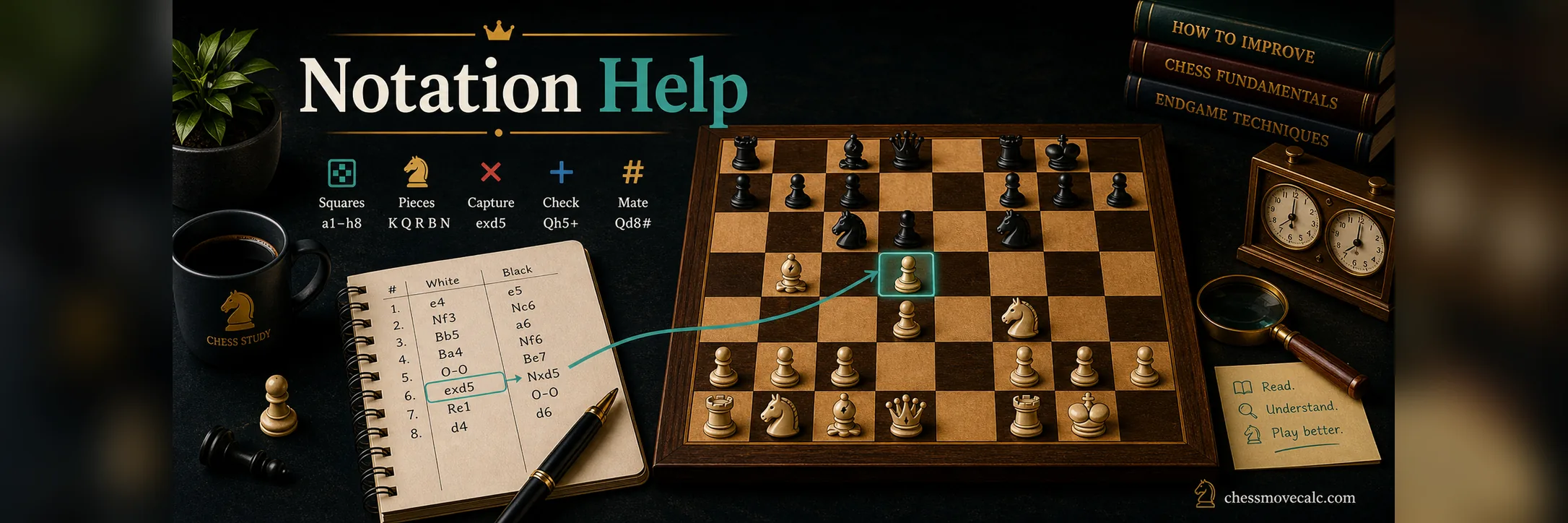
Reading notation FAQs
Is algebraic notation hard to learn?
No. Once square names and piece letters become familiar, most moves are surprisingly readable.
Why is the knight N and not K?
Because K already belongs to the king.
How do I read pawn captures?
Read the starting file, then x, then the destination square. For example, exd5 means the e-pawn captured on d5.
What does a plus sign mean in notation?
It means the move gives check.
How do I know which rook or knight moved?
Notation adds disambiguation, such as Nbd2 or R1e2, when two identical pieces can move to the same square.
What is the fastest way to get good at reading moves?
Use short board-based drills and test yourself with a notation converter until common patterns feel automatic.
Best practice loop
Read the move, say it in words, point to the destination square, then check it on a board. Repeating that loop is how notation starts feeling effortless.
Practice reading notation on a live board
Feed moves into the converter, watch the board update, and build the decoding reflex faster.