Chess notation is easier when it is explained like a language, not a code dump
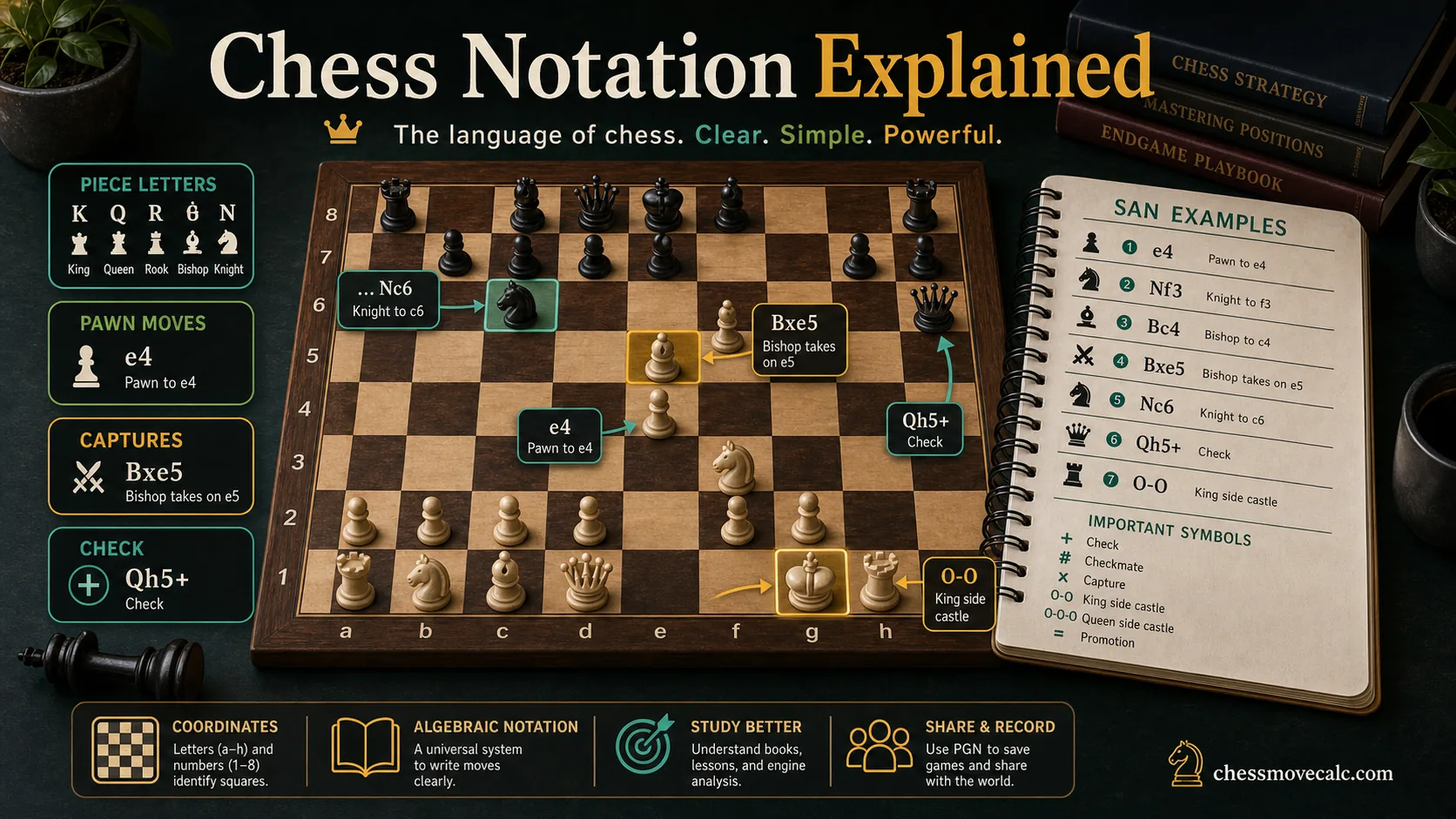
Notation becomes much less intimidating once you know what each character is trying to tell you.
Notation-related searches already cluster around algebraic chess notation calculator, chess notation converter, chess algebraic notation calculator, and several solver-flavored queries. The opportunity is clear. People need help with notation, but the site still needs a richer educational layer around the tool.
This page is designed to become that hub. It is broader than a glossary and broader than a one-page symbol sheet. It gives beginners the whole map: how the board is named, how pieces are represented, how captures and checks are written, how castling and promotion work, and how notation connects to related formats like FEN and PGN.
That wide scope matters because notation can feel either too shallow or too dense when it is explained badly. The goal here is simpler pacing, stronger visuals, and a tighter bridge between explanation and practice. You should leave this page feeling able to read a short score, not just memorize isolated definitions.
It also helps to separate this article from the two neighboring posts in the cluster. This is the broad beginner guide.
If you want a more focused decoding lesson, go next to
How to Read Algebraic Chess Notation.
If you want the fastest lookup page for symbols like x, +, #, !?, and =Q,
go to Chess Notation Symbols Explained.
For now, think of this as your main orientation page. We are building the floor first so everything else in the notation cluster has a clean place to point back to.
That orientation matters because notation problems come in layers. One player needs board coordinates. Another understands coordinates but not captures. Another can read ordinary moves but gets lost when castling, promotion, or FEN appears. A strong authority page should not pretend all those readers are at the same stage. It should move them from the ground up in a sequence that feels natural.
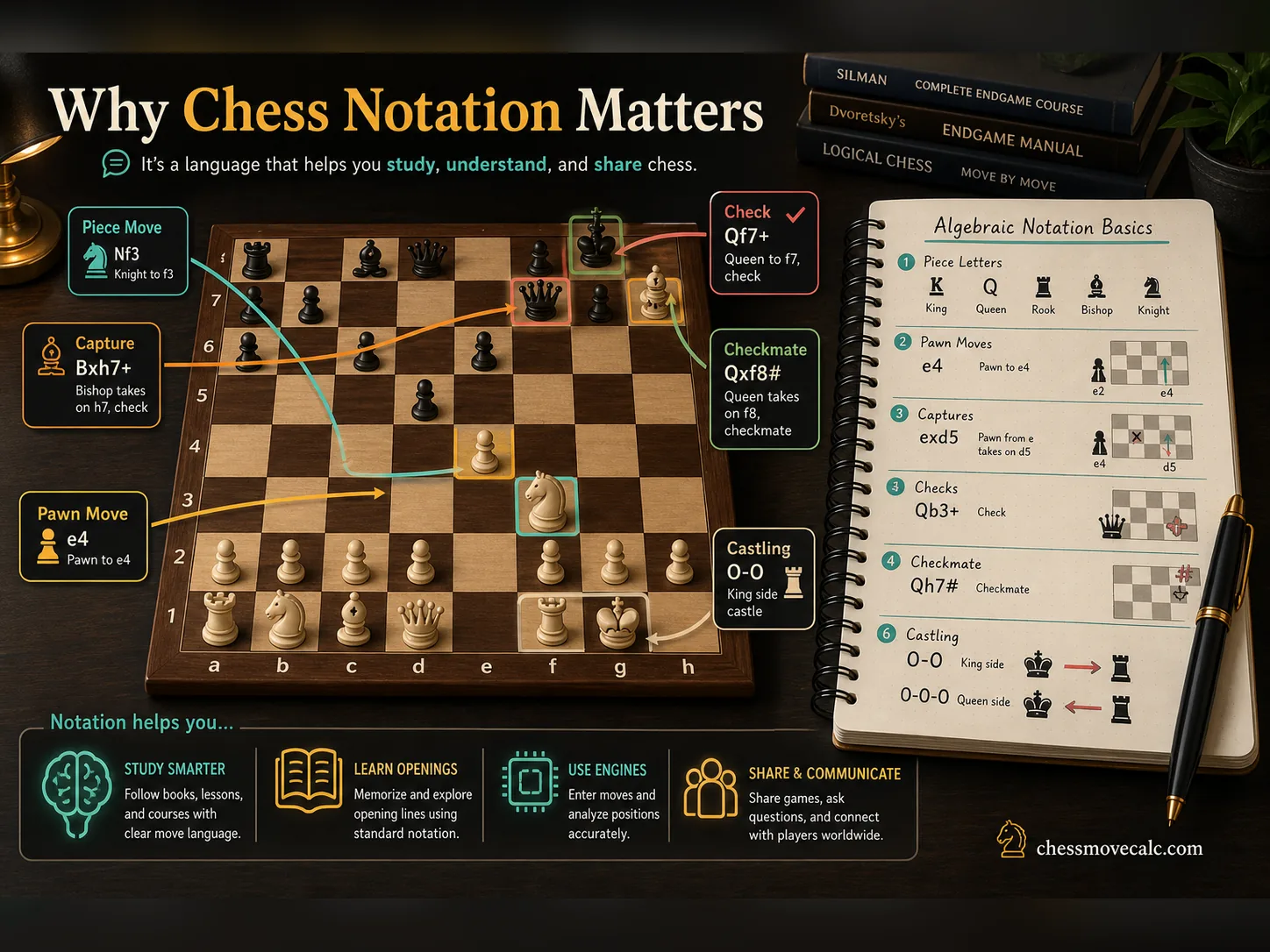
Notation is the transport layer of chess learning. It lets players record, share, replay, and analyze ideas.
Why chess notation matters in the first place
Chess notation exists because players need a consistent way to record moves. Without it, studying a game would require replaying from memory or staring at screenshots. With notation, a whole game becomes portable. You can save it, share it, convert it, feed it into an engine, or compare it with opening theory.
That is why notation appears everywhere. It is in books, online courses, puzzle explanations, analysis boards, PGN files, opening databases, and forum discussions. It is also why your notation converter has strong long-tail potential. People are not always looking for a glamorous tool. Often they simply need a move sequence translated into something understandable.
Once you learn notation, you unlock much more than one formatting skill. You become able to read annotated games, study model openings, follow engine lines, and save your own analysis cleanly. Notation literacy is a force multiplier for almost everything else in chess improvement.
It is also one of the easiest areas where a small amount of deliberate practice creates permanent improvement. Once move reading becomes natural, it keeps paying you back across books, courses, openings, tactics, and game review.
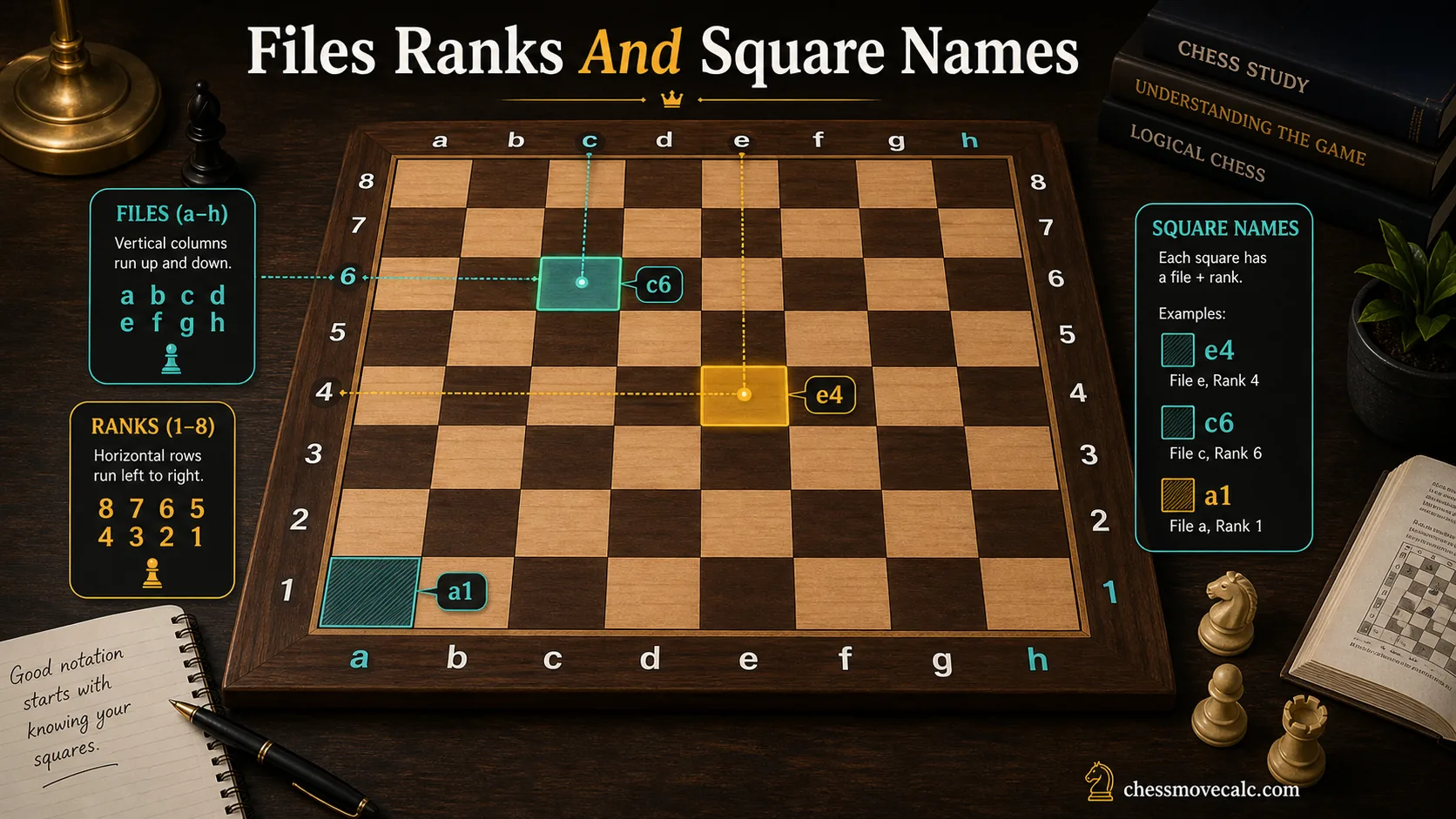
Every notation lesson begins with board coordinates. If you know square names, the rest starts making sense.
Start with files, ranks, and square names
A chessboard is named like a grid. The vertical columns are called files and are labeled a through h.
The horizontal rows are called ranks and are numbered 1 through 8.
Put one file and one rank together and you get a square name such as e4, d5, or h7.
This is the first thing beginners must internalize because nearly every move in notation ends with a destination square.
If you cannot quickly recognize that Nf3 ends on f3, the whole system stays blurry.
That is why square naming is the real alphabet of notation.
It also connects naturally to other beginner pages on the site. If you still need help orienting the board itself, review how to set up a chessboard. Once the board makes visual sense, the coordinates stop feeling abstract and start feeling obvious.
Fast memory trick
Read square names out loud while following a real board. The notation improves faster when the coordinates become physical, not just verbal.
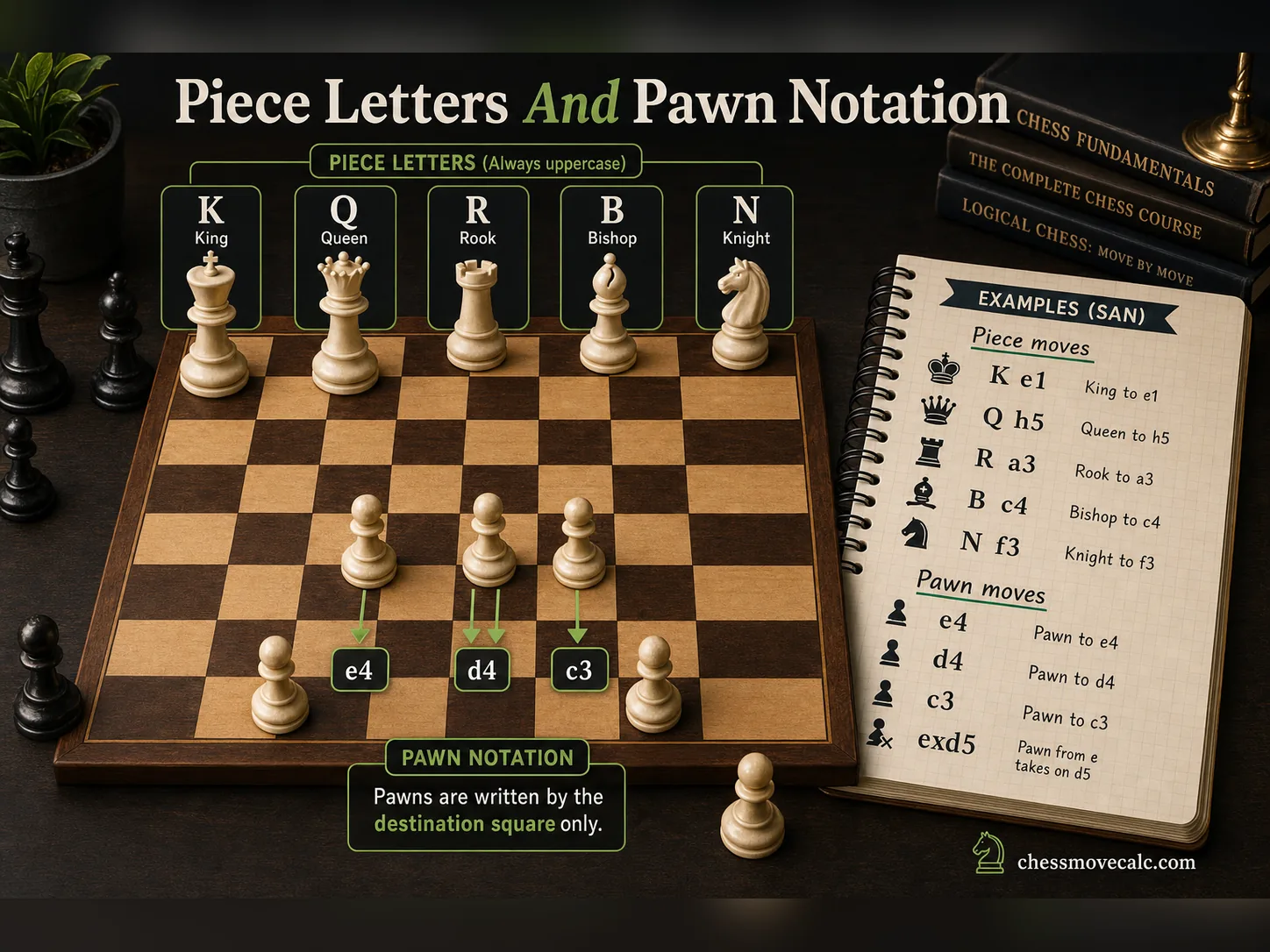
Most pieces use a letter. Pawns are the quiet exception that make beginner notation look stranger than it really is.
Piece letters and why pawns are written differently
In algebraic notation, the king is K, queen is Q, rook is R, bishop is B, and knight is N.
The knight uses N because K is already taken by the king. This is one of the first little rules beginners need to memorize.
Pawns are different. A normal pawn move is written only by destination square. So if a pawn moves to e4, the notation is simply e4.
There is no P in front. That is why beginner move lists often look confusing at first: some moves start with letters and some do not.
Once you know that “no letter usually means pawn,” the pattern becomes much more readable.
This is also where many notation-converter searches come from. Players see a move string like e4 e5 Nf3 Nc6 and understand some of it,
but not all of it. A broad guide like this page explains the logic. A converter gives immediate practice. Together they form a much better user path than either one alone.
It helps to think of notation as a compressed sentence. The piece letter tells you who moved. The destination square tells you where it went. Extra symbols tell you what happened along the way. Once you start reading moves that way, the system feels less arbitrary and much more consistent.
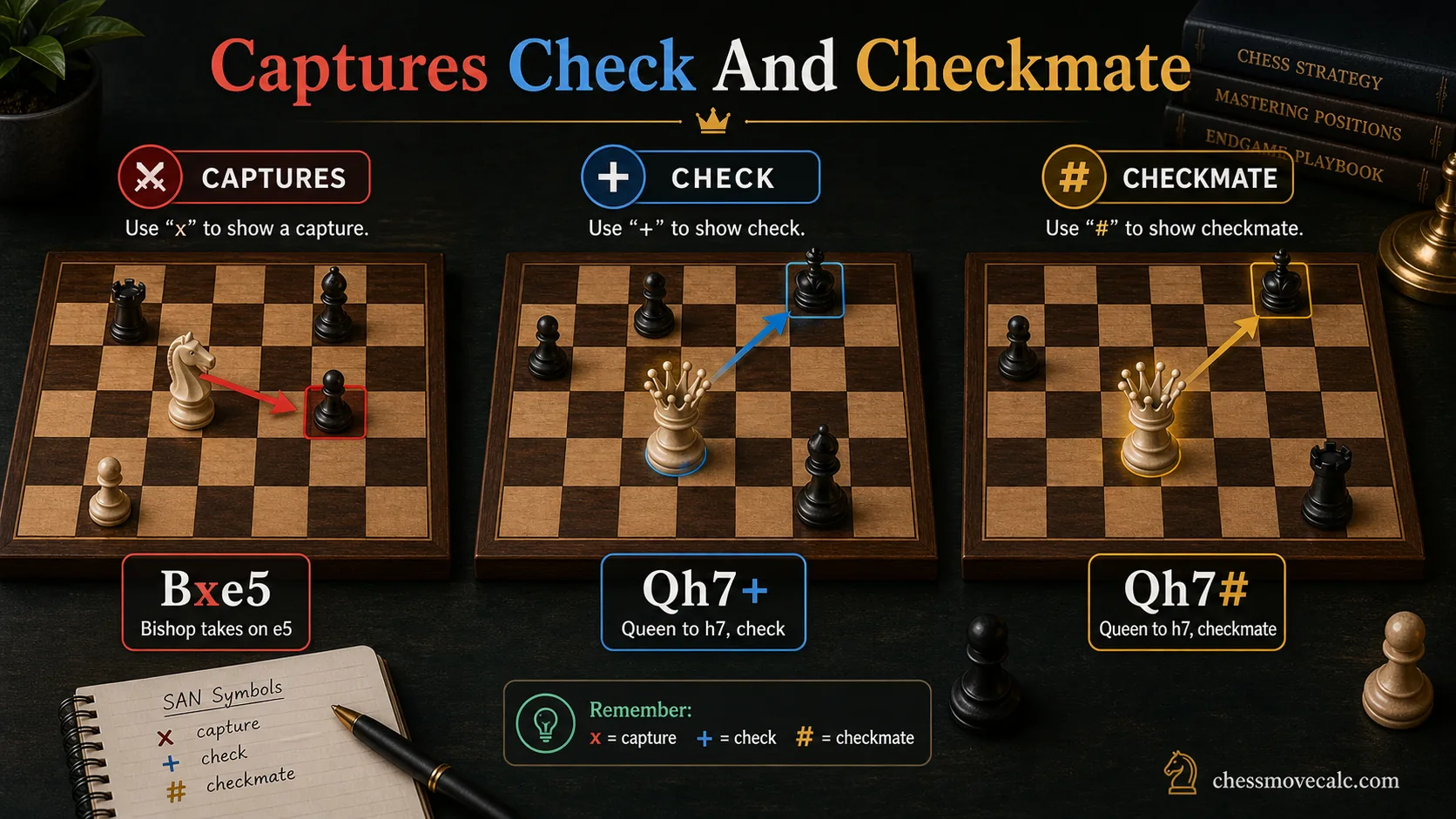
Once you know the symbols, notation becomes descriptive: it tells you not just where a move goes, but what the move does.
How captures, checks, and checkmate are written
The symbol x means a capture. So Bxe5 means a bishop captures something on e5.
If a pawn captures, the notation includes the pawn's starting file. So exd5 means the pawn from the e-file captures on d5.
This is one of the first places where notation becomes more expressive than plain square naming.
The symbol + means check. So Qh7+ means the queen moved to h7 and gave check.
The symbol # means checkmate. So Qh7# means the move on h7 ended the game immediately.
These two symbols are some of the fastest to learn because their meaning is so concrete.
Notation can also include annotations in published games, but those are a separate layer. This page teaches the core move language first.
If you want the dedicated quick-reference page for symbols including !, ?, !!, and ?!,
use the notation symbols guide.
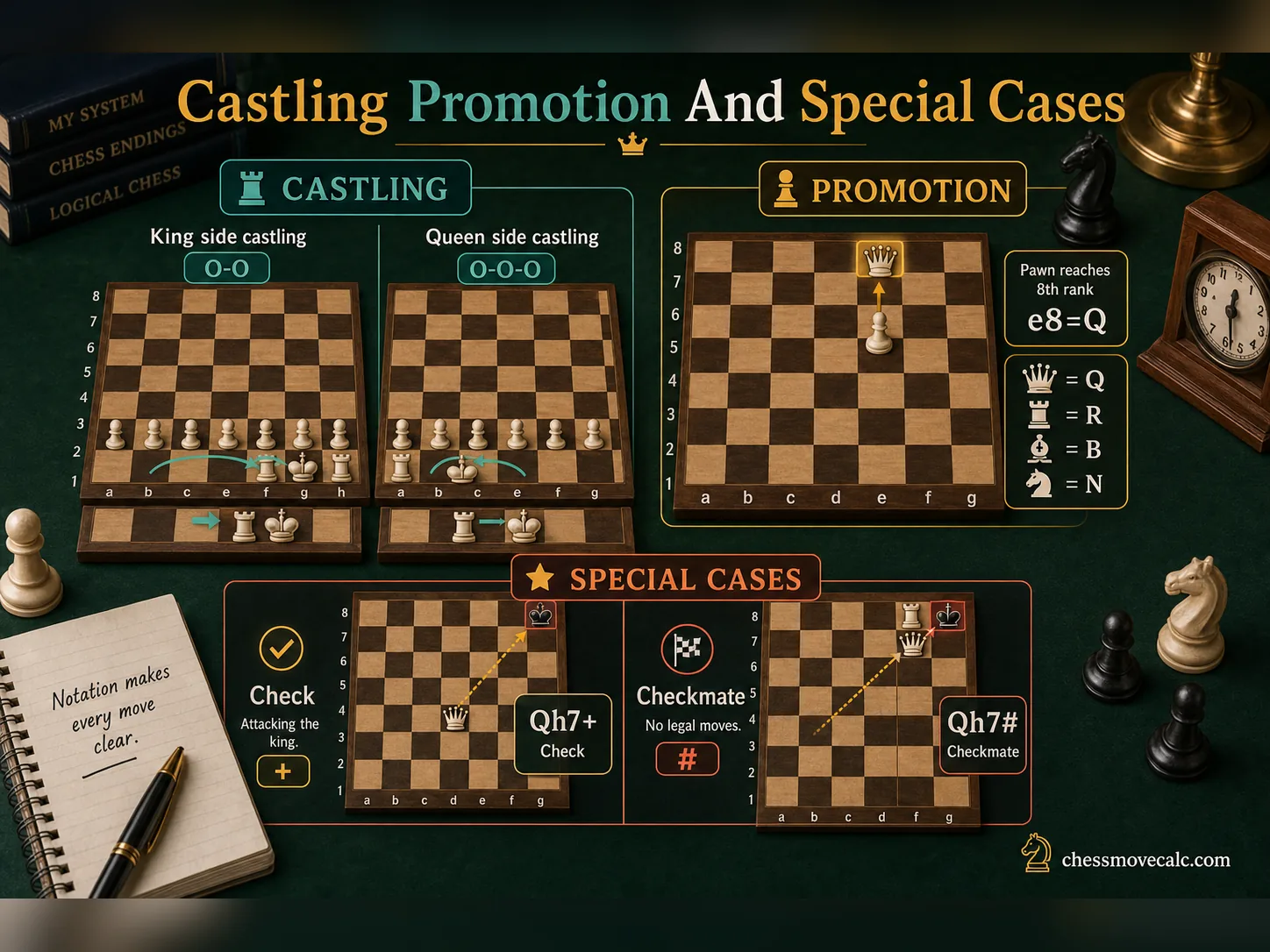
Special cases only feel special until you see the pattern. Then they become some of the easiest moves to recognize.
Castling, promotions, and other special notation rules
Castling has its own notation because two pieces move together. Kingside castling is written O-O and queenside castling is written O-O-O.
The letter is not zero. It is the capital letter O. That small detail trips up a surprising number of beginners.
Promotions are written with an equals sign. So if a pawn reaches e8 and becomes a queen, the notation is e8=Q.
If that move also gives check or mate, the notation can add the extra symbol too. You might see something like e8=Q+.
En passant is usually recorded like an ordinary pawn capture, though some annotated texts may add e.p. for clarity.
Disambiguation can also appear when two identical pieces can move to the same square. That more advanced case is covered in greater detail in the follow-up post
How to Read Algebraic Chess Notation,
where the whole page is built around decoding examples.
The key comfort point for beginners is that special cases do not replace the rest of notation. They extend it. You are still reading the same language, just with a few extra markers when the move is unusual.
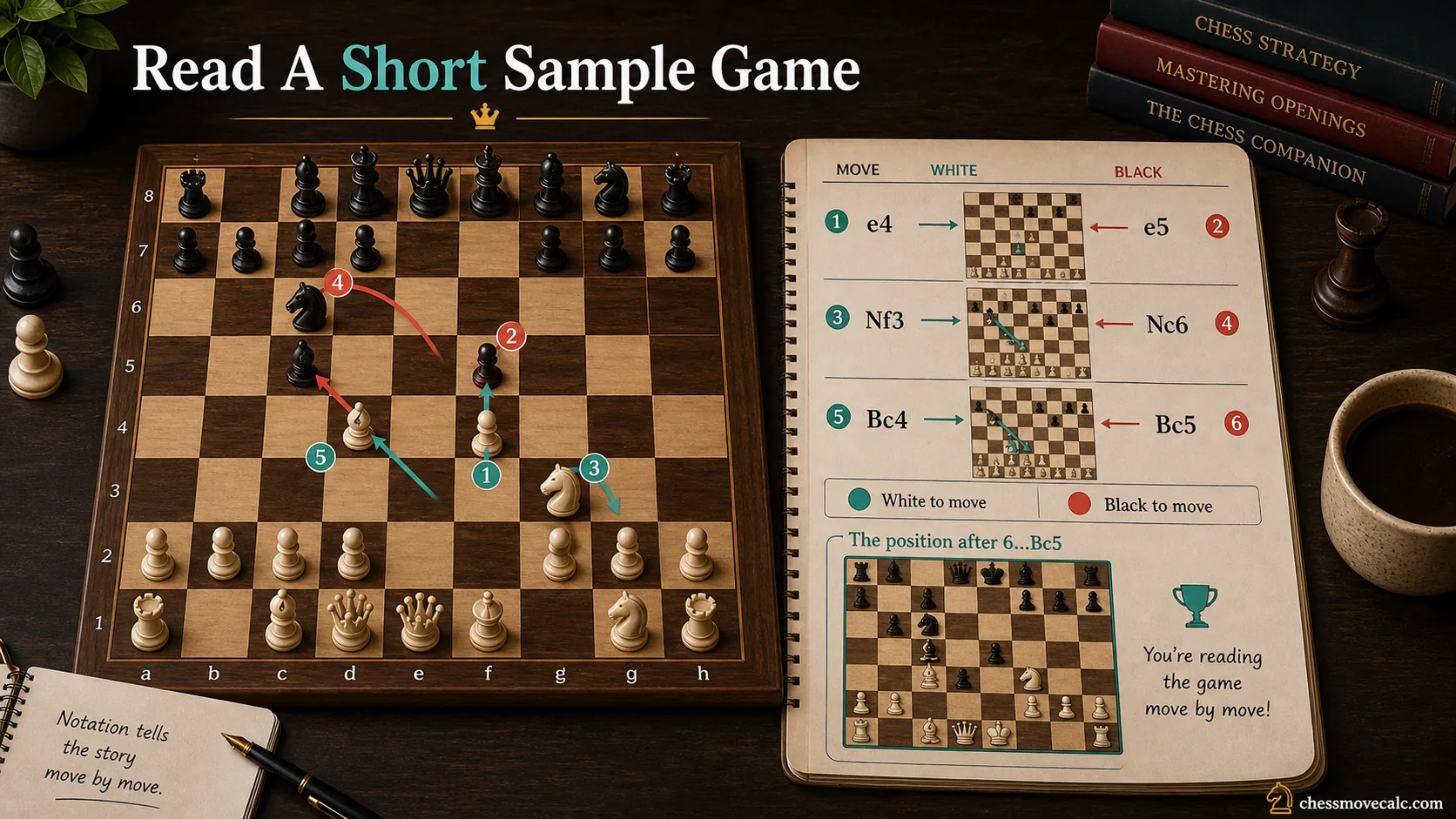
A short sample score is where the isolated rules start turning into fluent reading.
Read a short sample game move by move
Consider this common opening sequence: 1. e4 e5 2. Nf3 Nc6 3. Bb5 a6 4. Ba4 Nf6 5. O-O Be7.
At first glance it may look compressed, but after the earlier sections it becomes readable. White's first move is a pawn to e4.
Black answers with a pawn to e5. White's knight goes to f3. Black's knight goes to c6.
Then White's bishop goes to b5, Black pushes a pawn to a6, White retreats the bishop to a4,
Black develops the knight to f6, White castles kingside with O-O, and Black develops the bishop to e7.
A move list that once looked like code now reads like a compact game story.
This is the moment many learners need. Not more definitions, but proof that the notation actually becomes usable. If you want more practice built specifically around decoding moves and recognizing patterns like disambiguation, captures, and special cases, the next article in the sequence is How to Read Algebraic Chess Notation.
And if you want to test yourself immediately, paste a few moves into the notation converter and compare what you expected with what the board actually shows. That kind of instant feedback speeds up retention dramatically.
This is also the point where notation stops being “study material” and starts becoming a practical tool. Once you can read a short score comfortably, opening lines, annotated examples, and engine suggestions all become much easier to use. The notation is no longer a wall between you and the idea.
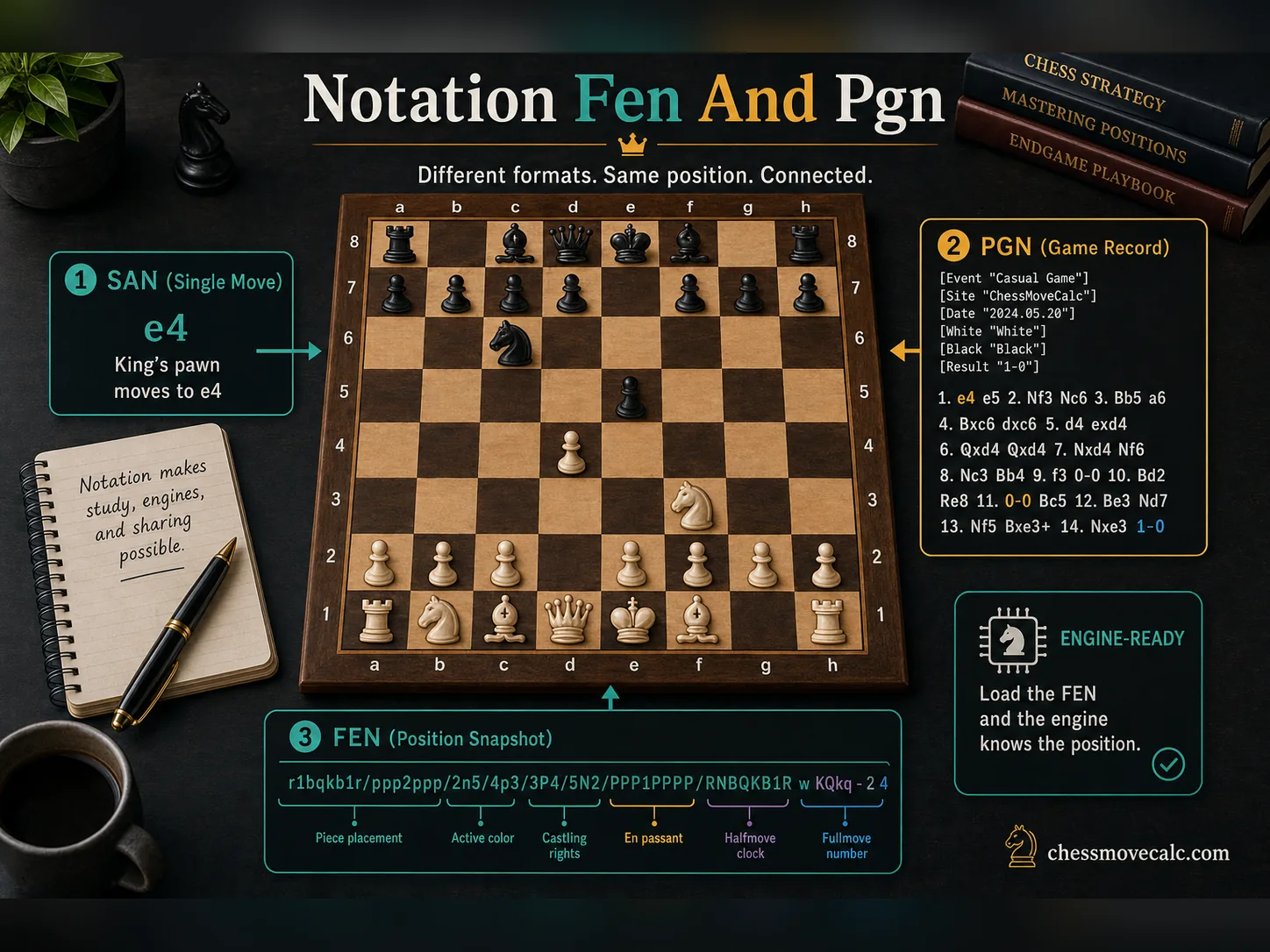
Notation is part of a bigger ecosystem. Algebraic notation, PGN, and FEN each solve a different storage problem.
How notation connects to FEN, PGN, and engine tools
Algebraic notation is the move language. PGN is the larger file format that stores a whole game, headers included. FEN stores one exact position snapshot. These formats overlap, but they are not interchangeable. Understanding the difference helps you choose the right tool faster.
If you have a move list and want to replay or translate it, algebraic notation is the starting point. If you want to preserve the full game record, PGN is usually the better format. If you only need one position for a best-move check, FEN is often better. That is why this content cluster is structured the way it is. The broad notation guide points outward to more specific help rather than trying to cram every format into one page.
For position-input workflows, continue to How to Use FEN to Analyze Chess Positions. For move-decoding practice, continue to How to Read Algebraic Chess Notation. For symbol lookup, use Chess Notation Symbols Explained. For format cleanup across PGN, FEN, and move text, use How to Convert PGN, FEN, and Chess Notation.
Seeing those formats as a family, not as competing systems, makes study much easier. PGN packages the whole conversation. FEN saves one precise moment. When you know which job each format performs, tool choice becomes much more obvious.
That clarity is one of the easiest ways to reduce friction for new players. Instead of feeling like chess software invented three competing formats, you begin to see that each one is simply optimized for a different job in the same learning workflow.
Once that relationship clicks, notation feels much less fragmented and much more usable.
That alone removes a lot of beginner confusion fast.
It also changes how you study. A lesson with notation becomes easier to follow, a puzzle line becomes less intimidating, and an engine recommendation becomes more actionable because you can read the move language directly instead of translating every symbol slowly. In practice, that means notation fluency saves time across almost every serious chess resource you will use later.
That is why this guide matters beyond definitions. It is not just about knowing what letters mean. It is about building the reading foundation that lets the rest of your chess learning feel faster, lighter, and much less frustrating.
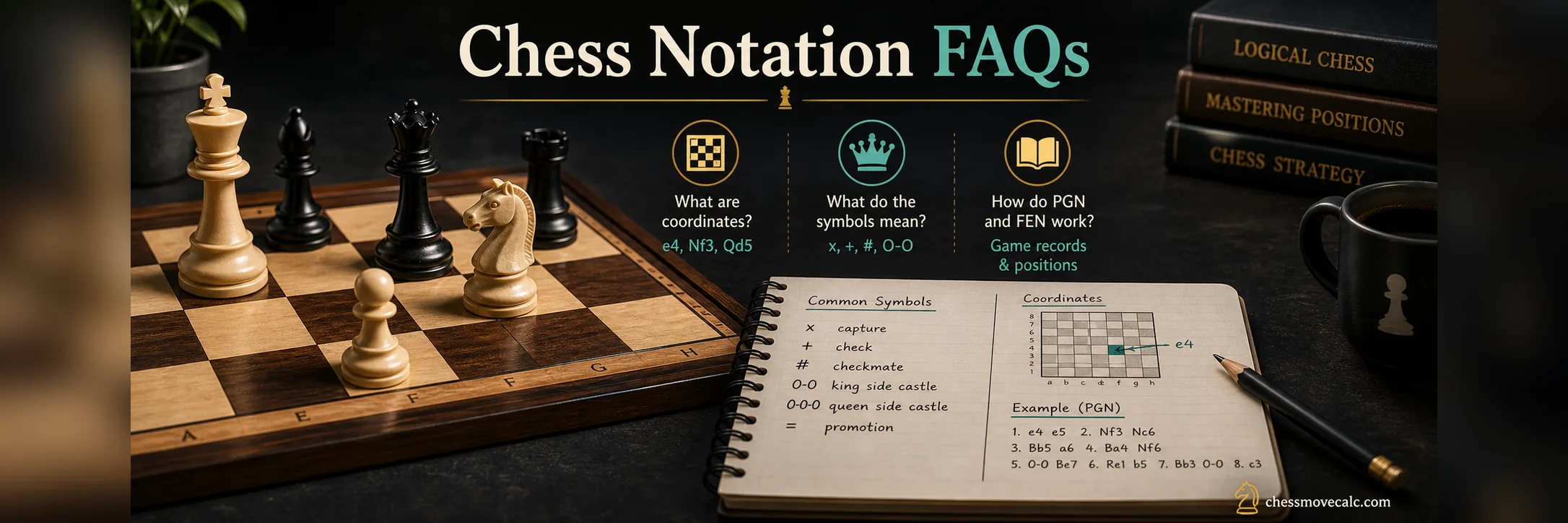
Chess notation FAQs
Is algebraic notation the same as chess notation?
In modern chess usage, algebraic notation is the standard notation system people usually mean when they say chess notation.
Why is the knight written as N?
Because K is already reserved for the king, so N became the standard letter for knight.
Why do pawns not get a letter?
Ordinary pawn moves are written by destination square only, which keeps the notation compact.
What does x mean in chess notation?
It means the move captures something on the destination square.
How do I read castling in notation?
O-O is kingside castling and O-O-O is queenside castling.
What is the easiest way to practice notation?
Read short move sequences on a board and test yourself using the notation converter until the symbols feel natural.
Test your notation on a live board
Paste moves into the converter, watch the board update, and turn abstract move strings into something visual and easy to trust.