A clean mental model for two formats people constantly mix up
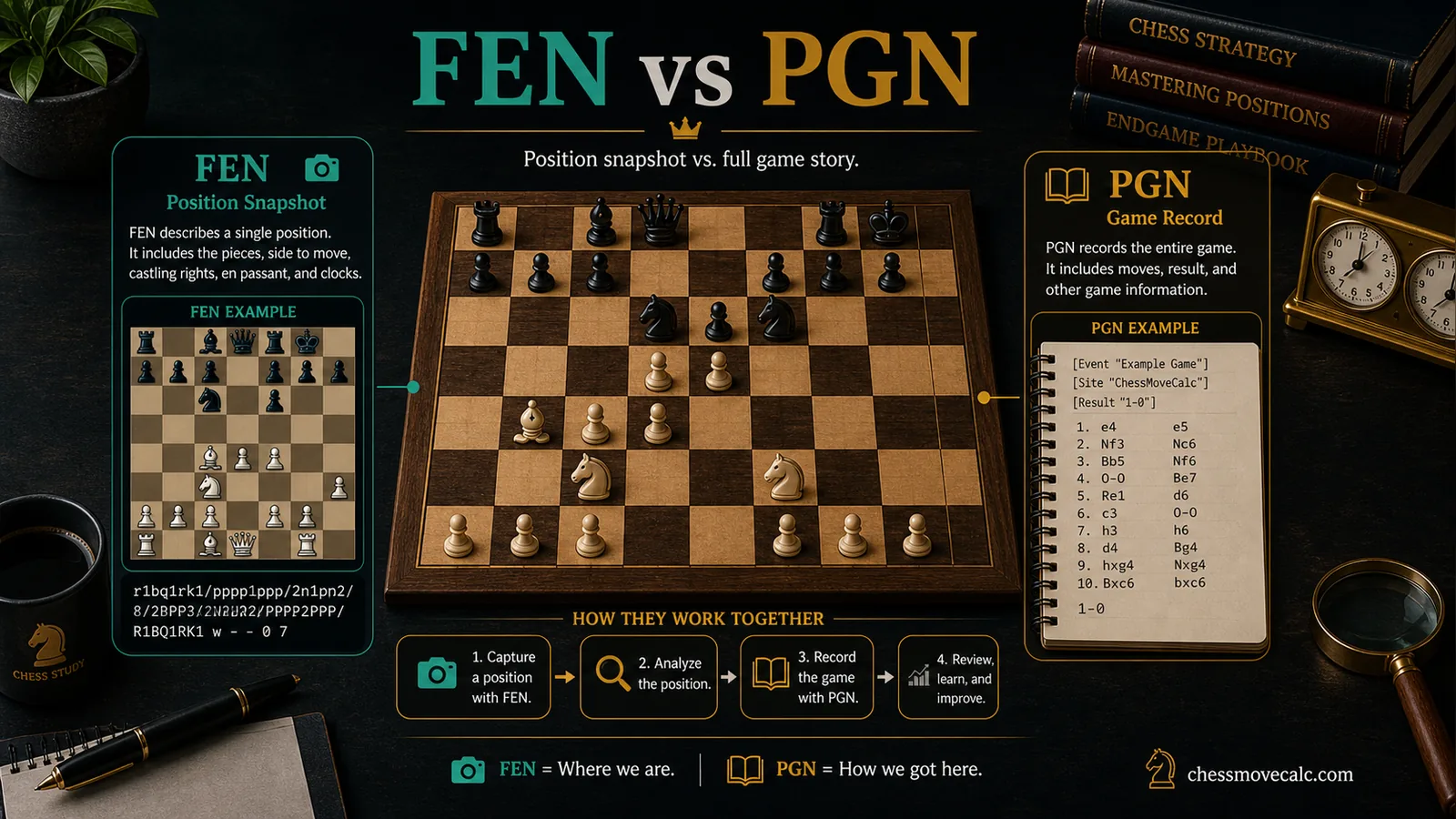
FEN is compact because it stores one board state, not a whole game history.
Many beginner pages define FEN and PGN separately, but they still leave readers with the same practical confusion: which one should I actually use? That confusion matters because the two formats often appear side by side inside analysis boards, study tools, game archives, puzzle pages, and notation converters.
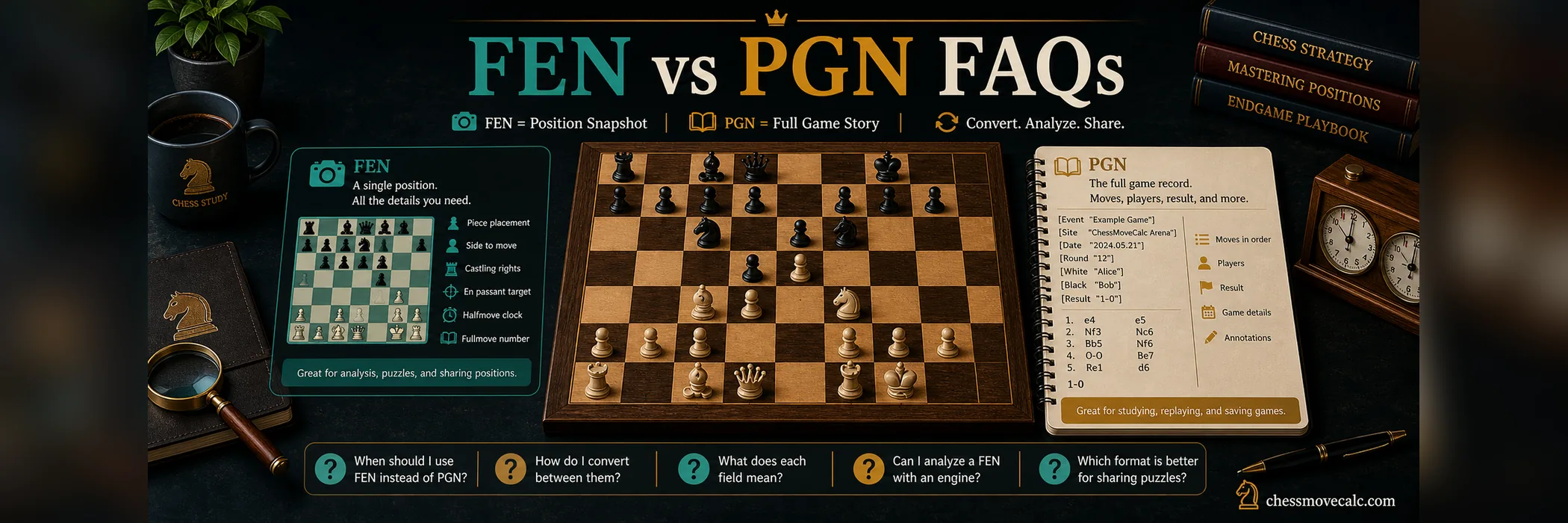
The easiest way to remember the difference is this: FEN is a snapshot, PGN is a story. A FEN string stores one exact board state. A PGN stores the game journey that produced that board, along with tags like player names, event details, comments, and variations. If you mix those jobs up, the wrong workflow feels broken even when the format itself is correct.
That is why this article stays tightly focused on comparison intent. It is different from How to Use FEN to Analyze Chess Positions, which teaches the FEN workflow directly, and different from How to Convert PGN, FEN, and Chess Notation, which is about conversion tasks. This page owns the simple question: what is the difference, and when is each one better?
If that difference becomes automatic, you save time everywhere else. Engine input gets faster, game review gets cleaner, and you stop expecting one format to do a job it was never designed to do.
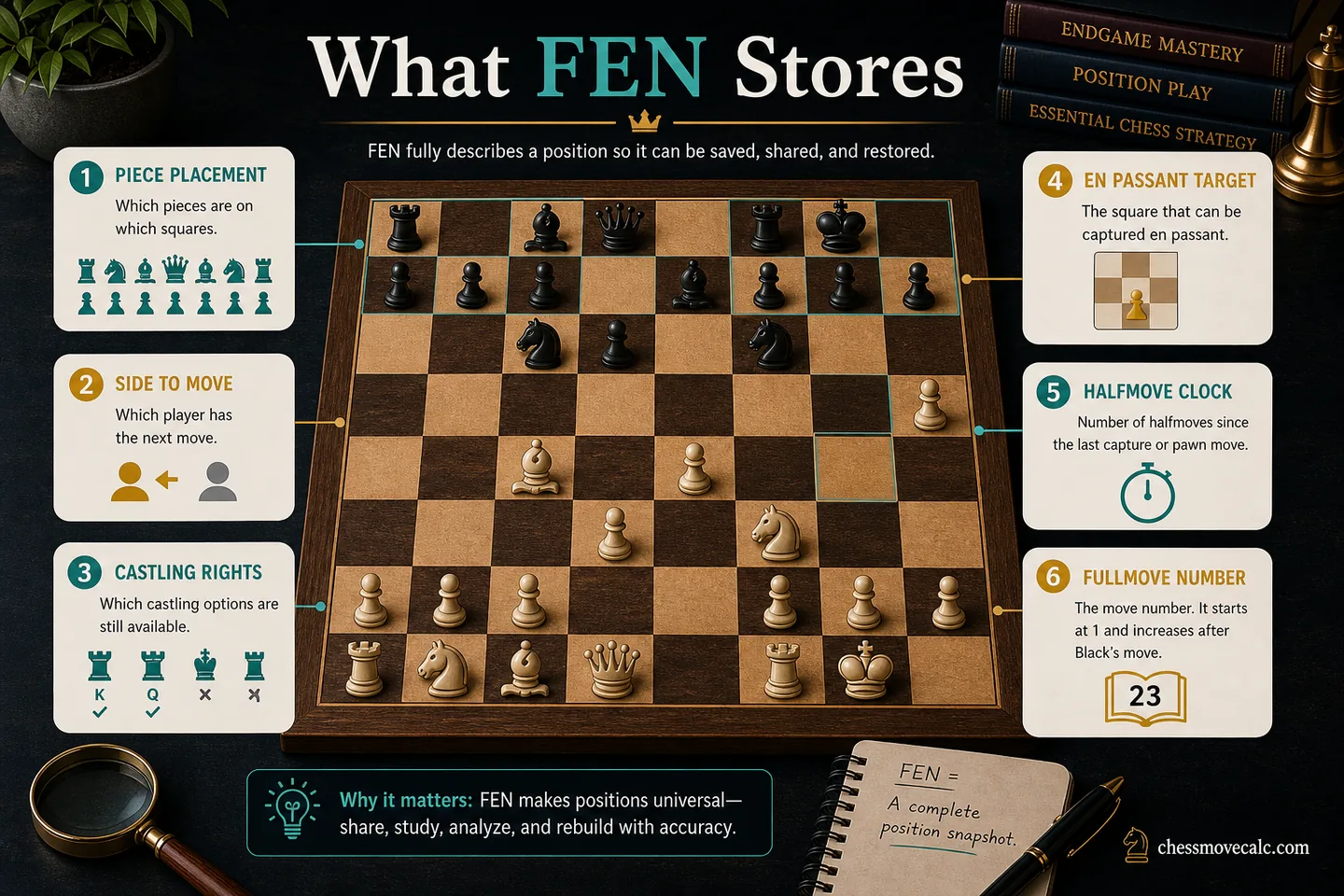
What FEN stores
It describes one exact position in a way engines and boards can recreate reliably. Piece placement, side to move, castling rights, the en passant target square, the halfmove clock, and the fullmove number all belong to the same snapshot. That makes FEN ideal for puzzles, exact position sharing, and one-position analysis.
In practice, the strongest habit is to keep the workflow simple. A correct FEN prevents manual setup errors that often distort engine output. If one field is wrong, the board may look close enough to fool you while still being analytically wrong.
- Piece placement, side to move, castling rights, en passant, halfmove, and fullmove fields all belong to the same snapshot.
- That makes FEN ideal for puzzles, exact position sharing, and one-position analysis.
- A correct FEN prevents manual setup errors that often distort engine output.
- If one field is wrong, the board may look close enough to fool you while still being analytically wrong.
Best use case
Reach for FEN when you care about one exact position and want the cleanest engine-ready input path.
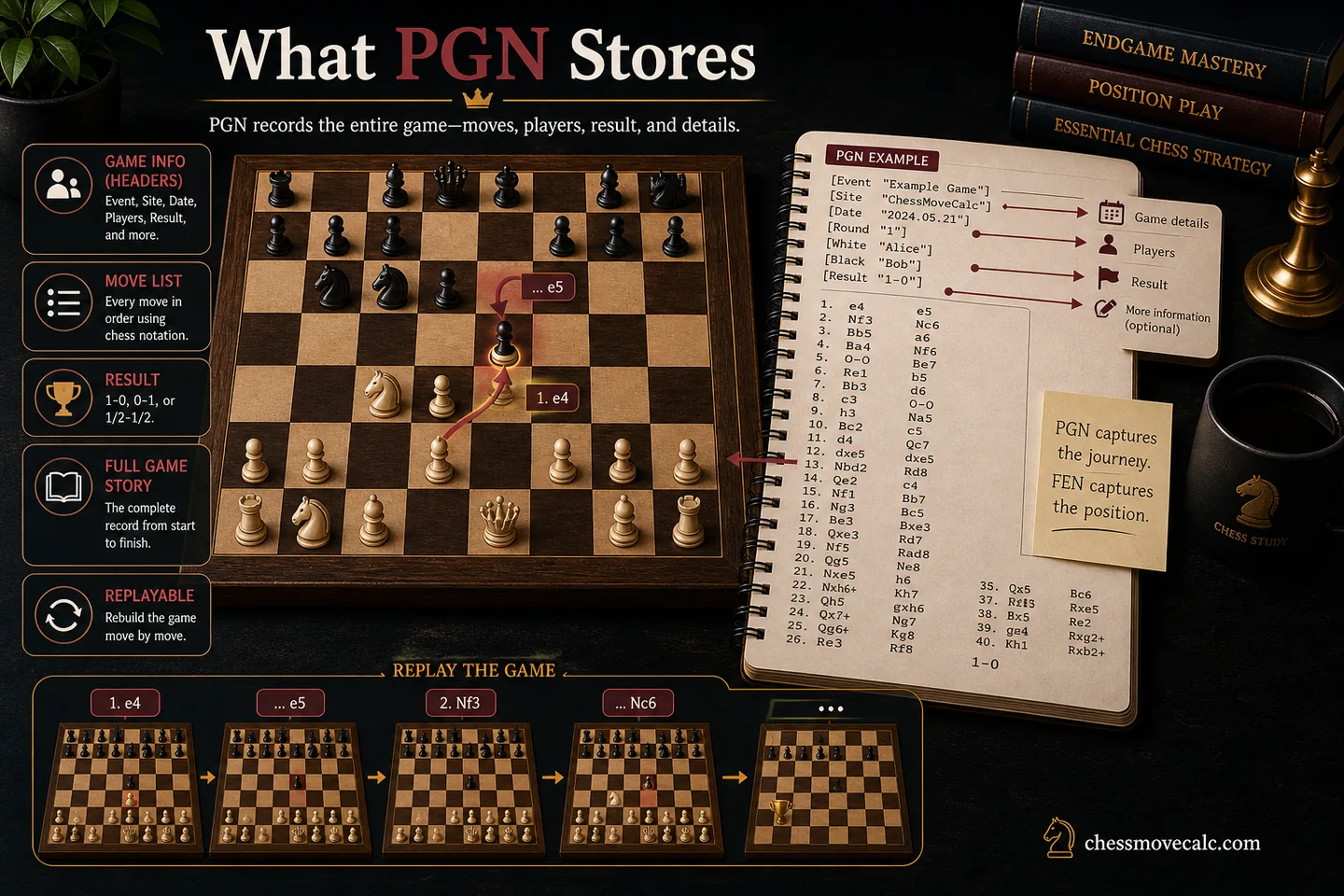
PGN is built for the full record, which is why it can hold much more context than FEN.
What PGN stores
It preserves the game story instead of freezing only one board state. PGN includes the move list, so you can replay how the position happened. Headers, comments, and variations make it useful for coaching, archives, and study.
In practice, the strongest habit is to keep the workflow simple. That broader scope is why PGN belongs in databases, lessons, and long-form review. A single FEN can show the final position, but it cannot explain the decisions that produced it.
- PGN includes the move list, so you can replay how the position happened.
- Headers, comments, and variations make it useful for coaching, archives, and study.
- That broader scope is why PGN belongs in databases, lessons, and long-form review.
- A single FEN can show the final position, but it cannot explain the decisions that produced it.
Why it matters
PGN is the right answer when your question is not just about the position but also about how the game got there.
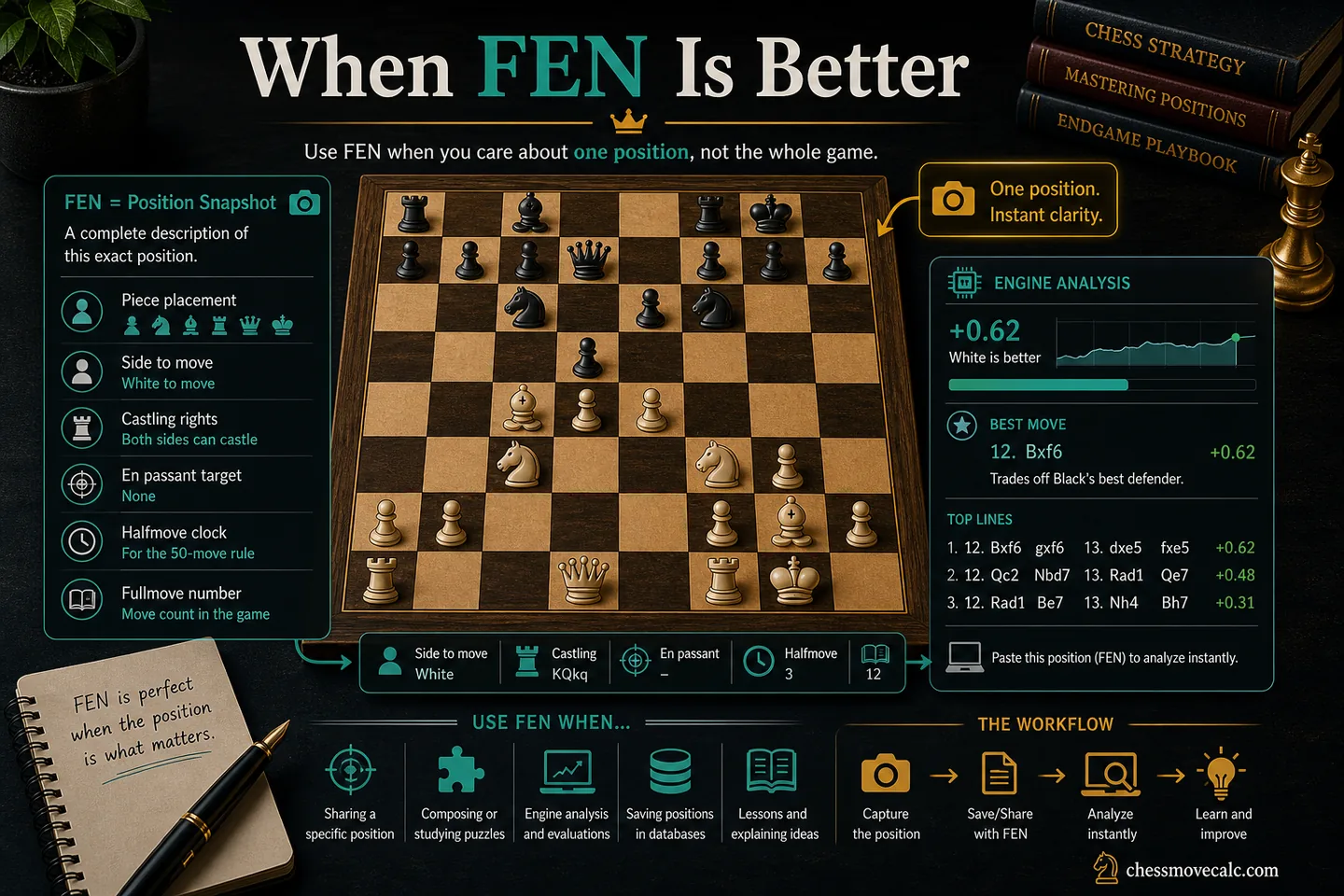
FEN wins when speed and position accuracy matter more than move history.
When FEN is better than PGN
Many chess tasks start from one board you see right now, not from a full archived game. One-position engine analysis is faster with FEN because you skip unnecessary replay. Puzzle sharing and board-editor workflows usually need only the current position.
In practice, the strongest habit is to keep the workflow simple. Artificial studies or test positions often do not need a legal full game history at all. If your next action is load this exact board, FEN is usually the cleaner choice.
- One-position engine analysis is faster with FEN because you skip unnecessary replay.
- Puzzle sharing and board-editor workflows usually need only the current position.
- Artificial studies or test positions often do not need a legal full game history at all.
- If your next action is load this exact board, FEN is usually the cleaner choice.
Remember the shortcut
If your next action is to load one exact board, FEN is usually the better first format.
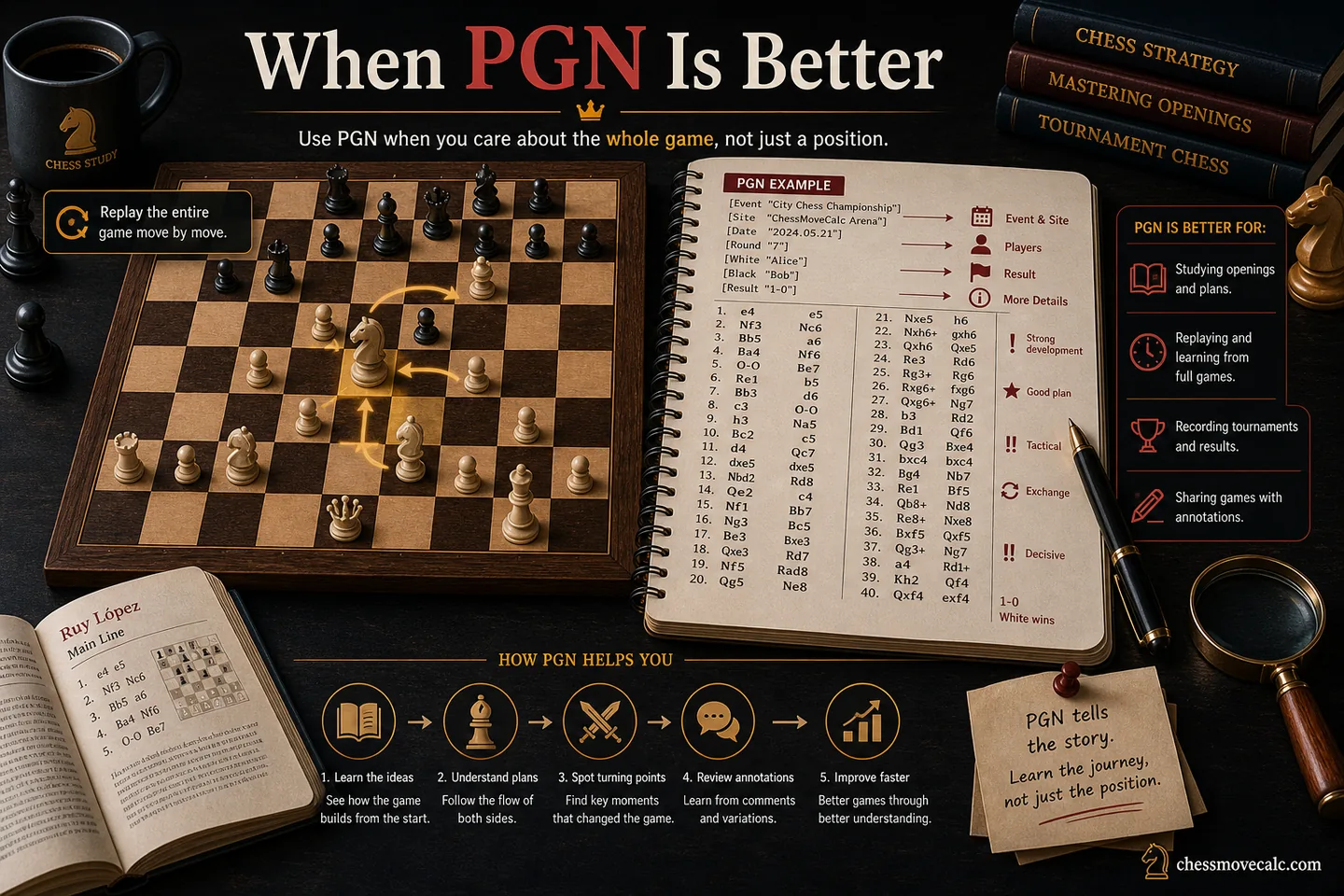
PGN wins when the moves, the story, and the annotations all matter.
When PGN is better than FEN
Review, opening prep, and coaching all depend on the route into the position, not only the destination. Game review needs the move history intact so mistakes make sense in context. Opening prep depends on variations and branching, which PGN handles naturally.
In practice, the strongest habit is to keep the workflow simple. Coaches and databases prefer PGN because it preserves teaching context instead of flattening it. If you want to replay, annotate, or archive, PGN is usually the stronger container.
- Game review needs the move history intact so mistakes make sense in context.
- Opening prep depends on variations and branching, which PGN handles naturally.
- Coaches and databases prefer PGN because it preserves teaching context instead of flattening it.
- If you want to replay, annotate, or archive, PGN is usually the stronger container.
Practical rule
If the story matters as much as the board, PGN is usually the better answer.
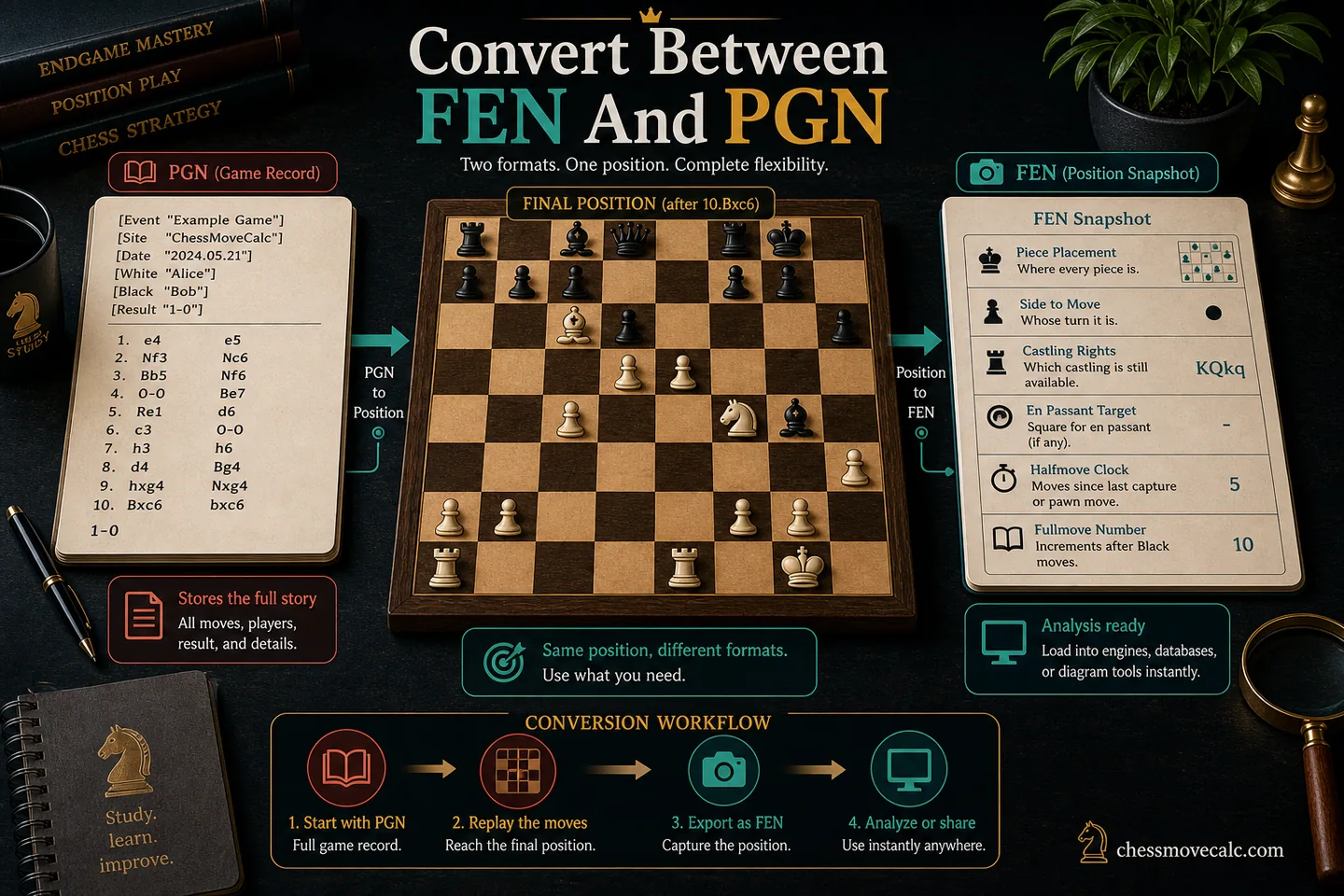
Conversion becomes simple once you stop expecting a perfect one-to-one relationship between the formats.
How to convert between FEN and PGN
The common direction is to extract one useful position from a fuller game record. PGN to FEN means advancing to the moment you care about and exporting that board state. FEN to board is easy because the format already describes one exact position.
In practice, the strongest habit is to keep the workflow simple. FEN cannot recreate a full PGN by itself because the move history is missing. Good converters help you verify the board visually instead of trusting the raw text blindly. For the practical workflow, move next into the dedicated conversion guide and test it with the converter.
- PGN to FEN means advancing to the moment you care about and exporting that board state.
- FEN to board is easy because the format already describes one exact position.
- FEN cannot recreate a full PGN by itself because the move history is missing.
- Good converters help you verify the board visually instead of trusting the raw text blindly.
Important limit
A FEN can recreate a position. It cannot by itself recreate the full move history that PGN carries.
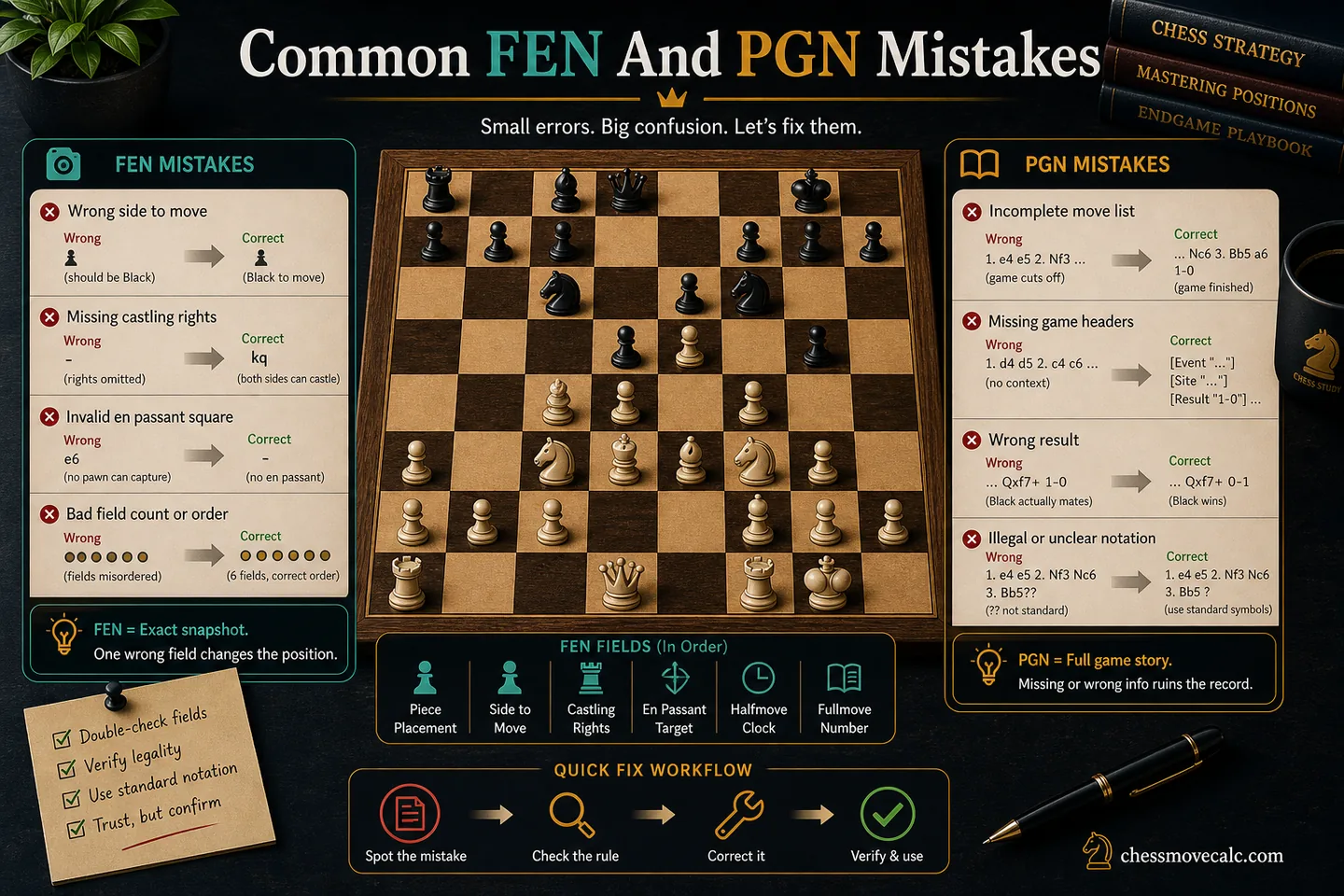
Most format frustration comes from using the right file in the wrong context or misreading what the format promises.
Common mistakes beginners make with each format
Beginners usually are not dealing with exotic bugs; they are usually asking one format to do another format's job. Do not expect FEN to store comments or the whole move history. Do not use PGN when one exact board state is all you really need.
In practice, the strongest habit is to keep the workflow simple. Always verify side to move and rights before trusting engine output. If the board matters more than the story, simplify the workflow instead of adding more notation.
- Do not expect FEN to store comments or the whole move history.
- Do not use PGN when one exact board state is all you really need.
- Always verify side to move and rights before trusting engine output.
- If the board matters more than the story, simplify the workflow instead of adding more notation.
Decision filter
Position question means FEN. Game-history question means PGN. That single habit prevents a lot of confusion.
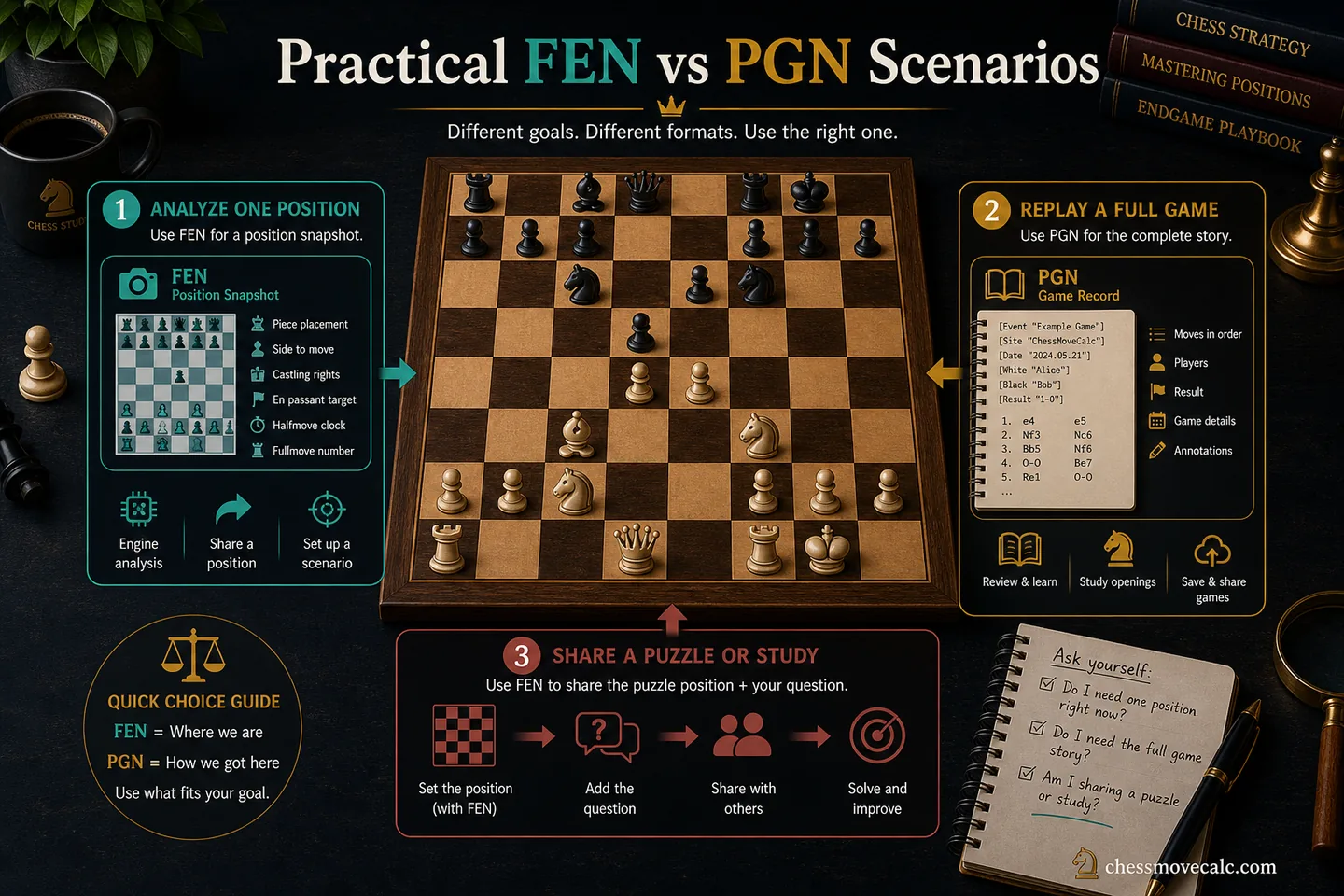
Real use cases make the format choice much easier than abstract definitions alone.
Practical FEN vs PGN scenarios that make the difference obvious
The difference becomes much easier to remember once you attach each format to a real task instead of to a vague technical definition. A puzzle position, engine test, or board share usually points toward FEN first. A full lesson file, tournament archive, or coaching review usually points toward PGN first, especially when SAN move text and annotations matter.
Beginners get less confused when they decide what the next action is before they decide which format to paste. That one-question habit prevents many fake conversion problems before they even begin.
A stronger habit is to ask what decision this concept should improve the very next time it appears. The strongest workflow is often PGN for history and FEN for the one moment you want to analyze deeply. Seeing the two formats cooperate is more useful than pretending they compete for the same job.
That bridge is often the missing ingredient between reading an article once and truly keeping the lesson when the position becomes real.
- A puzzle position, engine test, or board share usually points toward FEN first.
- A full lesson file, tournament archive, or coaching review usually points toward PGN first.
- Beginners get less confused when they decide what the next action is before they decide which format to paste.
- That one-question habit prevents many fake conversion problems before they even begin.
- The strongest workflow is often PGN for history and FEN for the one moment you want to analyze deeply.
- Seeing the two formats cooperate is more useful than pretending they compete for the same job.
Practical takeaway
FEN vs PGN in Chess: What’s the Difference? FAQs
What is the main difference between FEN and PGN?
FEN stores one exact position, while PGN stores the full game record with moves and metadata.
Is FEN better for engine analysis?
FEN is better when you want to analyze one exact position quickly. PGN is better when the move history matters.
Can PGN store comments and headers?
Yes. PGN can hold tags, annotations, comments, and variations in addition to the main move list.
Can one PGN contain many positions?
Yes. Every move in a PGN leads to a new board state, so one PGN can recreate an entire sequence of positions.
Can FEN recreate the full game?
No. FEN can recreate a position, but not the full move history that produced it.
Which format should beginners learn first?
Learn the basic idea of both, but use FEN for one-position tasks and PGN for full-game study.
Test FEN and PGN in a real workflow
Load a position, compare formats, and use the right one for the job instead of guessing.