Read the checkmate symbol in a legal sequence
The short game 1. f3 e5 2. g4 Qh4# ends in checkmate. Q identifies the queen, h4 is the destination square, and # means the opponent is checkmated. The game result is 0–1 because Black wins.
The symbols + and # describe check and checkmate. By contrast, ! and ? are annotations judging a move; they do not change the move’s legality or destination.
Load this exact position:
rnbqkbnr/pppp1ppp/8/4p3/6P1/5P2/PPPPP2P/RNBQKBNR b KQkq g3 0 2A symbol guide is useful because not every searcher wants the full notation lesson
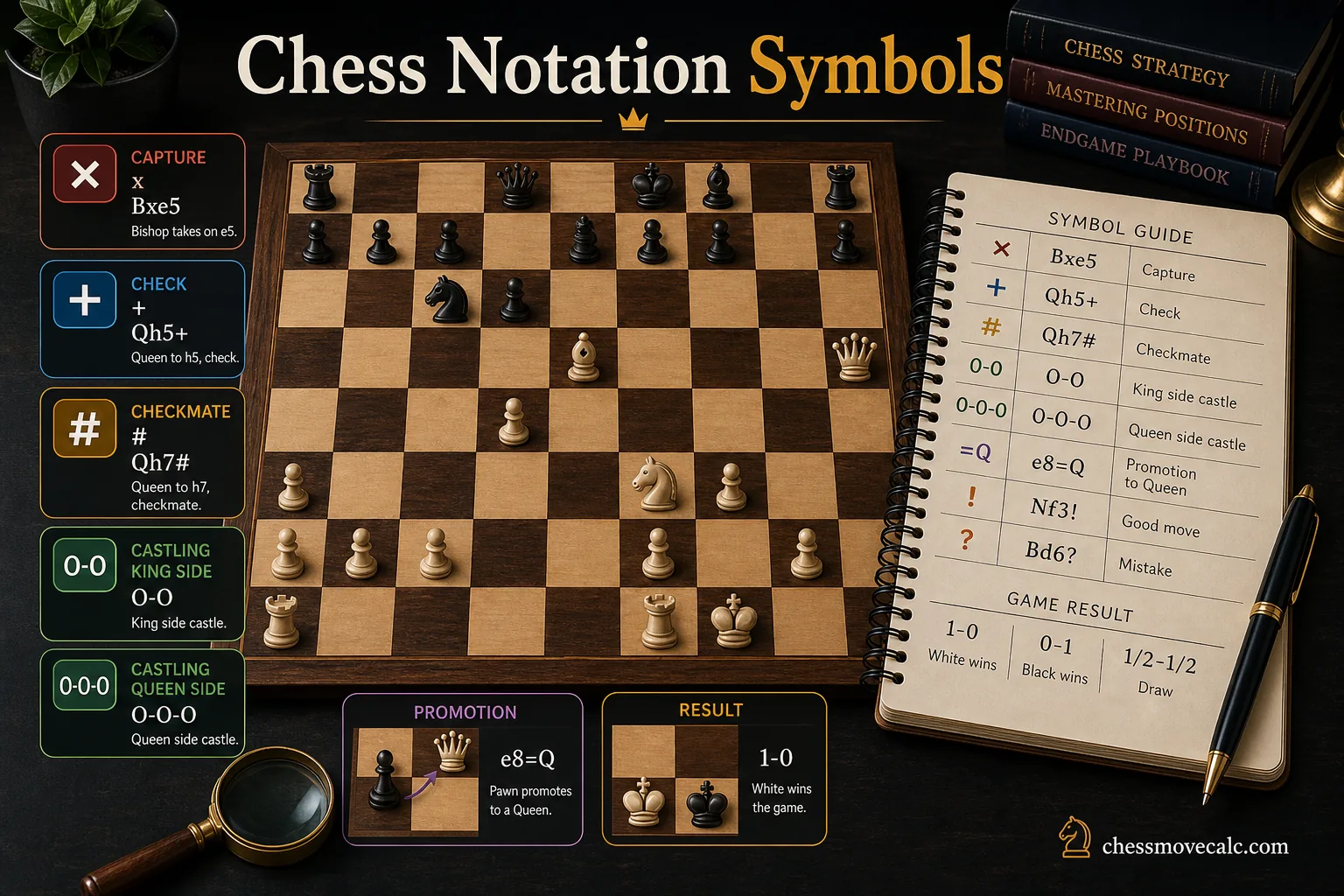
A good symbols page should answer fast, but it should also explain just enough context to make the answer stick.
Some notation searches are broad and educational. Others are highly specific. A player sees x, +, #, !?, or =Q
and wants a direct answer immediately. That is the intent this page is built to serve.
Use this page when one symbol interrupts your reading. For a complete introduction, see Chess Notation Explained. To practice decoding whole moves, use How to Read Algebraic Chess Notation.
The rule of thumb is simple: if you need the full language, start elsewhere. If you need the symbol meaning right now, stay here.
Keep move symbols separate from commentary: x, +, #, and promotion notation describe what happened on the board; ! and ? express an annotator’s judgment. For example, Qh4# records checkmate, while Qh4! praises the move without itself saying the game is over.
In other words, this page is built to be useful even when you arrive with only one question. If you learn more while you are here, great. But the first job is speed and clarity.
That is why the page is organized by symbol families instead of by abstract theory. You should be able to scroll, spot the category, and get unstuck quickly.
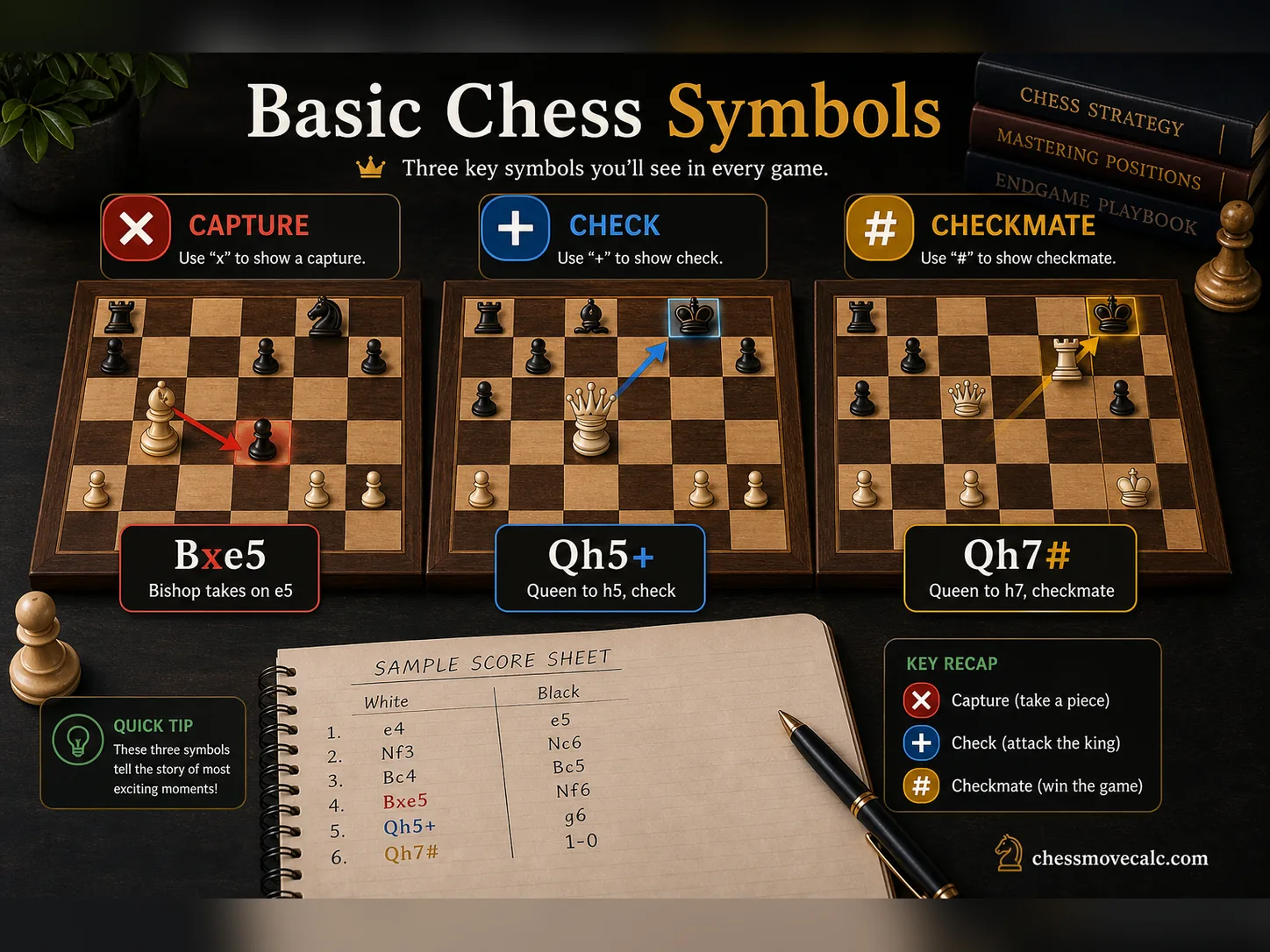
These are the first three symbols most beginners meet, and together they explain a lot of move notation.
Basic move symbols every beginner sees first
The symbol x means capture. When you see Bxe5, read it as “bishop takes on e5.” The plus sign + means check,
so Qh7+ is “queen to h7, check.” The symbol # means checkmate, so Qh7# ends the game.
These three symbols matter because they change the action of the move, not just the destination. A normal move and a checking move may land on the same square, but the added symbol tells you what happened tactically. That extra layer is what makes notation compact but expressive.
If you are completely new to notation, these are the best symbols to memorize first because they appear often and their meaning is immediate.
They also teach an important idea: notation is not only about where a move goes. It is also about what happened. That is why symbols deserve their own page instead of being treated like tiny side notes.
Once you understand that distinction, move lists become easier to scan. You stop reading everything at the same level and begin noticing which moves are forcing, which are routine, and which ended the game.
For many beginners, that is the first moment notation starts feeling informative instead of merely formal. The symbols are telling you where the tactical heat is.
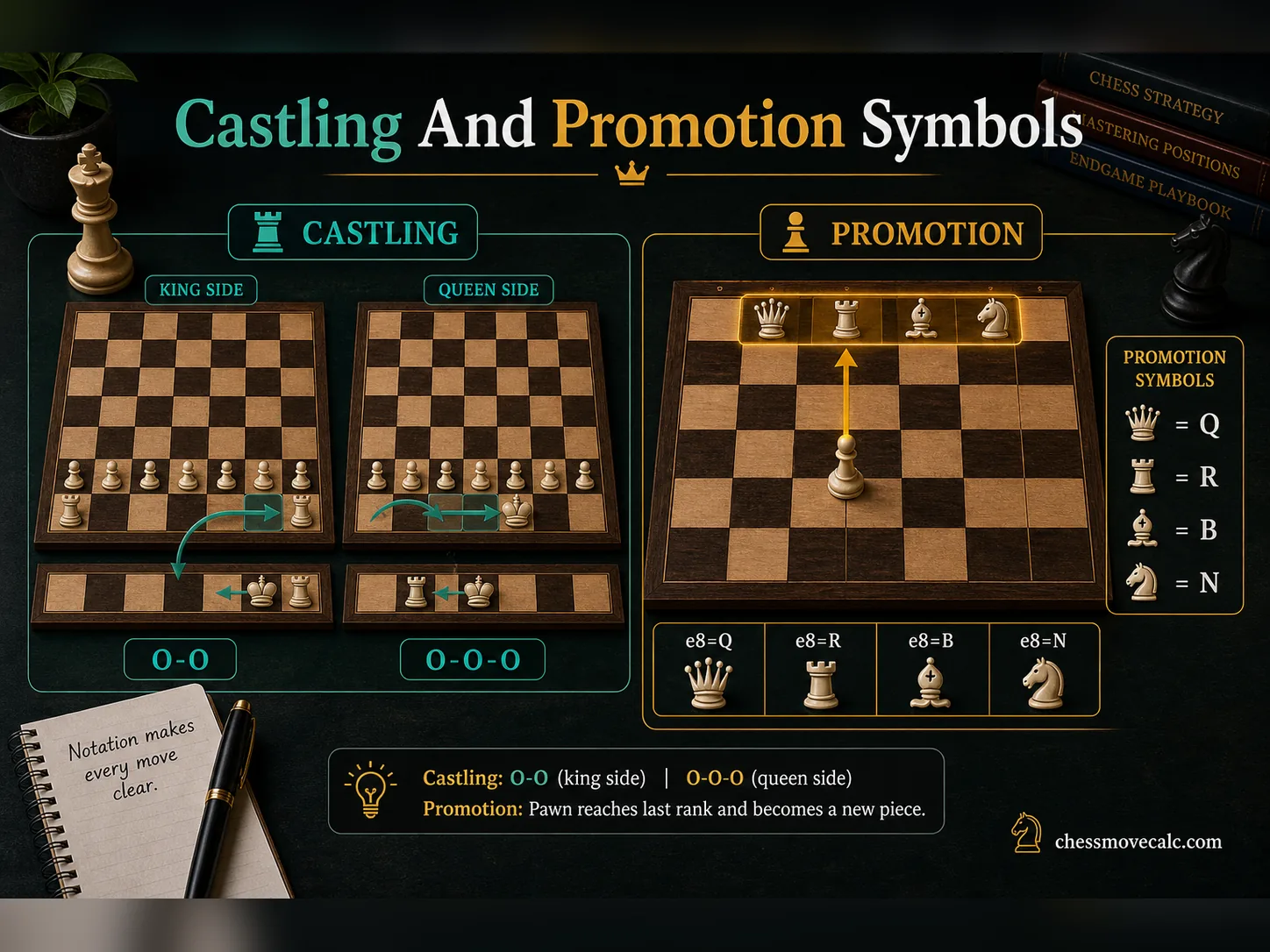
Castling and promotion are visually distinct in notation, which makes them easier to spot once you know what they mean.
Castling and promotion symbols
Kingside castling is written O-O and queenside castling is written O-O-O. These are not zeros. They are capital letter O characters.
Promotion uses an equals sign. So e8=Q means a pawn reached e8 and promoted to a queen.
Other promotion pieces work the same way: =R, =B, or =N. The notation can also combine symbols.
A move such as e8=Q+ tells you the pawn promoted to a queen and gave check at the same time.
These symbols appear less often than capture or check symbols, but they are easy to learn because the forms are so distinctive.
Castling and promotion are good examples of how notation stays efficient. Even when the move is unusual, the format still uses a compact pattern that experienced readers recognize immediately.
They are also visually memorable, which makes them great early wins for beginners. After you see O-O or e8=Q a few times,
those forms become some of the easiest patterns in the whole notation system.
Promotion symbols are especially important in puzzle and endgame content, where one short extra marker can completely change the meaning of the move. It is worth learning them early even if they do not appear in every game you read.
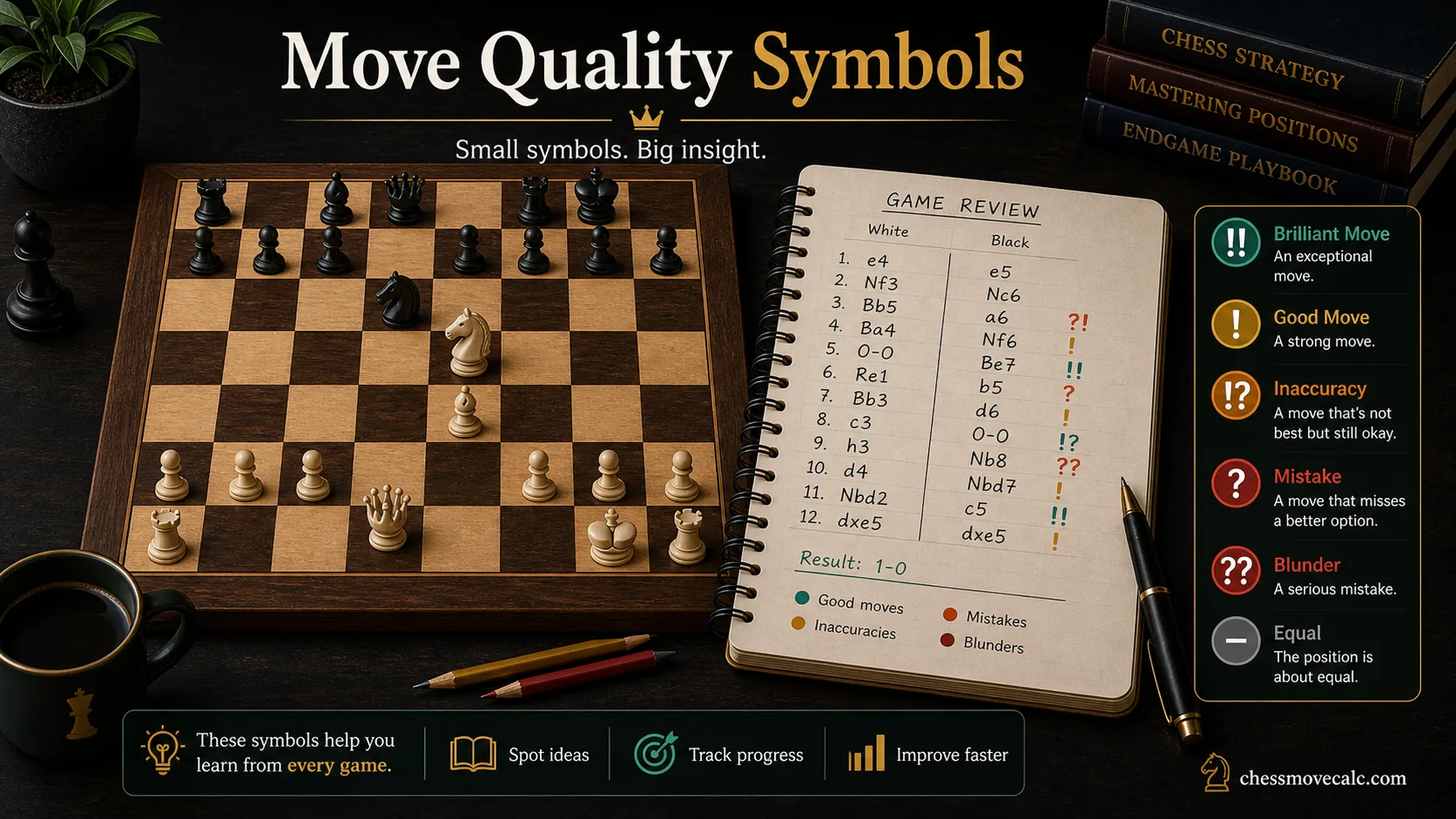
Annotation symbols belong to commentary and databases more than to the move itself, but they are still worth learning.
Annotation symbols like !, ?, !!, and ?!
Annotation symbols are evaluations added by humans, books, or databases. A single exclamation mark ! usually means a good move.
A question mark ? usually means a bad move. Double marks like !! and ?? intensify the judgment.
Mixed symbols are subtler. !? often means an interesting or enterprising move. ?! often means a dubious move:
not a total blunder, but probably suspicious. Different authors use these slightly differently, which is why context matters.
But the general emotional direction stays fairly consistent.
These marks are not part of basic legal notation in the same way that x or + are. They belong to analysis and commentary.
You will see them in annotated games, articles, and engine tools that attach judgments to moves after the game is over.
That difference matters. A move with x or + describes the move itself. A move with ! or ?! describes what someone thinks about the move.
One is core notation. The other is evaluative commentary layered on top.
Knowing that can prevent confusion when you read annotated games. The move did not magically contain an exclamation mark during play. The mark was added afterward by a human or a database trying to teach you something about the move.
That also explains why different sources sometimes use these symbols a little differently. The move itself is objective. The annotation is an interpretive layer added by a teacher, author, commentator, or engine-assisted database.
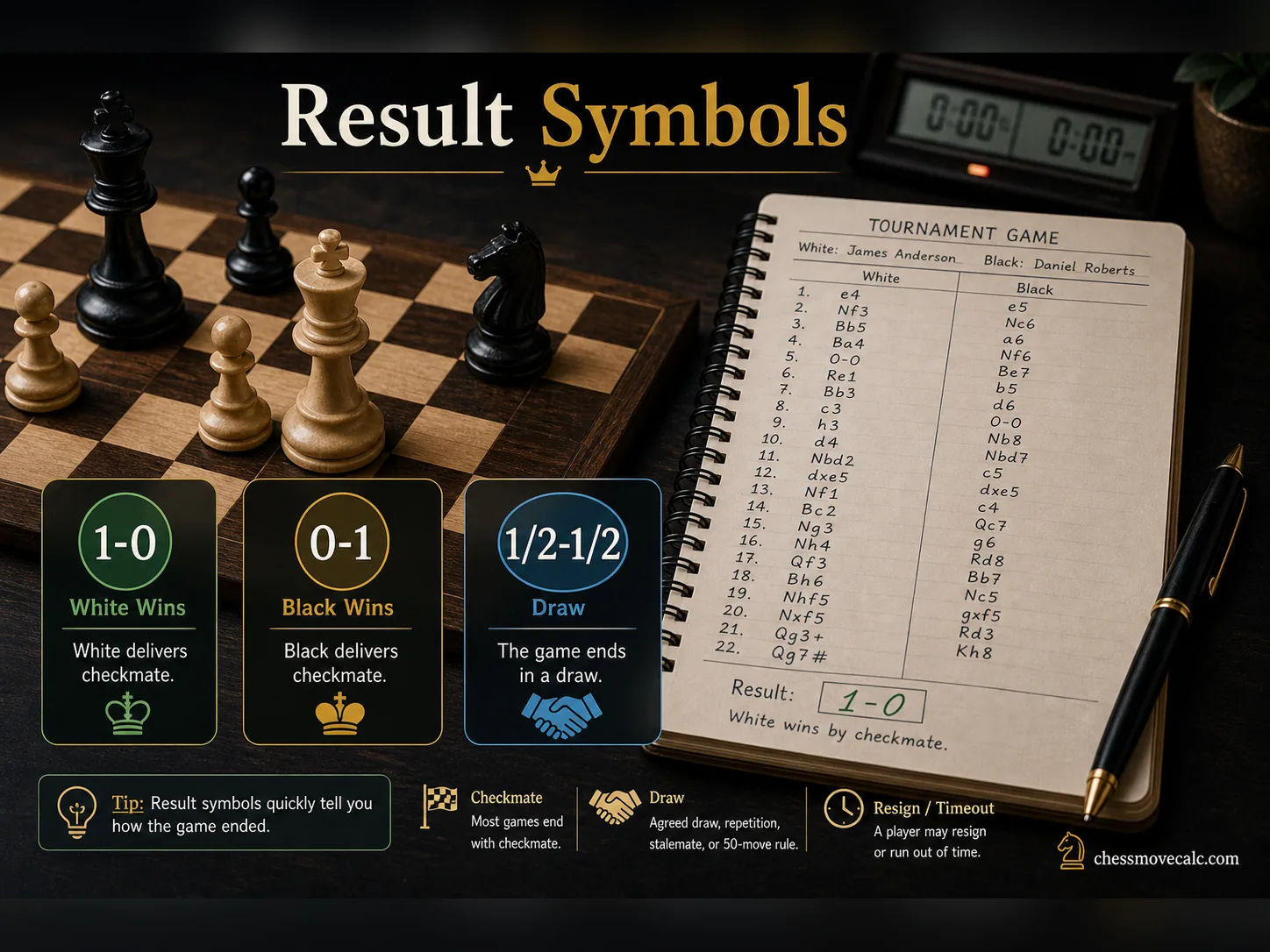
Game-result symbols are simple but essential when you read full scores and PGN files.
Result notation and score symbols
The result 1-0 means White won. 0-1 means Black won. 1/2-1/2 means the game was drawn.
These symbols usually appear at the end of a move list or in a PGN record.
They are easy to memorize, but they become more useful once you start reading whole scores or working with PGN files. If you only look at single moves, you may barely notice them. If you study full games, they become part of the natural visual rhythm of chess notation.
Result symbols also make database browsing faster. Before you study the details of a line or game, you can already see how the game ended, which is why these short forms remain standard in chess archives.
They are especially common in PGN files, where a result line helps software, databases, and human readers classify the game quickly. Even though they are simple, they are part of the wider notation ecosystem and worth recognizing instantly.
If you begin collecting your own games, these result markers will appear constantly. Recognizing them at a glance saves time when browsing archives or reviewing recent results.
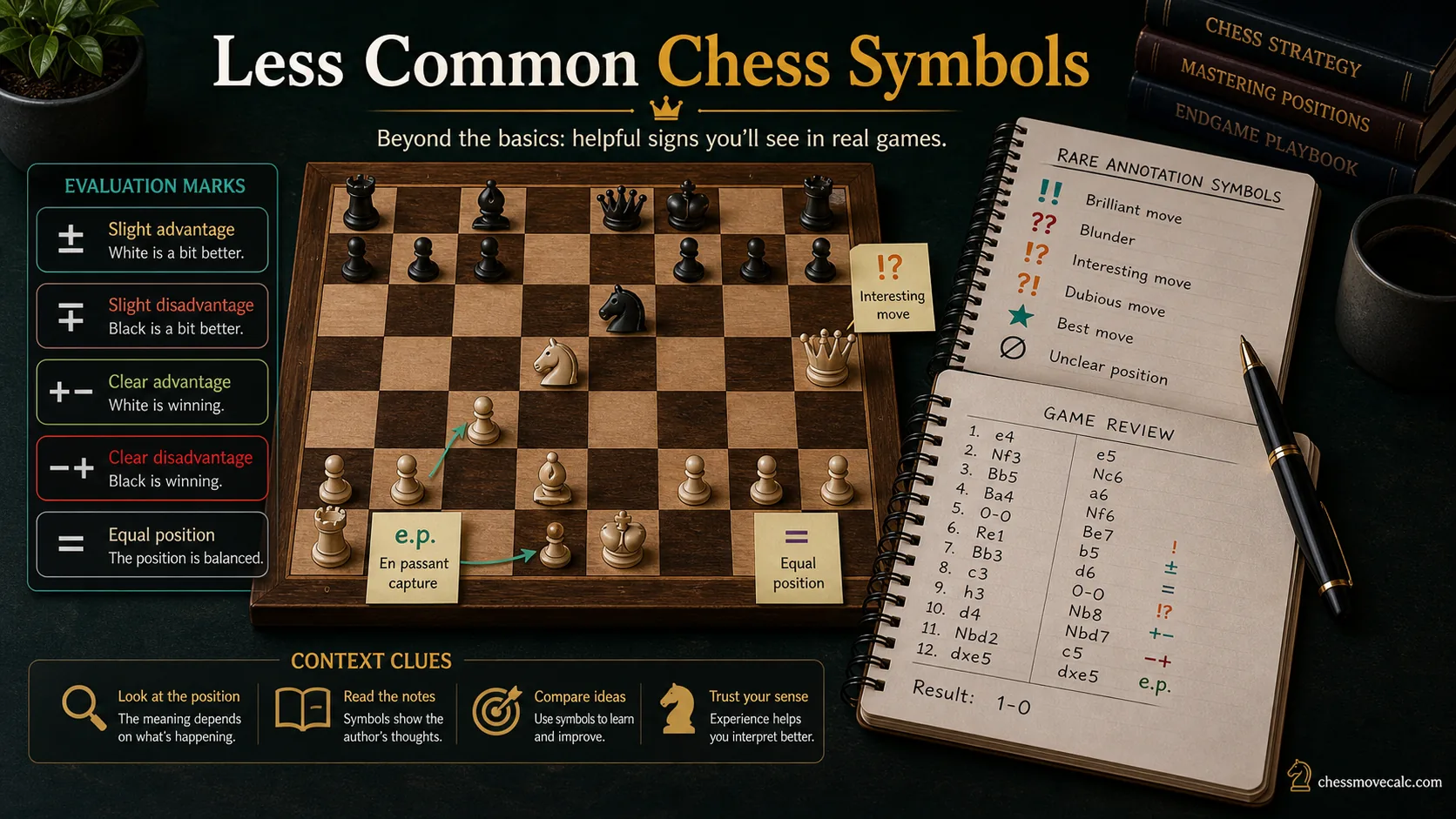
You do not need every advanced symbol on day one, but knowing they exist makes annotated games less intimidating.
Less common symbols you still should recognize
Some annotated material uses symbols like e.p. for en passant, +/− for a clear White advantage,
−/+ for a clear Black advantage, or equality-style marks such as = to suggest an even position.
You do not need to master these immediately, but it helps to know they exist.
These are more common in books, analysis articles, engine summaries, and advanced commentary than in simple beginner move lists. Think of them as an extra dialect layered on top of ordinary algebraic notation. The base move still matters most. The added symbol is commentary about the move or the position.
If you want to build confidence progressively, learn the basic action symbols first, then castling and promotion, then annotation marks, and only then these rarer evaluation symbols.
That order keeps the learning sane. There is no reason to memorize every rare plus-minus mark before you can comfortably read a normal capture or a castling move. The common language comes first. The advanced commentary layer can arrive later.
This matters because many beginners accidentally reverse the order. They try to learn every symbol from a glossary before they can comfortably read a short game score. It is much better to build breadth gradually on top of fluency.
In practice, that means using rare symbols as awareness points, not stress points. Notice them, learn the meaning, and keep moving. You do not need to master every uncommon mark before the page becomes useful.
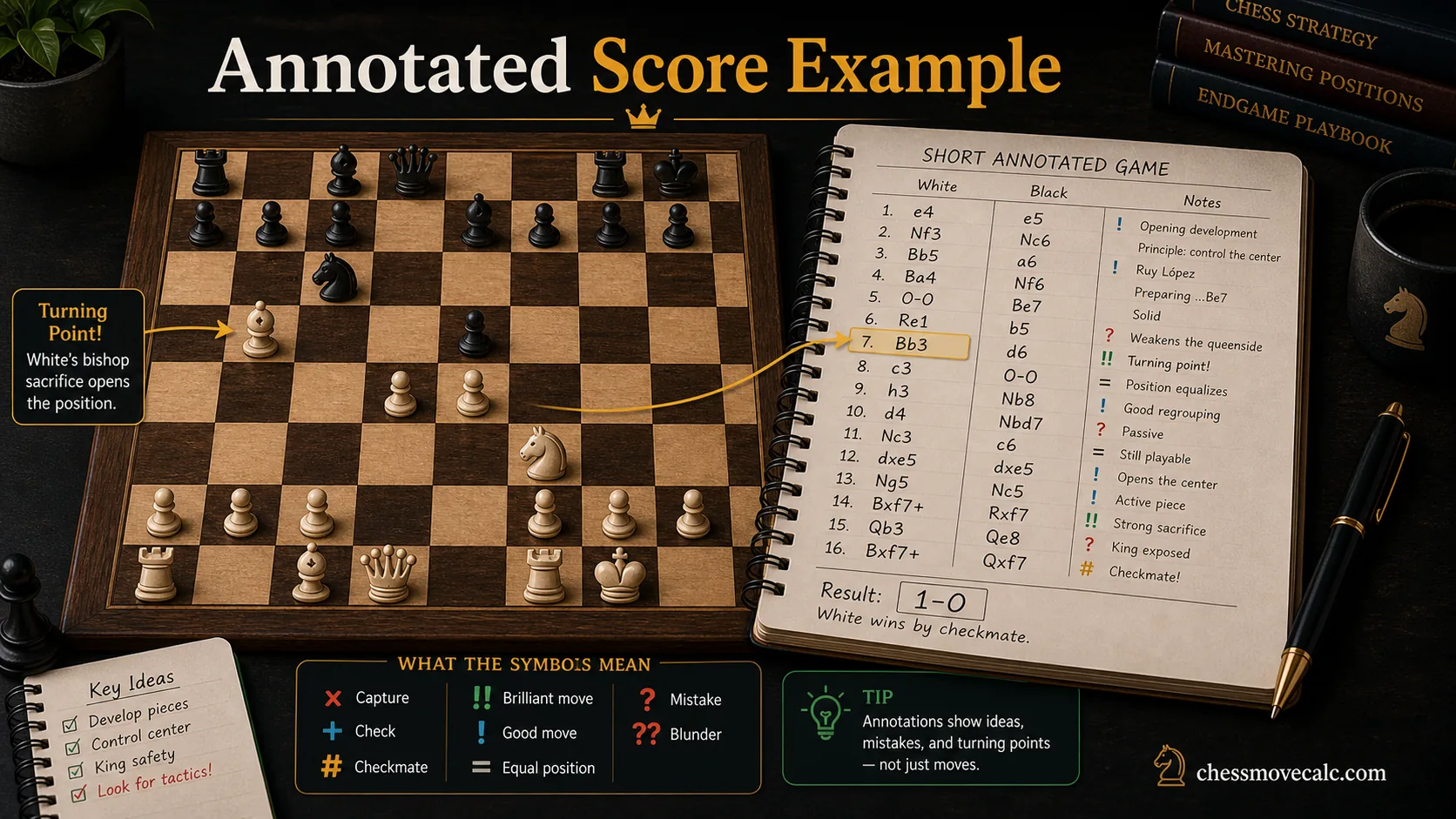
Symbols make more sense when you see them in a real move list instead of as isolated definitions.
Read a short annotated score in context
Imagine a line like 1. e4! e5 2. Nf3 Nc6 3. Bb5 a6?! 4. Bxc6 dxc6 5. O-O. That little sequence already uses several layers.
The exclamation mark on e4! is commentary saying the move is good. The dubious mark on a6?! suggests the move may be questionable.
Bxc6 shows a bishop capture. O-O shows castling.
This is why symbol pages work best when they show examples instead of definitions alone. The brain remembers faster when a symbol appears inside a real move. If you want full decoding practice instead of symbol lookup, go next to How to Read Algebraic Chess Notation.
If you want the big-picture language behind the symbols, use Chess Notation Explained. The three pages work best as a system: broad guide, decoding guide, and symbol lookup guide.
That system is intentional. One page explains the language, one page trains reading fluency, and this page solves the “wait, what does that symbol mean?” moment. Used together, they make the site much more helpful than any one page trying to cover all three jobs at once.
It also makes internal linking more useful. A lookup query can land here, a reader can deepen into the main guide or the reading drills, and the site can support different stages of the same learning journey without forcing every visitor through the same page shape.
That layered approach is exactly how a stronger authority site should behave. Quick pages solve quick problems, and deeper pages carry the reader forward when they are ready for more context.
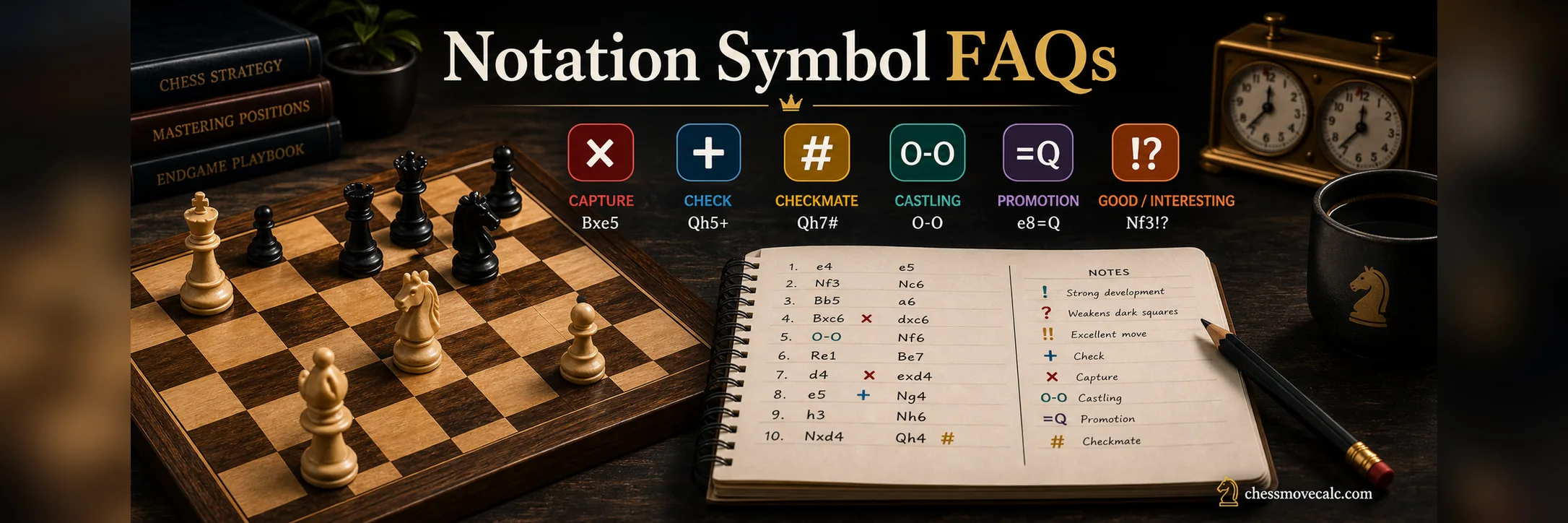
Notation symbol FAQs
What does x mean in chess notation?
It means the move captures something on the destination square.
What is the difference between + and #?
+ means check and # means checkmate.
What does !? mean in annotated games?
It usually means an interesting move with mixed value or practical complexity.
Why is castling written O-O?
Castling has its own traditional notation rather than ordinary square-based destination notation.
What does =Q mean?
It means a pawn promoted to a queen.
Do I need to memorize all notation symbols at once?
No. Learn the common ones first and add the rarer commentary symbols over time.
Best learning order
Start with x, +, #, O-O, and =Q. Then add ! and ?, then the rarer annotation and evaluation marks only when you begin reading more annotated material.
Test notation symbols on a real board
Plug move strings into the converter and turn each symbol into something visual and memorable.