Worked Elo example: equal ratings
Suppose both players have a rating of 1500 and you use K = 20. Their expected score is 0.5 each. A win changes the winner’s rating by 20 × (1 − 0.5) = +10; a loss changes it by 20 × (0 − 0.5) = −10. A draw changes neither rating in this example.
This is the basic Elo calculation. An official federation can specify different K-factors, rounding, tables, and eligibility rules. Online platforms may use different rating systems. Use the calculator to explore the inputs, not as a substitute for an official published rating.
What the Elo system is really trying to tell you
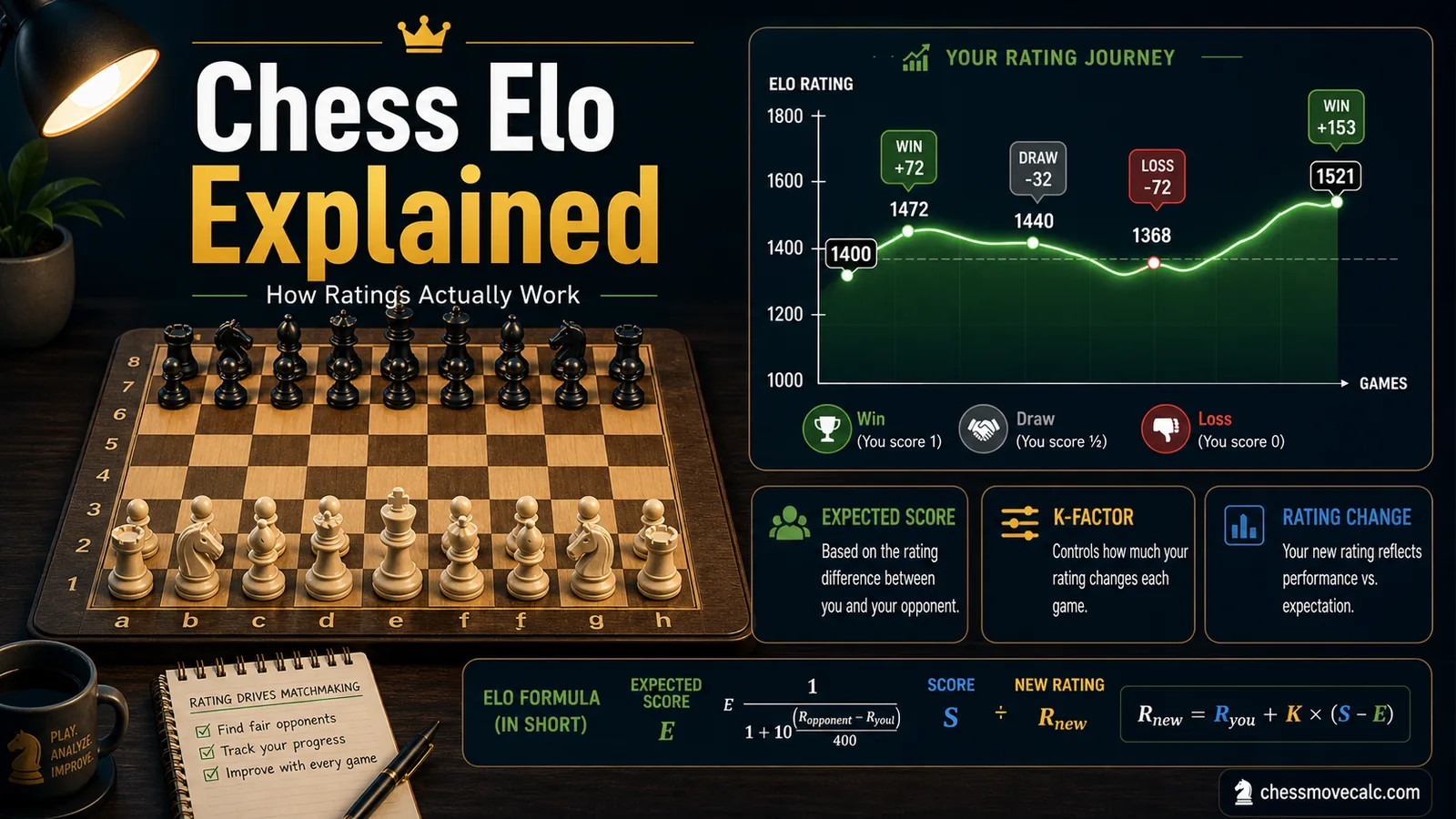
Elo is more useful when you see it as a prediction system instead of a status label.
Most rating confusion starts because players treat Elo like a personal grade instead of a prediction system. In reality, Elo is trying to estimate how often one player should score against another player over time. That is why the same result can change your number by different amounts depending on the opponent.
This page owns the foundation layer. It is broader than the gain-and-loss guide, which focuses on the math of individual changes. It is broader than the FIDE calculator guide, which handles official over-the-board specifics. Here the goal is simpler: understand what Elo is trying to measure and why the number behaves the way it does.
That broader framing matters because players often panic over one result, one streak, or one comparison chart. If you know how expected score, rating pools, and update systems work, you become much harder to mislead by shallow rating takes.
You also start using rating tools more intelligently. Instead of asking only whether your number is good, you begin asking whether it is stable, what pool it belongs to, and what kind of improvement it actually reflects.
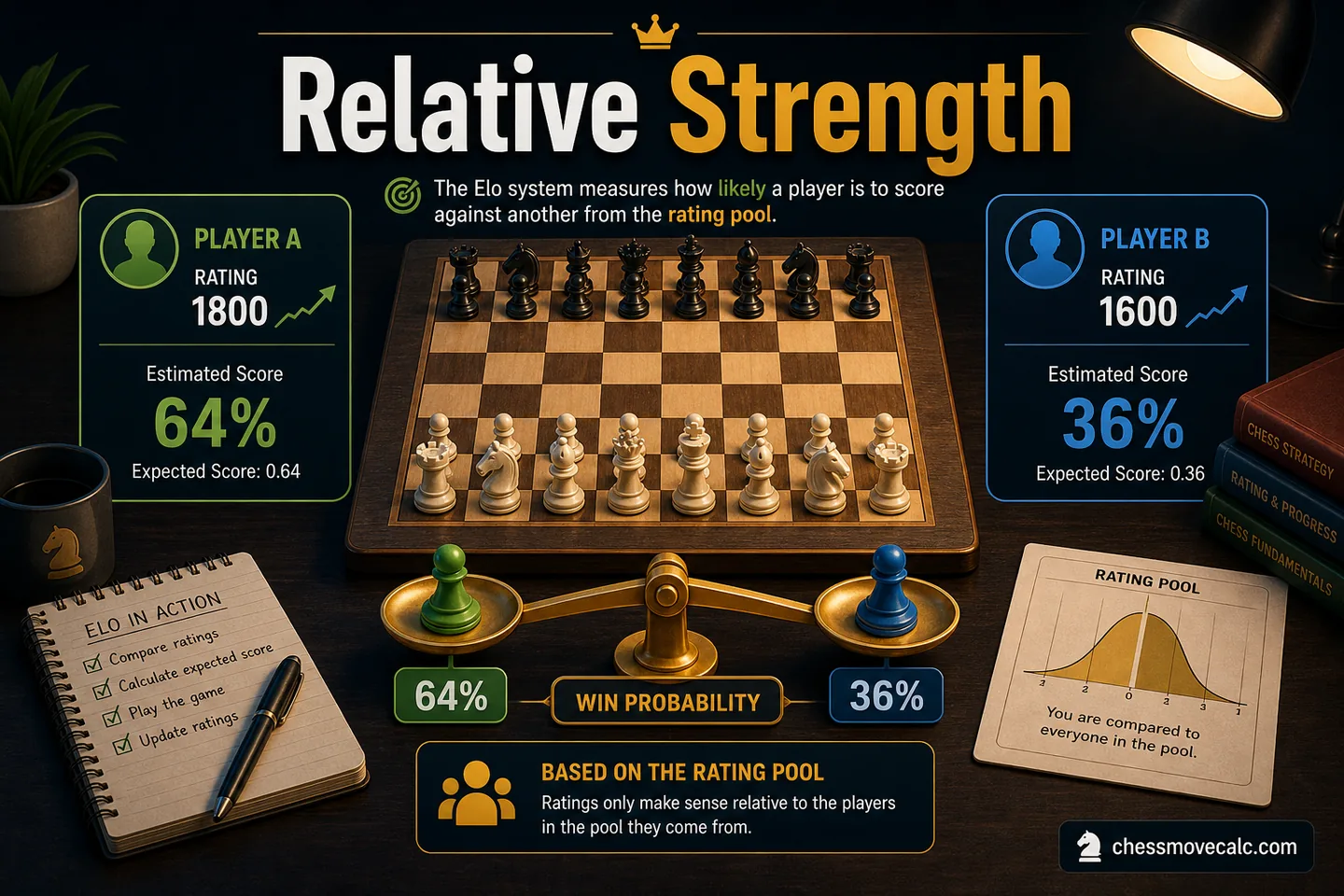
What the Elo system is trying to measure
Its purpose is to estimate expected scoring strength in future games, not to capture every nuance of your chess personality. A higher rating suggests stronger expected results against the same pool of opponents. The system works best over many games, not as a verdict on one evening or one tournament.
That is also where many players misread their own results. Ratings are estimates, so they naturally lag behind fast improvement or fast decline. That is why short streaks can feel dramatic even when the long-term signal has barely changed.
A practical way to use this section is to translate the idea into decisions you can actually make during study and rating review, instead of treating the number as a mysterious label.
- A higher rating suggests stronger expected results against the same pool of opponents.
- The system works best over many games, not as a verdict on one evening or one tournament.
- Ratings are estimates, so they naturally lag behind fast improvement or fast decline.
- That is why short streaks can feel dramatic even when the long-term signal has barely changed.
Best mental model
Think of rating as a forecast that gets sharper with more games, not as a once-and-for-all judgment.
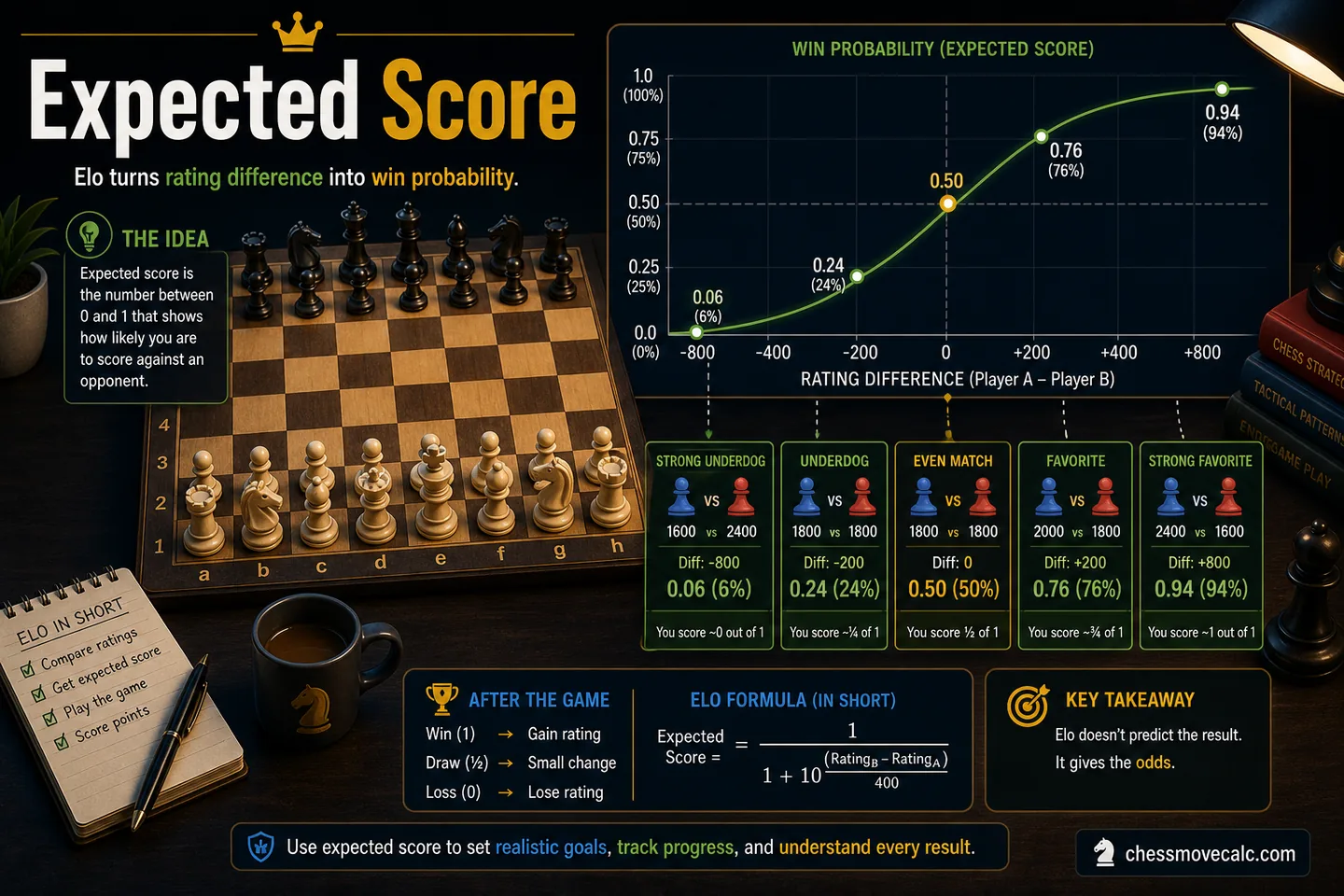
expected score is the bridge between rating difference and rating movement.
How expected score works
The system compares what happened with what was expected before the game started. If two equally rated players meet, the expected score is close to even. If a stronger player wins, the change is usually small because the result was expected.
That is also where many players misread their own results. If a lower-rated player scores well, the change grows because the result beat expectation. That expectation framework is why upset results move the number more than routine ones.
- If two equally rated players meet, the expected score is close to even.
- If a stronger player wins, the change is usually small because the result was expected.
- If a lower-rated player scores well, the change grows because the result beat expectation.
- That expectation framework is why upset results move the number more than routine ones.
Simple takeaway
Rating movement is really a comparison between actual score and expected score.
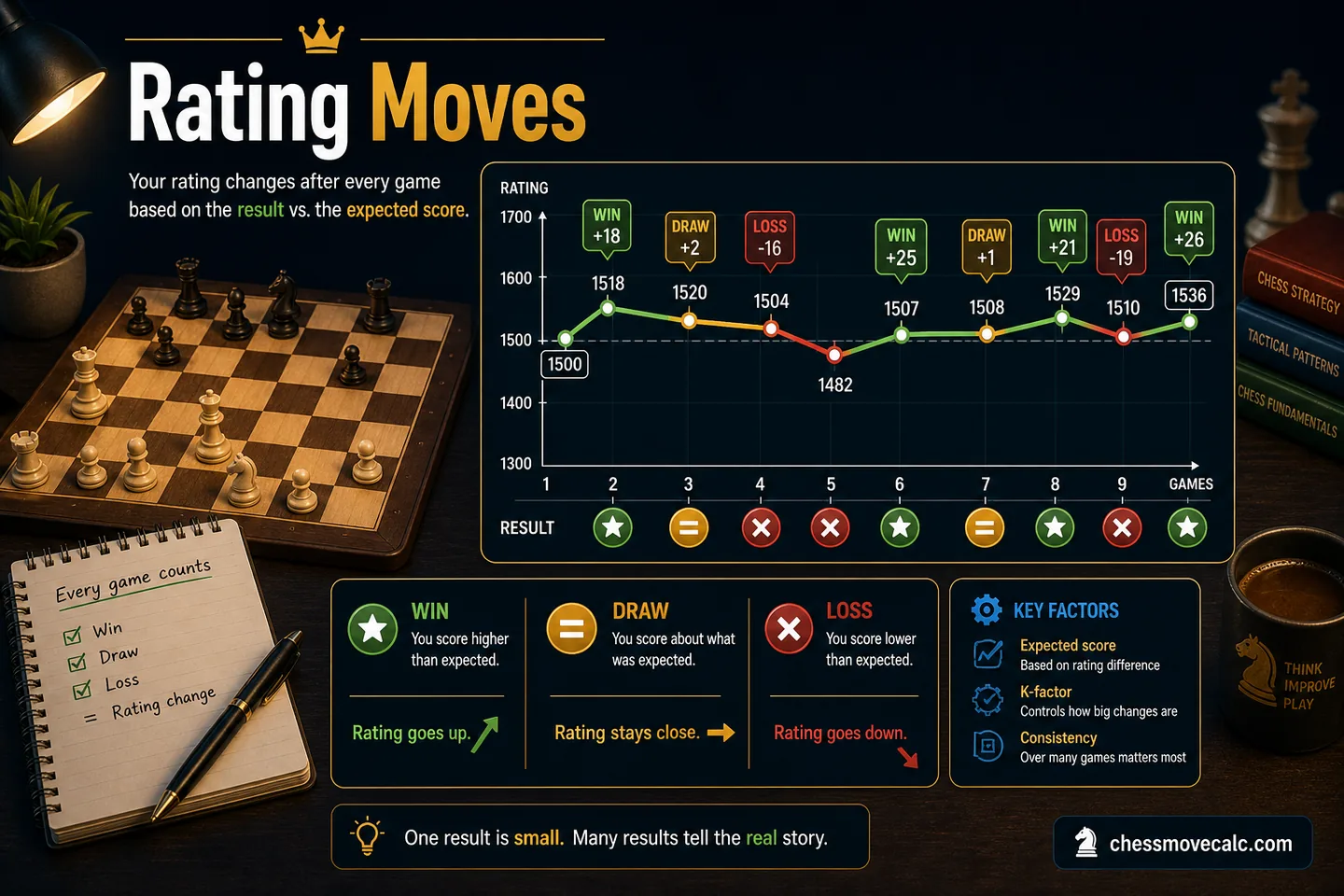
rating changes are not random because they follow a consistent reward-and-correction logic.
Why your rating goes up and down
The system gives more credit when you outperform expectation and removes more points when you underperform expectation. Beating a stronger player usually gains more than beating a weaker player. Drawing a stronger player can still be a positive result for your rating.
That is also where many players misread their own results. Losing to a weaker player can hurt more because the result was less expected. That is why the same scoreline can feel completely different depending on the opponent mix.
- Beating a stronger player usually gains more than beating a weaker player.
- Drawing a stronger player can still be a positive result for your rating.
- Losing to a weaker player can hurt more because the result was less expected.
- That is why the same scoreline can feel completely different depending on the opponent mix.
Use the result wisely
A good event is not only about wins. It is about how your results compared with the level of opposition.
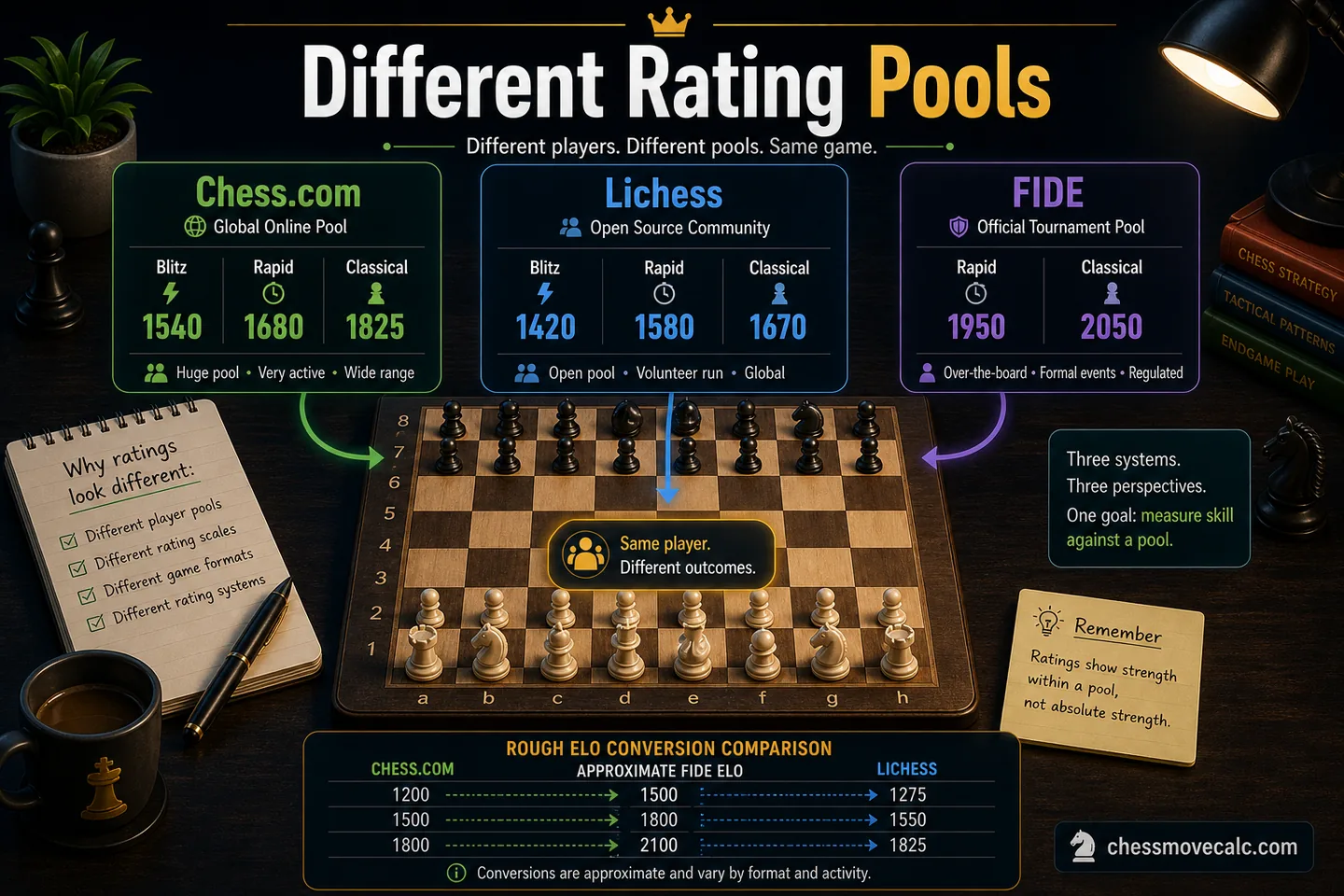
different platforms do not share one universal pool, which means the numbers are not interchangeable at face value.
Why Chess.com, Lichess, and FIDE can all look different
System design, player pool, time controls, and update rules all shape the number you see. Online pools include different habits, different time controls, and different levels of volume. FIDE ratings come from official over-the-board competition rather than the broader online environment.
That is also where many players misread their own results. That means the same player can look stronger or weaker depending on where the games were played. The number is still useful inside its own pool even when cross-platform comparisons need caution.
A practical way to use this section is to translate the idea into decisions you can actually make during study and rating review, instead of treating the number as a mysterious label. For the direct comparison angle, continue into the platform comparison guide.
- Online pools include different habits, different time controls, and different levels of volume.
- FIDE ratings come from official over-the-board competition rather than the broader online environment.
- That means the same player can look stronger or weaker depending on where the games were played.
- The number is still useful inside its own pool even when cross-platform comparisons need caution.
Avoid exact conversion claims
Treat cross-platform comparisons as ranges and tendencies, not as perfect one-number translations.
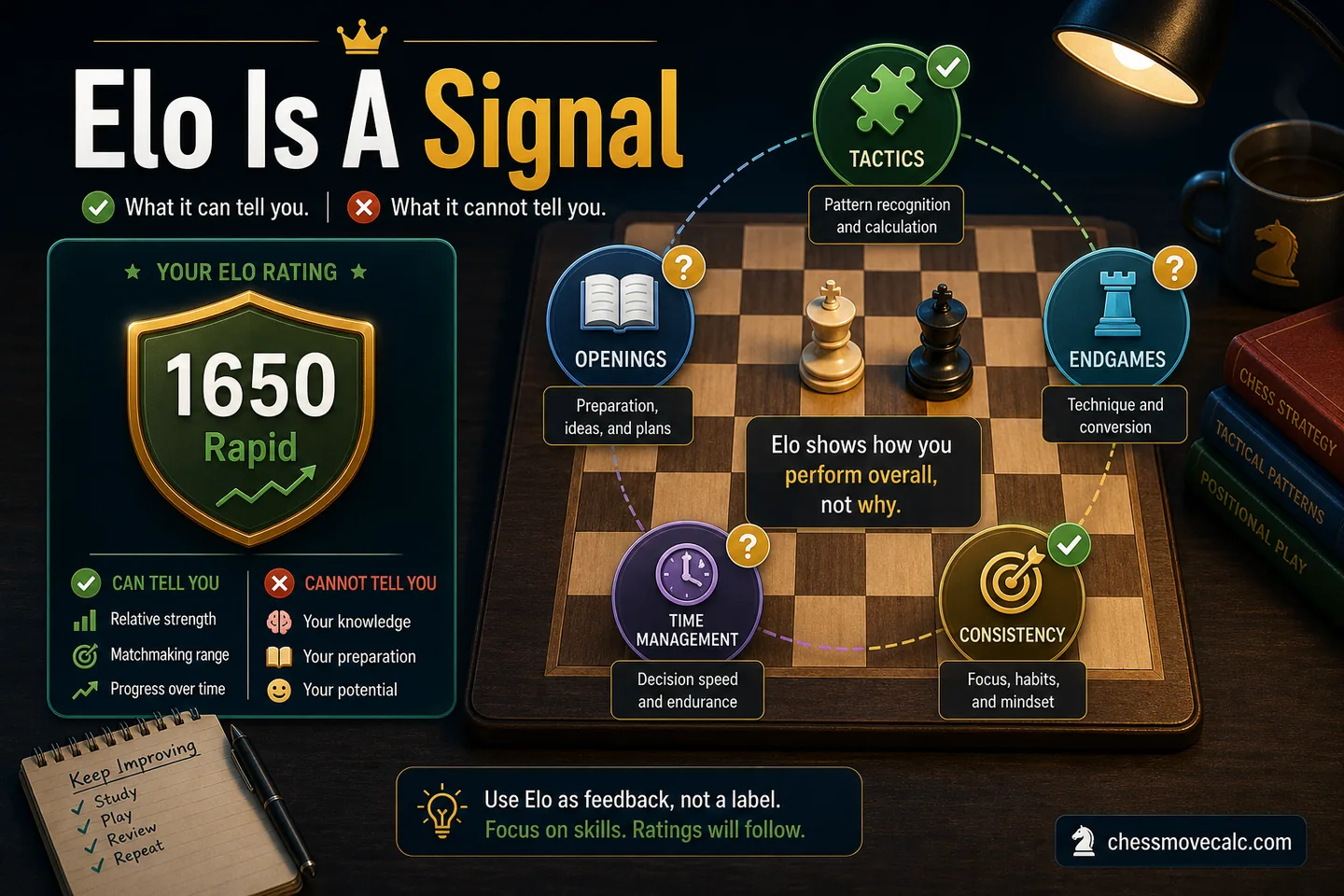
ratings are helpful, but they are not a complete description of your chess skill.
What Elo can and cannot tell you
They tell you something real about results, while still missing style, nerves, opening taste, and growth speed. A rating can summarize scoring strength inside one environment reasonably well. It cannot tell you whether your endgames, tactics, or practical nerves are better than your peers.
That is also where many players misread their own results. It also cannot capture how fast you are improving if the sample size is still small. That is why strong improvement plans track rating alongside game review, blunders, and decision quality.
- A rating can summarize scoring strength inside one environment reasonably well.
- It cannot tell you whether your endgames, tactics, or practical nerves are better than your peers.
- It also cannot capture how fast you are improving if the sample size is still small.
- That is why strong improvement plans track rating alongside game review, blunders, and decision quality.
Use rating in context
Ratings are useful dashboards, but they work best when paired with honest analysis habits.
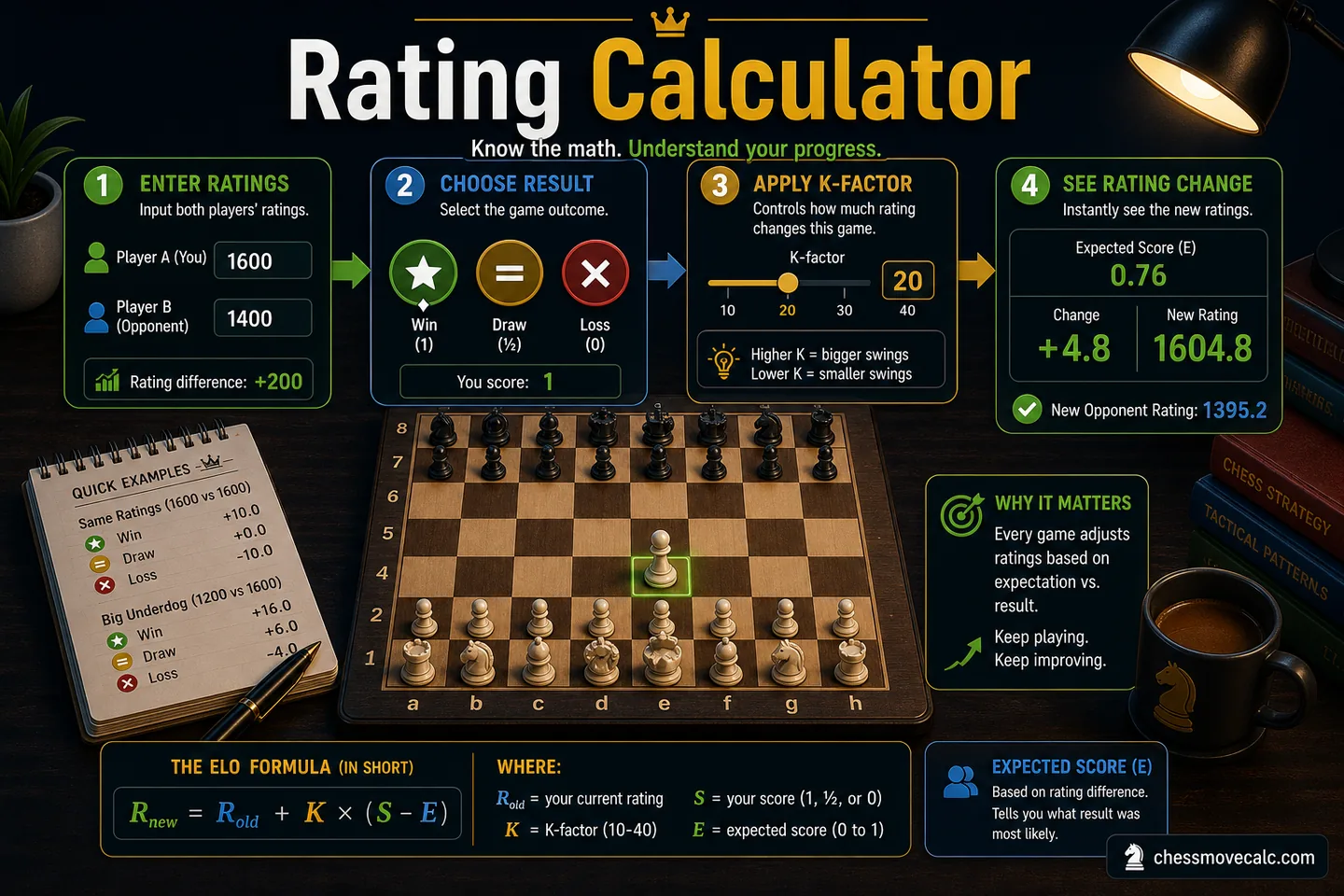
calculators are most useful when they set expectations instead of replacing understanding.
When and how to use a rating calculator
The best time to use one is before or after an event when you want a rough sense of likely movement. Use calculators to estimate possible outcomes against different opponent levels. Use them after a game or event to understand why the number changed the way it did.
That is also where many players misread their own results. Do not use them as proof that every platform or federation must behave identically. A calculator is strongest when it clarifies the model instead of feeding obsession over every single point.
- Use calculators to estimate possible outcomes against different opponent levels.
- Use them after a game or event to understand why the number changed the way it did.
- Do not use them as proof that every platform or federation must behave identically.
- A calculator is strongest when it clarifies the model instead of feeding obsession over every single point.
Best next step
Use the Elo Rating Calculator to test scenarios, then pair it with the gain-and-loss guide for deeper interpretation.
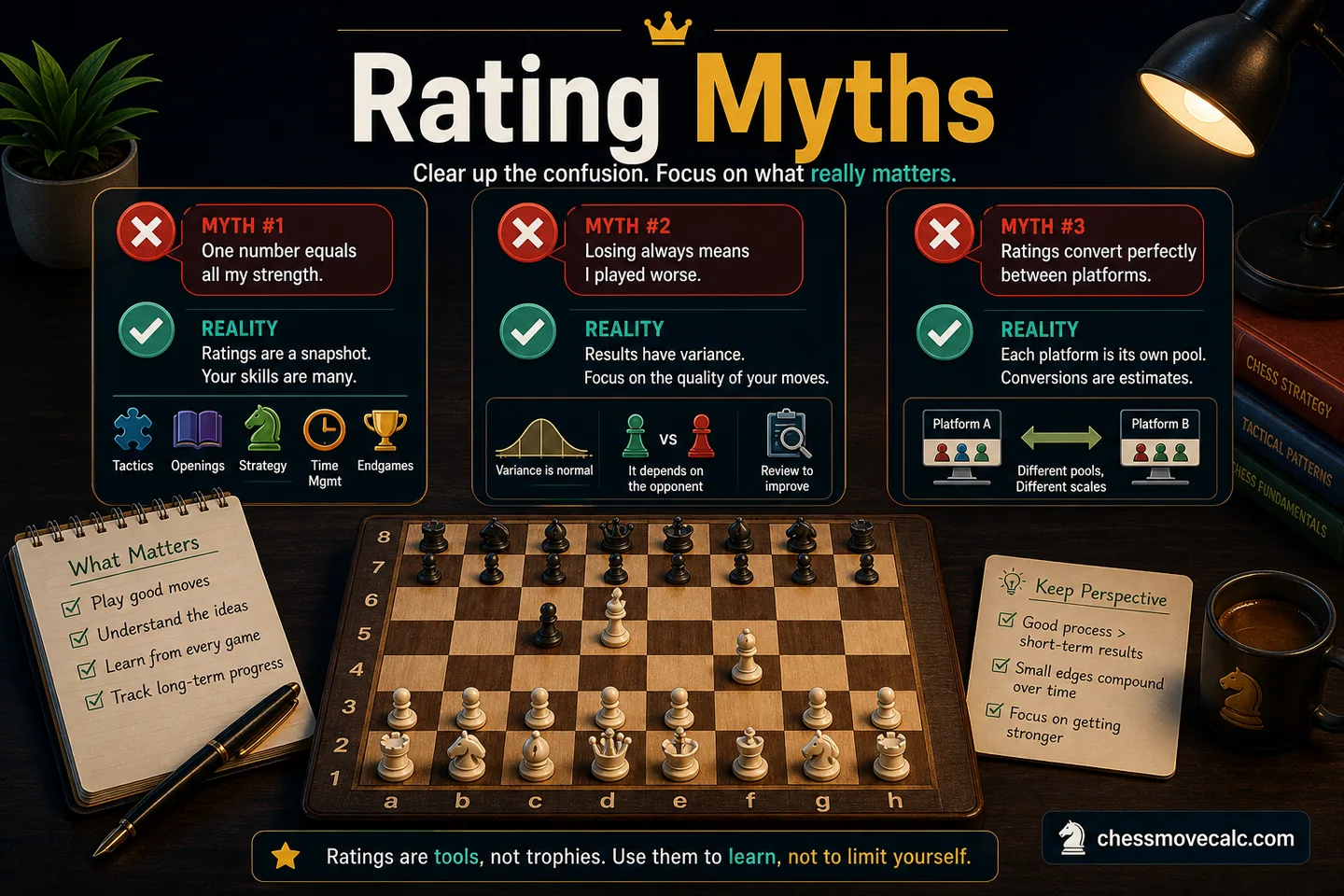
A lot of rating stress comes from myths, not from the rating system itself.
Rating myths that confuse players more than they help
Many players create unnecessary anxiety by expecting ratings to behave like report cards instead of like noisy long-term estimates. One bad event does not suddenly rewrite your true playing strength. A higher number on one platform does not automatically mean you are objectively stronger there in every sense; for practical benchmarks, see what counts as a good chess rating.
Rapid improvement can temporarily outrun the rating, which is why the number sometimes feels slow to react. Short streaks can also make players feel stronger or weaker than the long-term sample really suggests.
A stronger habit is to ask what decision this concept should improve the very next time it appears. The healthiest way to use rating is as feedback about trends, not as a daily identity crisis. When the myths fade, the calculator and the comparison guides become much easier to use calmly.
That bridge is often the missing ingredient between reading an article once and truly keeping the lesson when the position becomes real.
- One bad event does not suddenly rewrite your true playing strength.
- A higher number on one platform does not automatically mean you are objectively stronger there in every sense.
- Rapid improvement can temporarily outrun the rating, which is why the number sometimes feels slow to react.
- Short streaks can also make players feel stronger or weaker than the long-term sample really suggests.
- The healthiest way to use rating is as feedback about trends, not as a daily identity crisis.
- When the myths fade, the calculator and the comparison guides become much easier to use calmly.
Practical takeaway
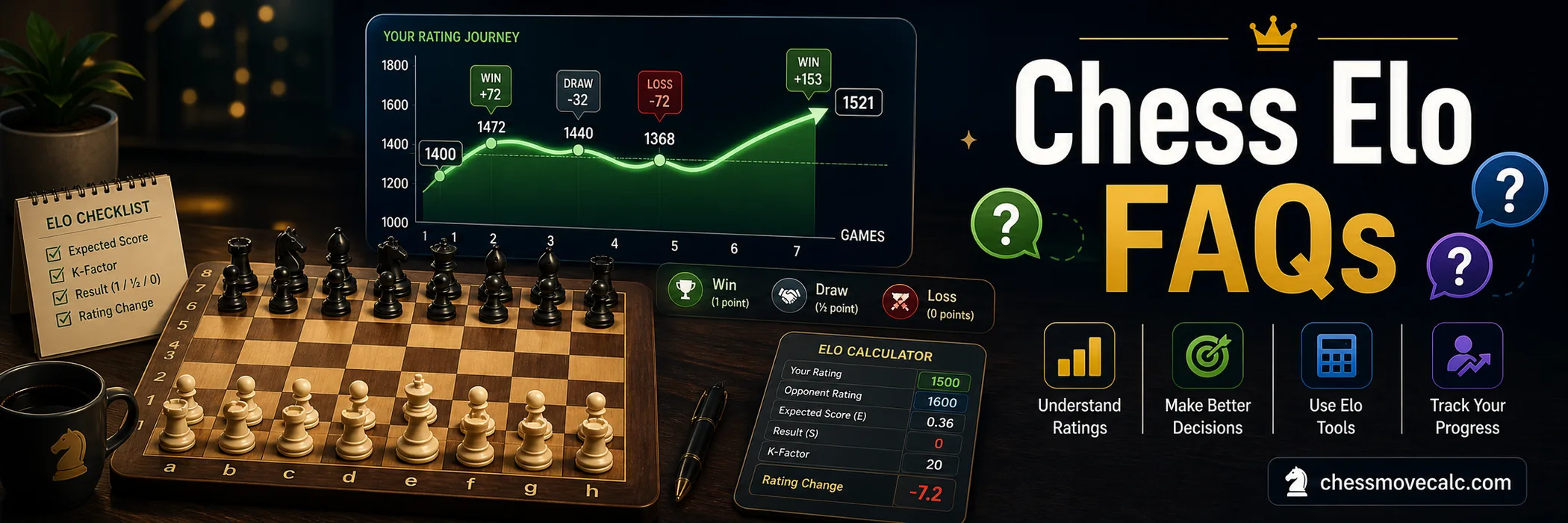
Chess Elo Explained: How Ratings Actually Work FAQs
What does Elo mean in chess?
It is a rating method that estimates expected scoring strength between players.
Why do I gain more points against stronger players?
Because outperforming expectation is rewarded more than producing an expected result.
Is online rating the same as FIDE rating?
No. They use different pools and update systems, so the same player can have different numbers.
What is expected score?
Expected score is the result the rating system predicts before the game based on the rating gap.
Can Elo measure my true strength perfectly?
No. It is useful, but it is still only one model of performance over time.
Should I compare ratings across sites directly?
Only carefully. It is better to compare broad ranges and the same time controls than to assume exact conversion.
Check your rating scenarios with the calculator
Use the calculator to model results, then use the guides in this cluster to understand what the numbers really mean.