The rule feels weird only until the timing window becomes clear
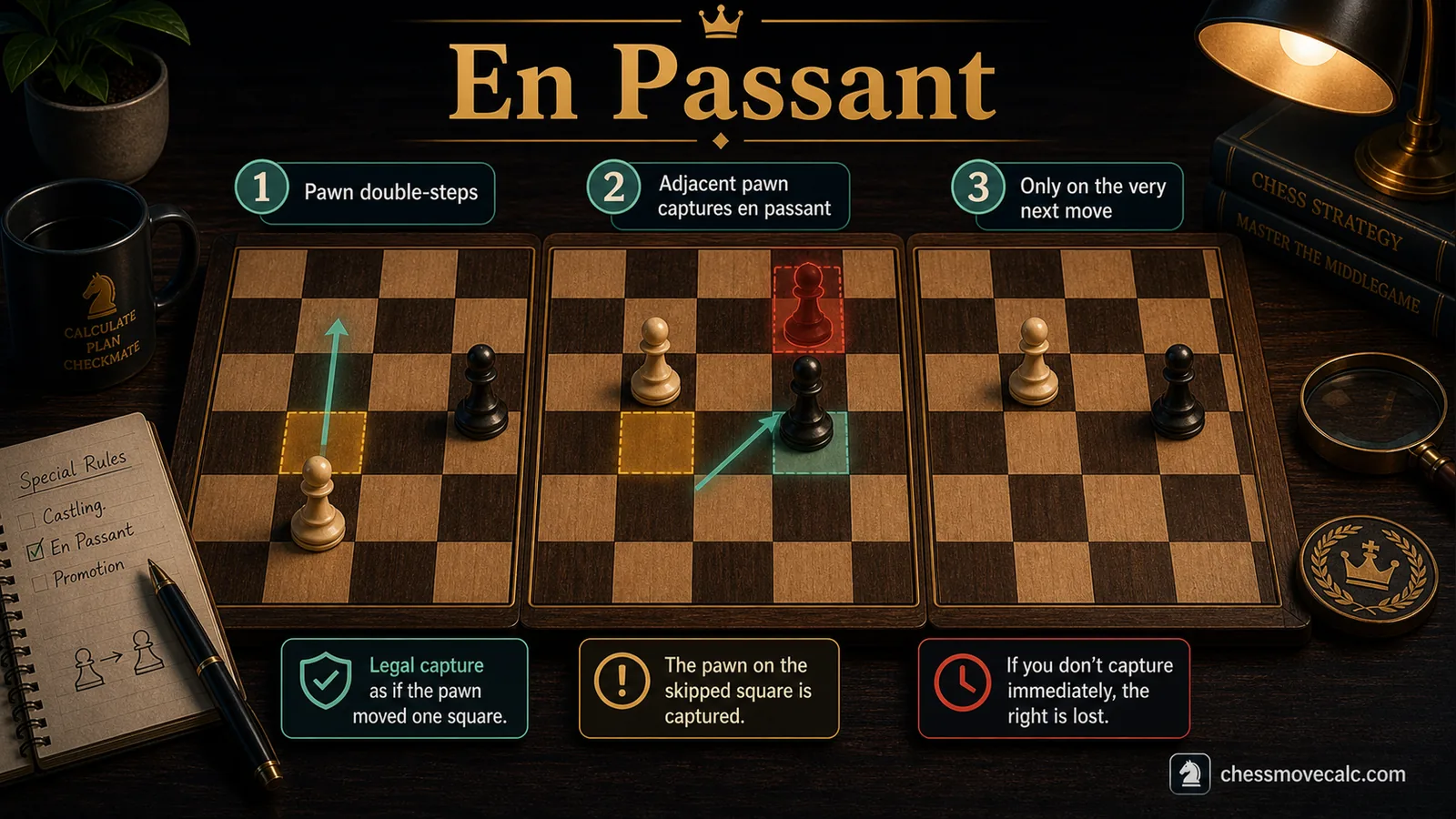
the rule is easier once you picture it as a special pawn capture triggered by a two-square advance.
En passant has a reputation for being complicated, but the real issue is usually not the move itself. It is the timing. If that timing window is fuzzy, the rule keeps feeling magical or arbitrary. If the timing window is clear, the rule becomes much easier to remember.
That is why this page focuses on clarity over jargon. It pairs naturally with pawn movement basics and with FEN workflows, because en passant also affects exact position state.
A strong guide should explain what the move is, the exact legal conditions, why the rule exists, how it appears in notation and FEN, and what makes delayed attempts illegal. Many pages cover only half of that.
Once those layers connect, en passant stops being the strange exception you vaguely remember and becomes a rule you can actually use and recognize.
That matters for real games, puzzles, and board validation alike.
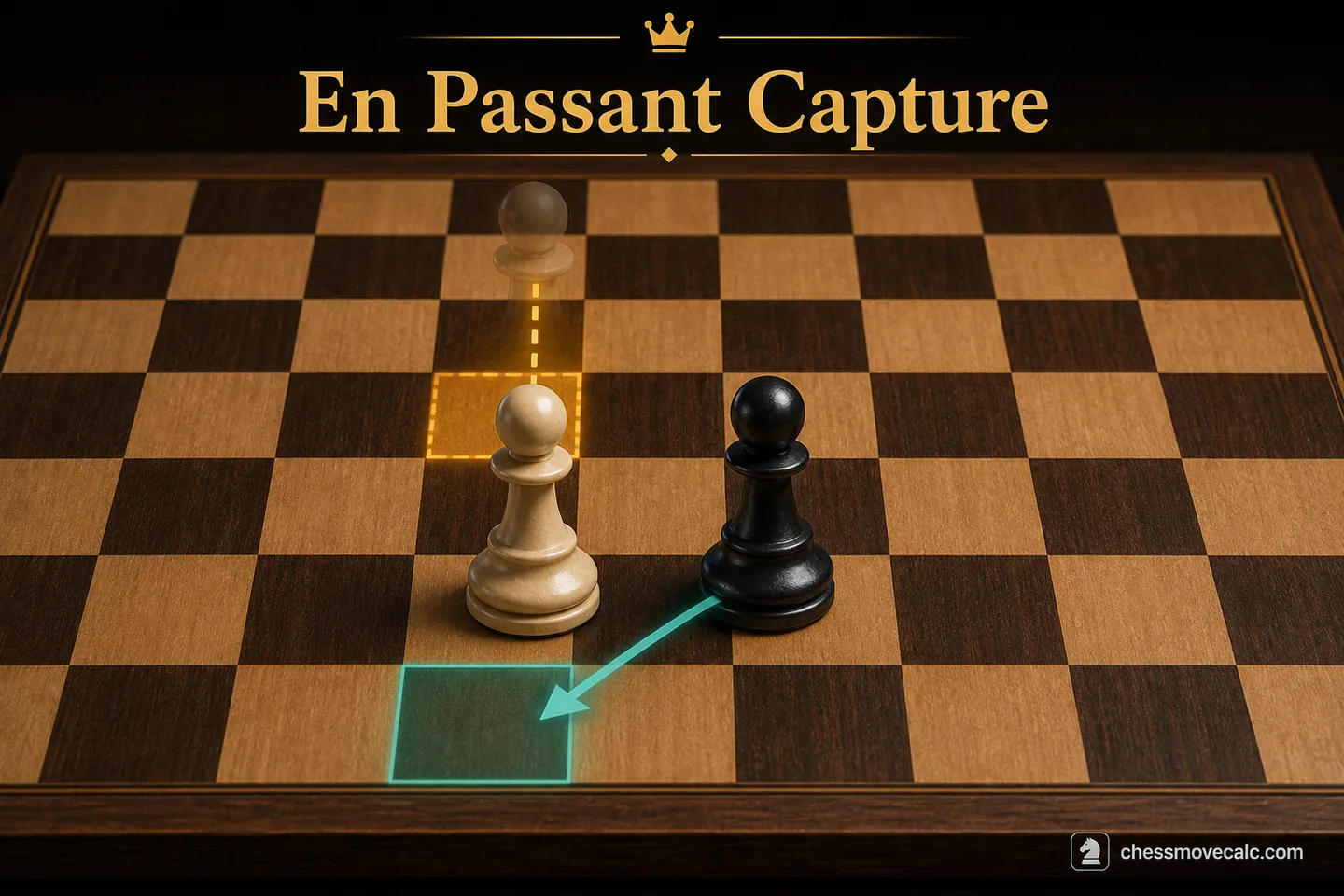
What en passant actually is
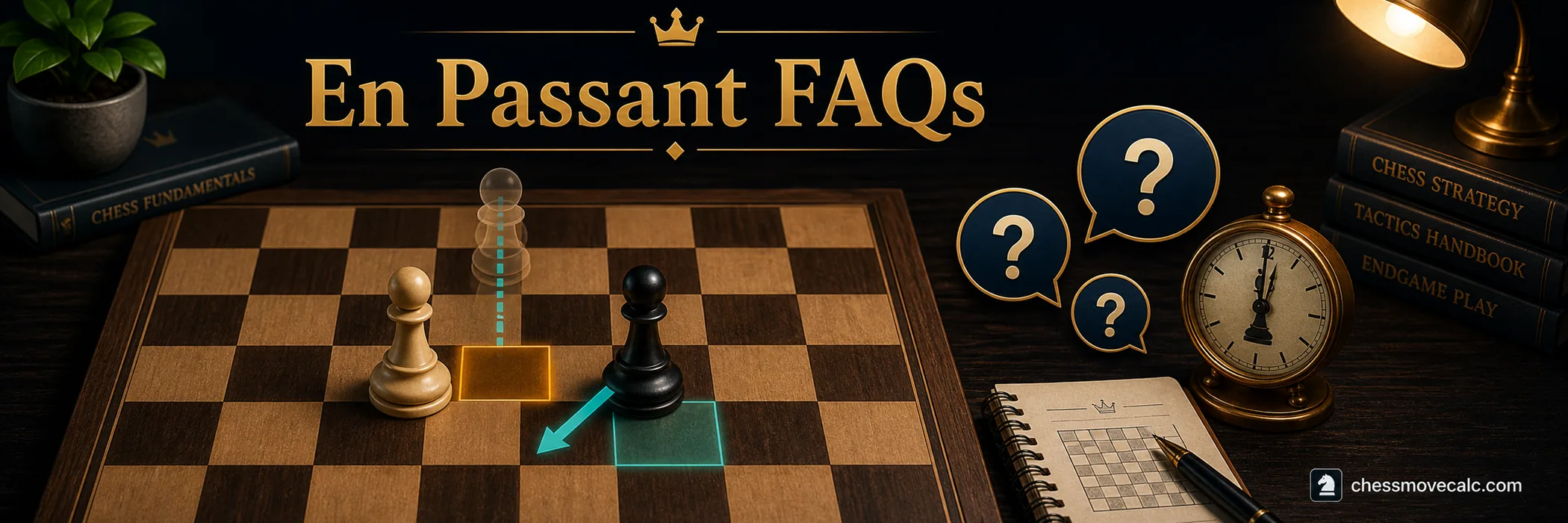
One pawn jumps two squares from its starting rank and an adjacent enemy pawn may capture it as if it moved only one. Only pawns can perform or suffer this capture. The capturing pawn moves diagonally, just like an ordinary pawn capture.
That is where many beginners either simplify too much or remember the rule in a half-correct way. What feels unusual is the square of the captured pawn, not the capture motion itself. That is why the concept becomes clearer when shown on a board instead of only in words.
The practical goal is to make the rule easy to use over a real board, not just easy to recite in isolation.
- Only pawns can perform or suffer this capture.
- The capturing pawn moves diagonally, just like an ordinary pawn capture.
- What feels unusual is the square of the captured pawn, not the capture motion itself.
- That is why the concept becomes clearer when shown on a board instead of only in words.
One-sentence version
En passant is an immediate pawn capture after an adjacent pawn makes a two-square move.
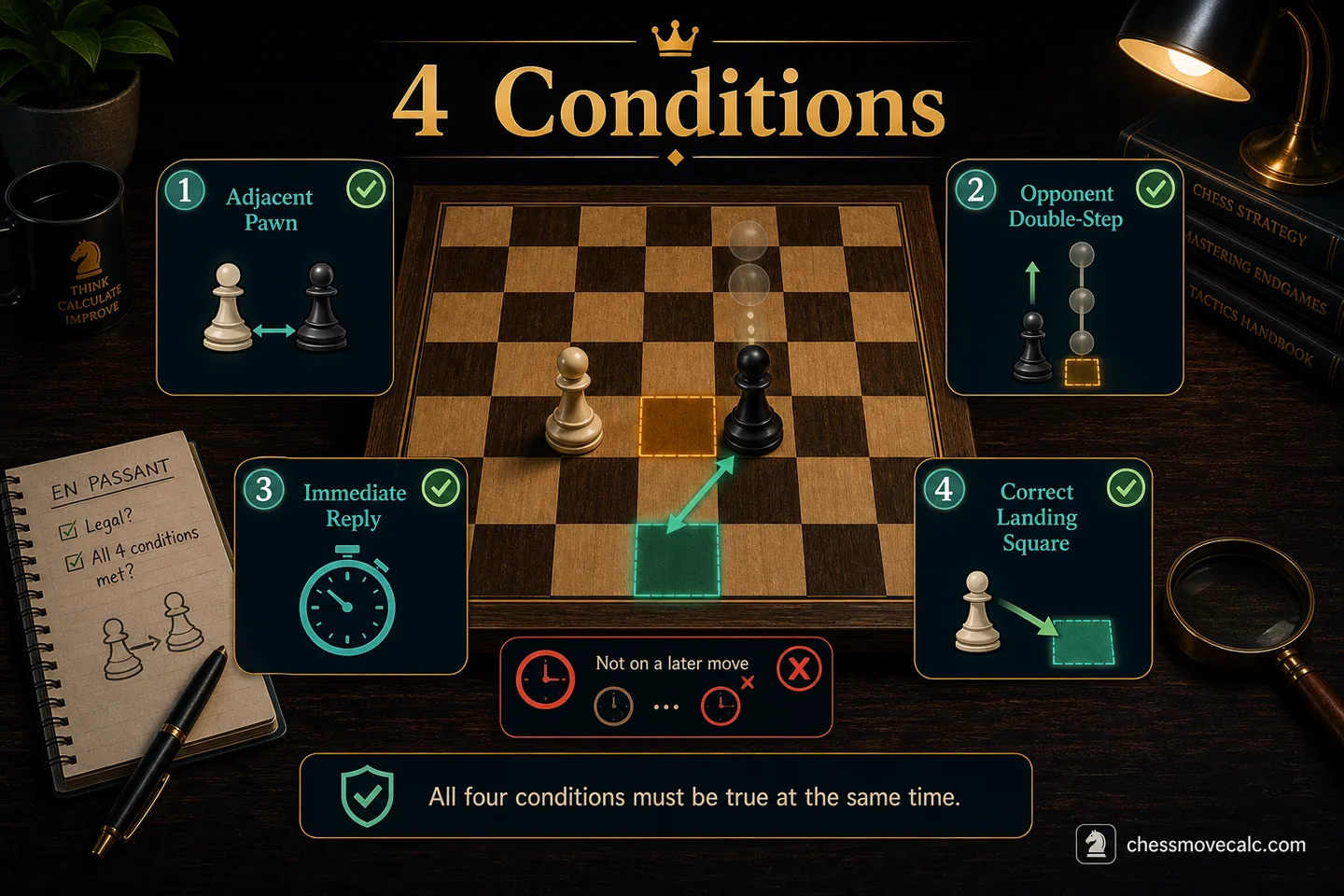
legality depends on a short checklist, and the timing item is the one most players miss.
The exact conditions for a legal en passant capture
The exact conditions for a legal en passant capture matters because the enemy pawn must just have moved two squares and the capture must happen immediately on the next move. The pawns must be adjacent after the double-step move. The capture must be available only because the pawn moved two squares in one turn.
That is where many beginners either simplify too much or remember the rule in a half-correct way. If you do not take the chance immediately, the right disappears. That one-move timing window is what makes legal and illegal examples so easy to separate.
- The pawns must be adjacent after the double-step move.
- The capture must be available only because the pawn moved two squares in one turn.
- If you do not take the chance immediately, the right disappears.
- That one-move timing window is what makes legal and illegal examples so easy to separate.
Main beginner error
If you wait a move, en passant is gone. The chance does not stay available later.
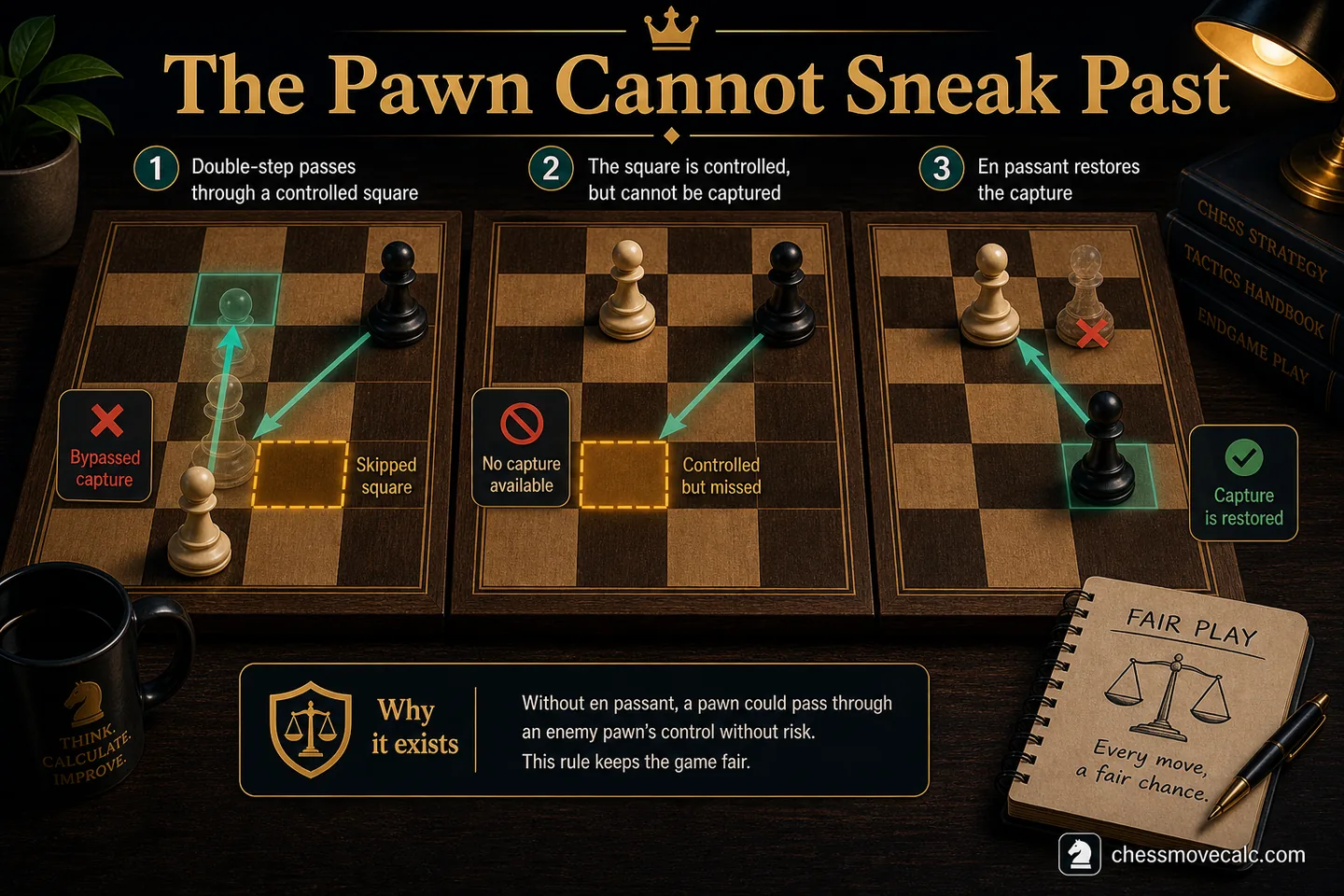
the rule exists to keep the double-step pawn move from creating a strange loophole.
Why the rule exists
Without en passant, a pawn could escape the influence of an adjacent enemy pawn in a way the one-square movement logic did not intend. The double-step move is a convenience rule that speeds up the opening phase. En passant preserves fairness by stopping that convenience from erasing adjacent pawn control completely.
That is where many beginners either simplify too much or remember the rule in a half-correct way. That historical reason makes the rule feel more logical and less random. The move is special, but the reason behind it is actually consistent.
- The double-step move is a convenience rule that speeds up the opening phase.
- En passant preserves fairness by stopping that convenience from erasing adjacent pawn control completely.
- That historical reason makes the rule feel more logical and less random.
- The move is special, but the reason behind it is actually consistent.
Better memory hook
Remember en passant as a fairness rule tied to the two-square opening move.
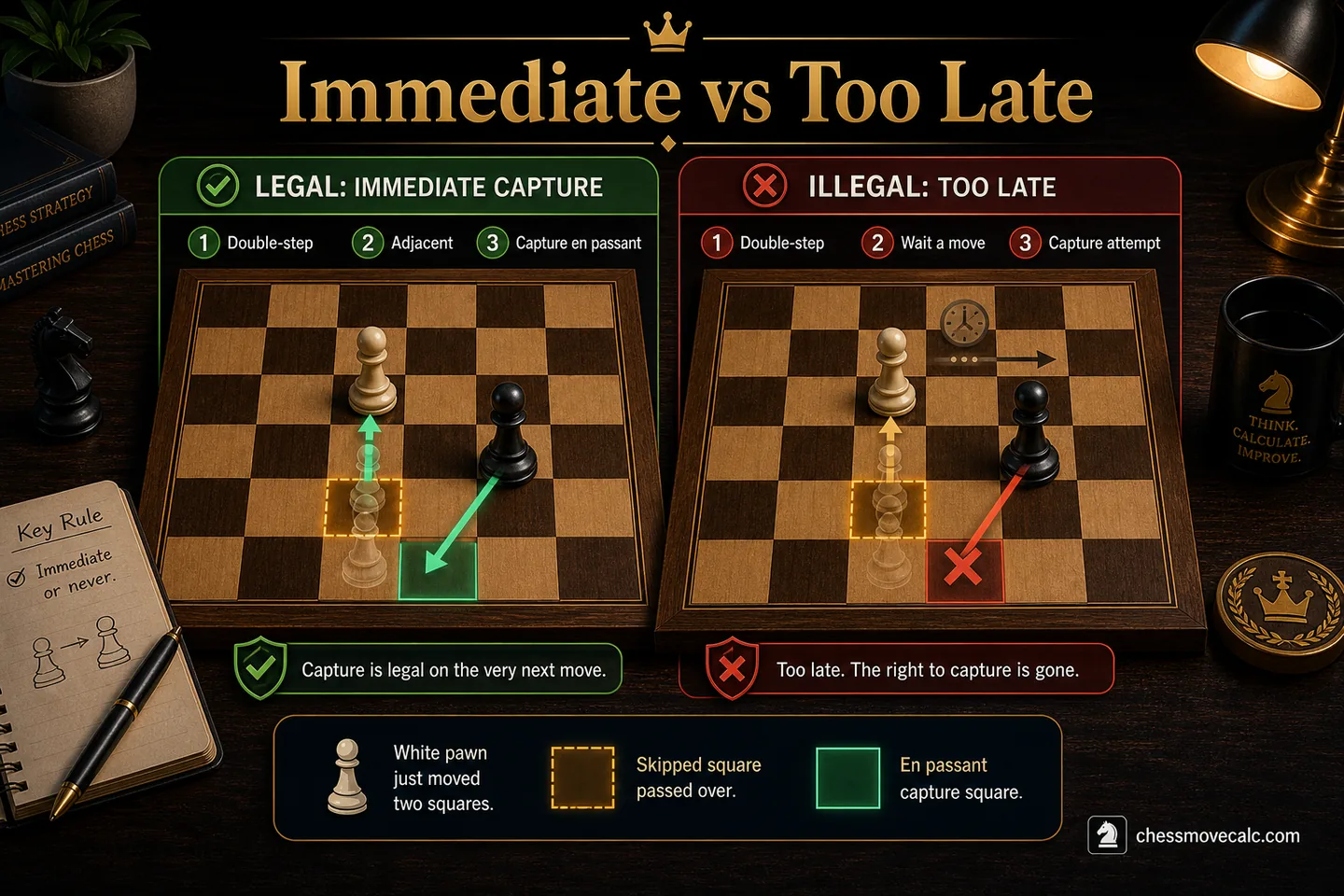
examples matter here because almost all confusion is really timing confusion.
Legal vs illegal en passant examples
Seeing the legal immediate reply next to the illegal delayed version makes the distinction stick quickly. A legal example happens right after the enemy pawn’s two-square jump. An illegal example tries to take en passant after another move has already happened.
That is where many beginners either simplify too much or remember the rule in a half-correct way. The board may look similar in both cases, but the timing history is different. That hidden history is why exact position state matters so much in rules and in FEN.
- A legal example happens right after the enemy pawn’s two-square jump.
- An illegal example tries to take en passant after another move has already happened.
- The board may look similar in both cases, but the timing history is different.
- That hidden history is why exact position state matters so much in rules and in FEN.
Fast legality test
Ask one question first: did the double-step just happen on the previous move?
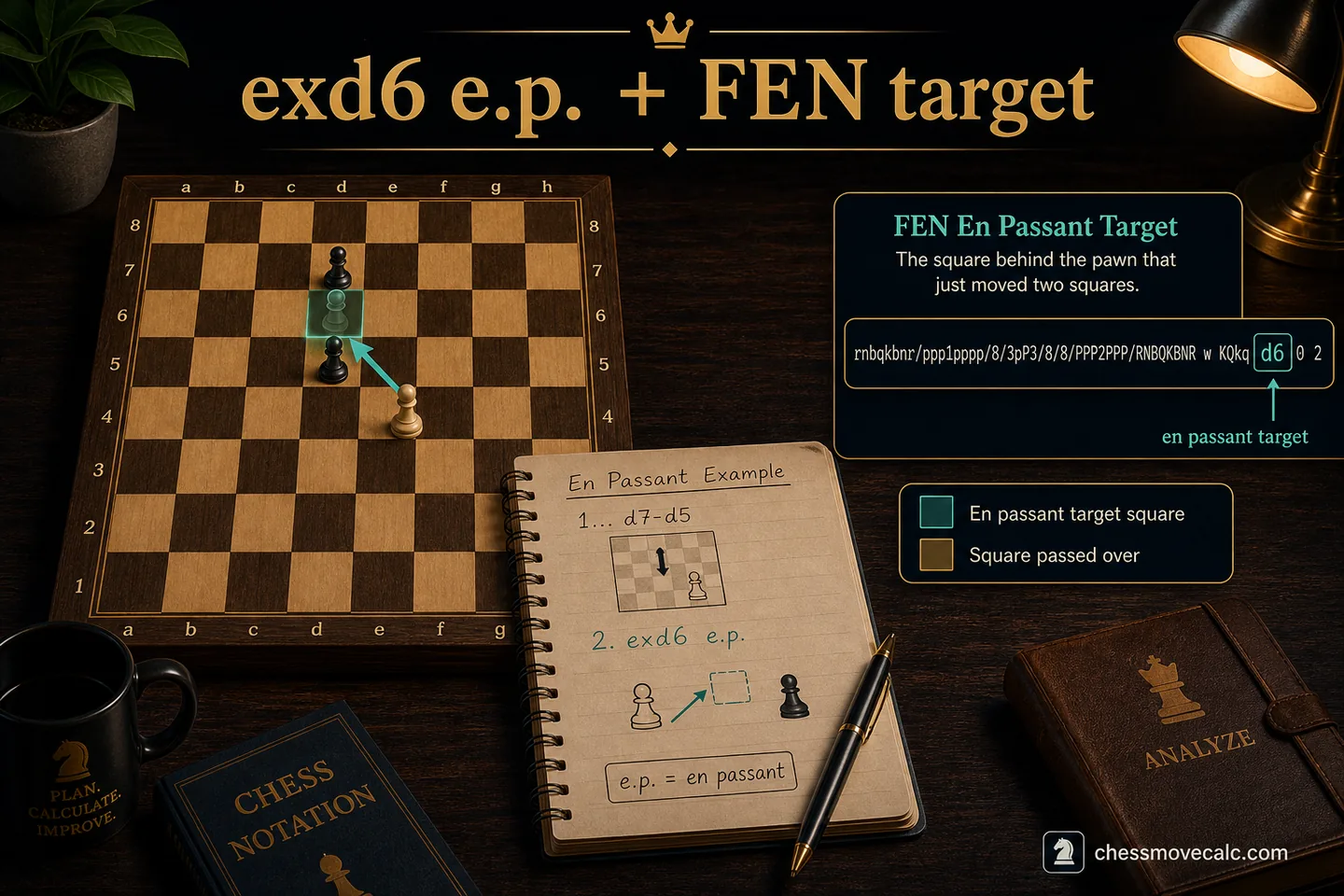
format knowledge matters because en passant is one of the best examples of why board state is more than piece placement alone.
En passant in notation and FEN
The rule can affect notation and also the en passant target field in a FEN string. A move list may annotate the special capture in ordinary pawn-capture style or with extra explanation in teaching material. A FEN can include an en passant target square because the position must remember whether the immediate chance exists.
That is where many beginners either simplify too much or remember the rule in a half-correct way. That is why badly built FEN positions can misrepresent legal options even when the pieces look correct. Rules knowledge and format knowledge reinforce each other strongly on this topic.
- A move list may annotate the special capture in ordinary pawn-capture style or with extra explanation in teaching material.
- A FEN can include an en passant target square because the position must remember whether the immediate chance exists.
- That is why badly built FEN positions can misrepresent legal options even when the pieces look correct.
- Rules knowledge and format knowledge reinforce each other strongly on this topic.
Best companion read
Pair this page with the FEN guide if you want to see why state details matter so much.
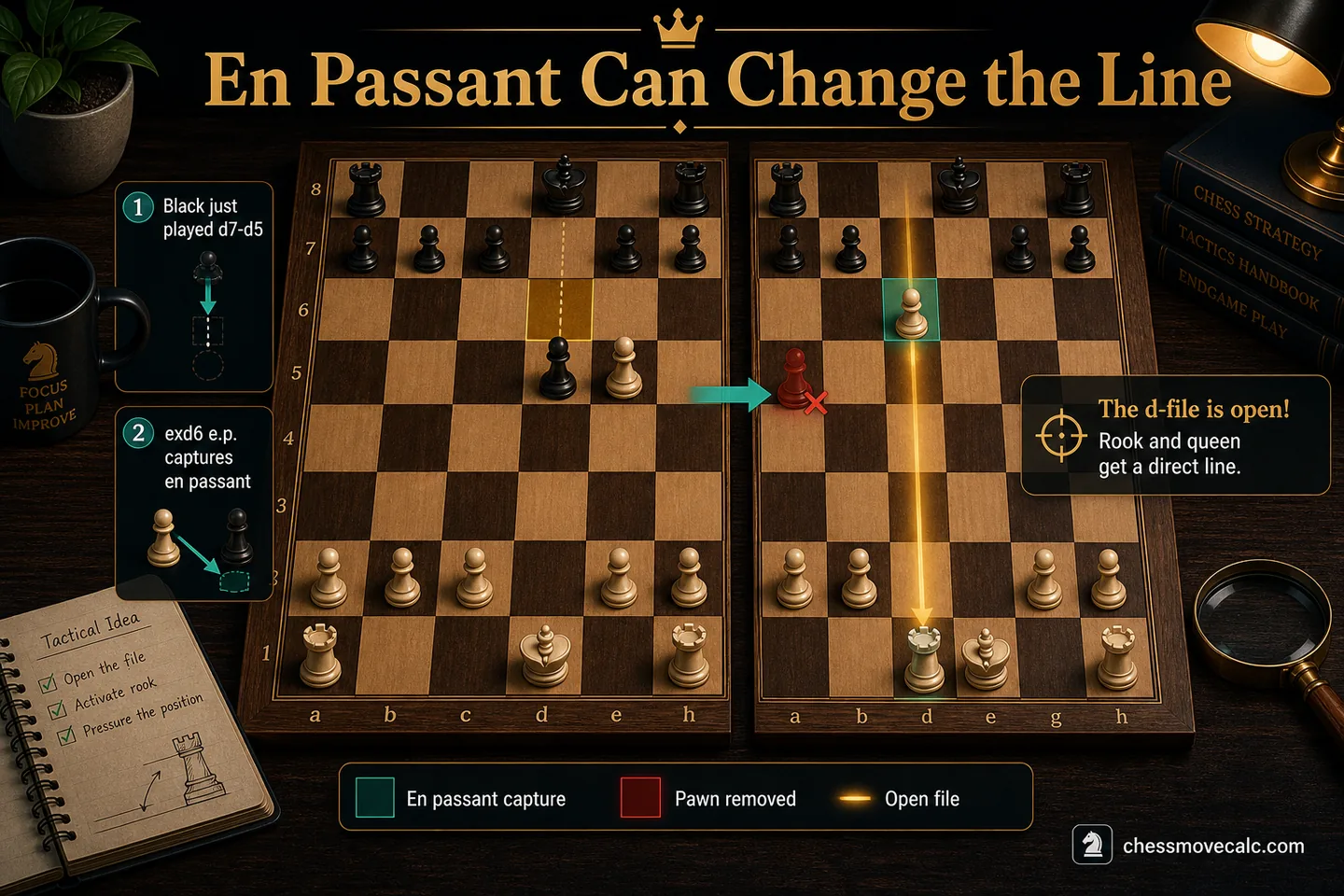
en passant is not only a rules quiz; it can matter tactically when files, diagonals, or move order change.
Tactical uses of en passant
The capture can open lines, change pawn structure, or remove a key blocker at the right moment. Some puzzles use en passant to surprise players who remember the shape but forget the timing. The move can also alter file control in practical middlegames and endgames.
That is where many beginners either simplify too much or remember the rule in a half-correct way. That makes it worth learning as a useful tactical possibility, not only as trivia. A rule becomes easier to remember when you see that it can actually matter over the board.
- Some puzzles use en passant to surprise players who remember the shape but forget the timing.
- The move can also alter file control in practical middlegames and endgames.
- That makes it worth learning as a useful tactical possibility, not only as trivia.
- A rule becomes easier to remember when you see that it can actually matter over the board.
Why puzzles help
Tactical examples make unusual rules feel more memorable because they attach them to a consequence.
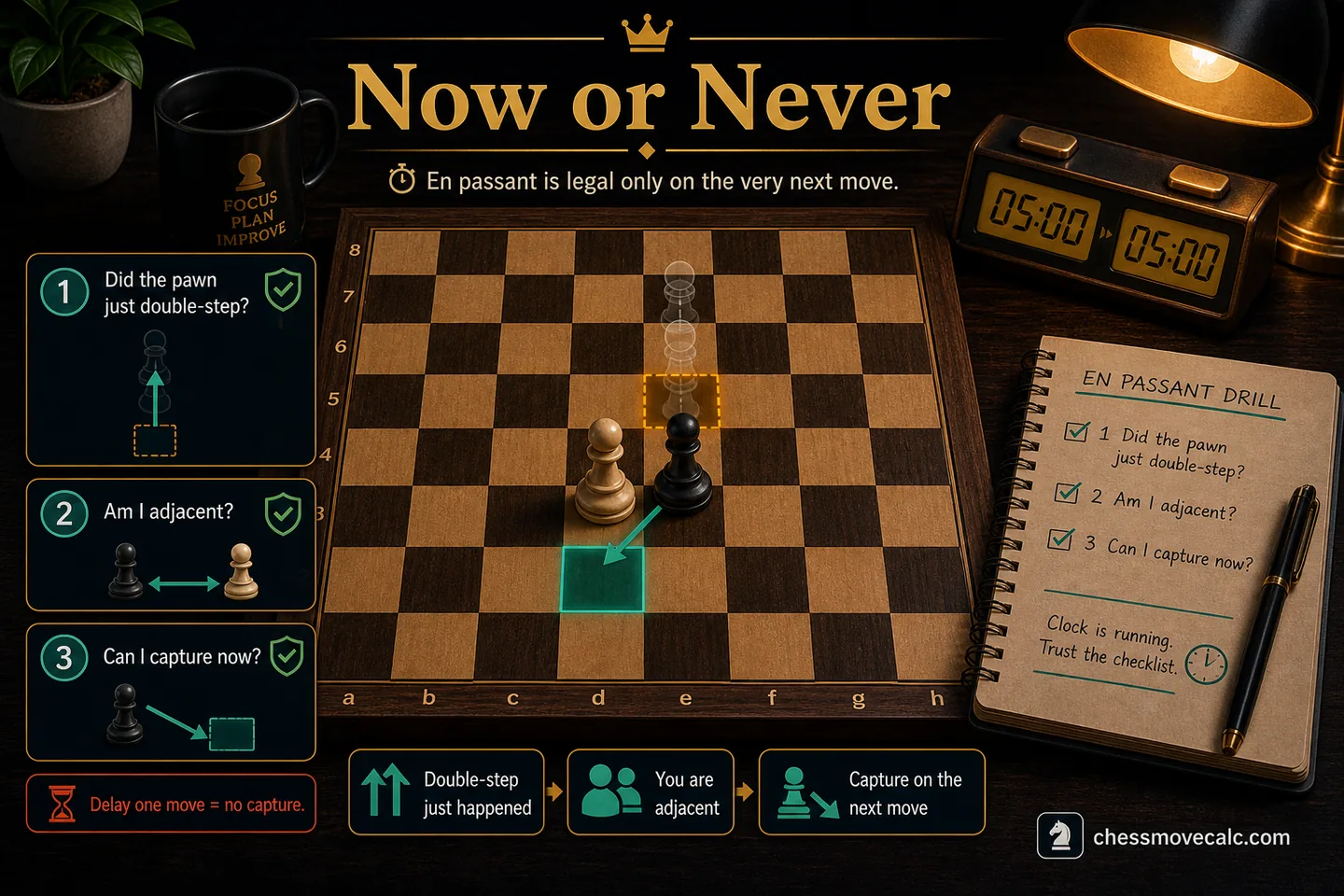
En passant is much easier once the one-move timing window becomes something you actively rehearse.
Timing drills that make en passant stop feeling mysterious
This rule sticks faster when you practice the timing question directly instead of only rereading the definition. After every two-square pawn move in training, ask whether an adjacent enemy pawn now has the right. Practice one legal and one illegal example side by side so the timing contrast becomes vivid.
Tie the move to FEN awareness so you remember that exact state matters too. Use puzzle-like examples to feel why the capture can matter tactically.
A stronger habit is to ask what decision this concept should improve the very next time it appears. A rule that once felt weird often becomes memorable after just a few good timing reps. That is because the mystery was never the move itself; it was the disappearing opportunity.
That bridge is often the missing ingredient between reading an article once and truly keeping the lesson when the position becomes real.
- After every two-square pawn move in training, ask whether an adjacent enemy pawn now has the right.
- Practice one legal and one illegal example side by side so the timing contrast becomes vivid.
- Tie the move to FEN awareness so you remember that exact state matters too.
- Use puzzle-like examples to feel why the capture can matter tactically.
- A rule that once felt weird often becomes memorable after just a few good timing reps.
- That is because the mystery was never the move itself; it was the disappearing opportunity.
Practical takeaway
En Passant Explained FAQs
What does en passant mean in chess?
It is a special pawn capture that can happen immediately after an adjacent pawn makes a two-square move.
When is en passant legal?
It is legal only right after the enemy pawn’s double-step move and only if the capture conditions are met.
Can you play en passant later if you miss the chance?
No. If you do not play it immediately, the right disappears.
Why does the rule exist?
It prevents the double-step pawn move from bypassing adjacent pawn control unfairly.
How is en passant written in notation?
It is usually shown as a normal pawn capture, sometimes with extra explanation in teaching material.
Why does en passant matter in FEN?
Because FEN may need to record the en passant target square so the exact legal state is preserved.
Test exact pawn states with the converter and solver
Use real positions to check the timing window and see how en passant changes what the board actually allows.