Read a square, then make the move
From White’s side, a1 is the lower-left square and h1 is the lower-right square. The move e2e4 takes White’s e-pawn two squares forward. In standard algebraic notation that move is written e4, because the destination is sufficient.
Turning the board around does not rename its squares. From Black’s view the files appear in reverse order on screen, but e4 is still e4.
Load this exact position:
rnbqkbnr/pppppppp/8/8/8/8/PPPPPPPP/RNBQKBNR w KQkq - 0 1Coordinates are not trivia; they are the language layer that makes setup and notation usable
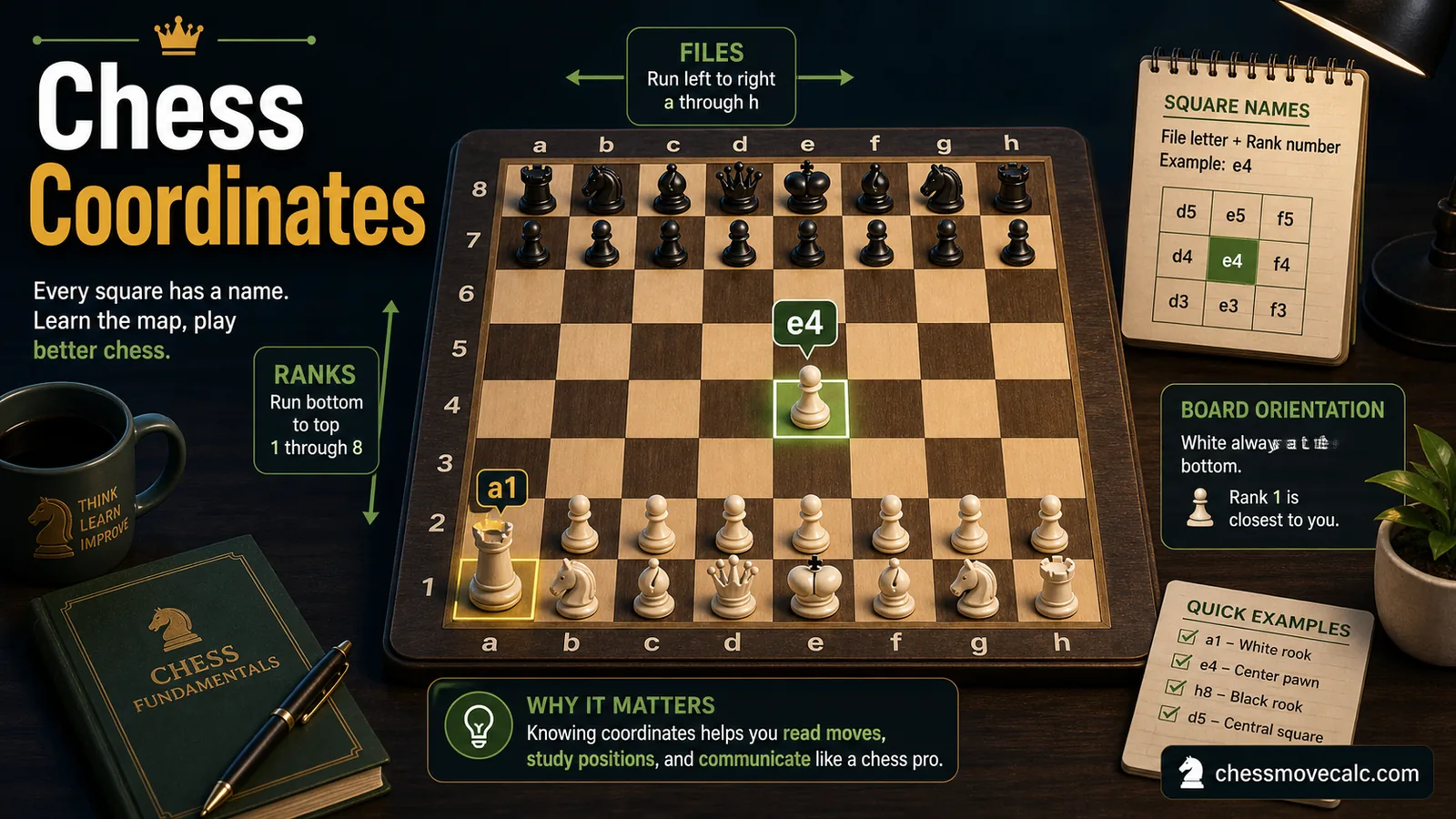
coordinates start with understanding that the board has two naming directions working together.
A lot of beginners meet coordinates too early and too abstractly. They hear files, ranks, and square names before those ideas are attached to real tasks. That makes the board feel like a grid quiz instead of a practical tool.
A better approach is to tie coordinates to things players already care about: where the queen starts, how notation names a move, how a teacher says “look at e4,” or how a position is loaded correctly.
That is why this page is more practical than a bare glossary. It links coordinates directly to setup, notation, and board awareness. It also pairs naturally with notation learning and queen placement.
Once square names feel normal, chess explanations speed up dramatically. Lessons become easier to follow. Move lists become less intimidating. Visualizing the board gets easier because each location actually means something to you.
That is the real purpose of coordinates: they make the board speak a consistent language.
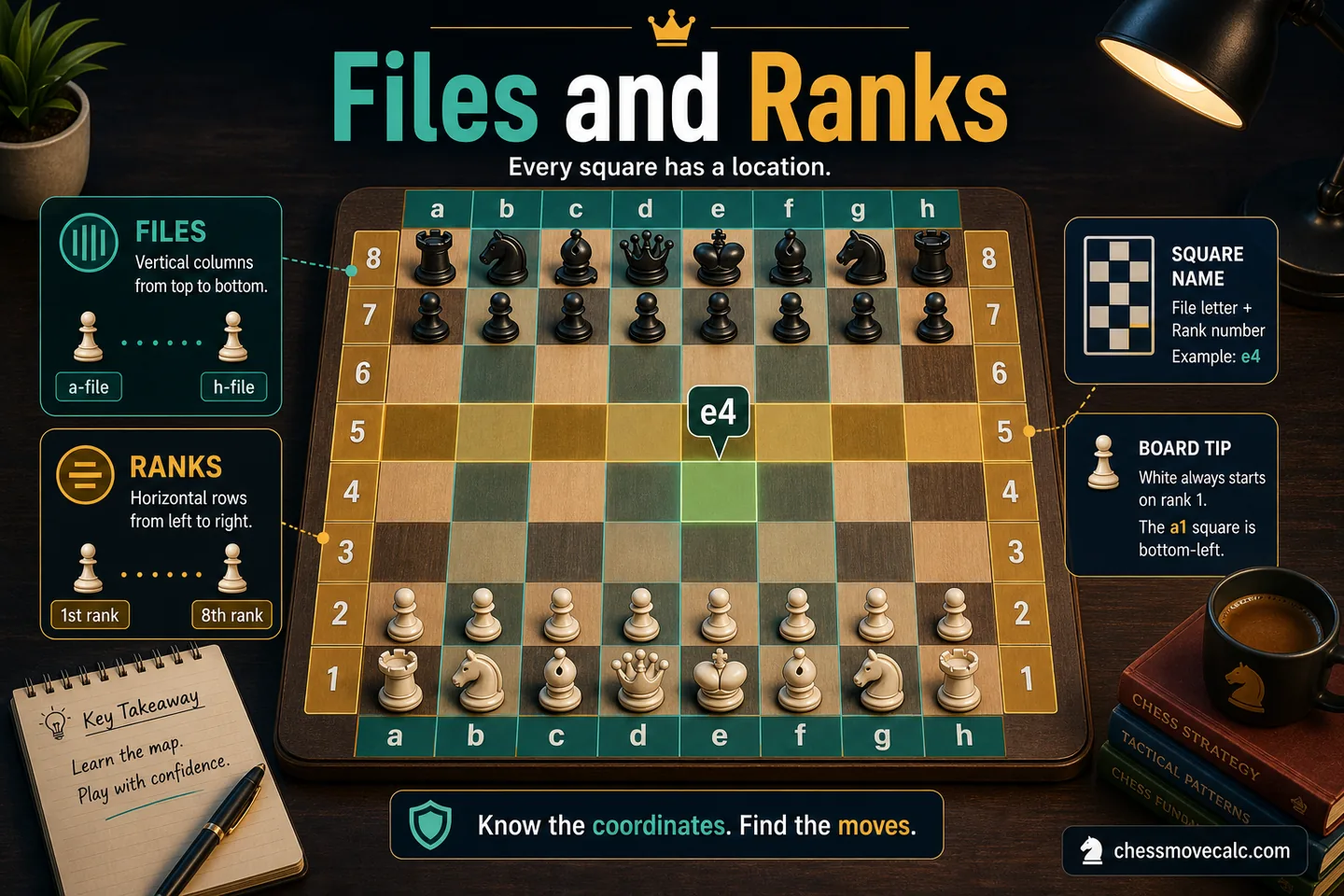
What files and ranks are
Files are the lettered columns and ranks are the numbered rows. Files run from a to h across the board. Ranks run from 1 to 8 as horizontal rows from White’s side upward.
That is where many beginners either simplify too much or remember the rule in a half-correct way. Once those two directions are stable, square naming becomes much less mysterious. Most confusion comes from reversing one of the directions mentally.
The practical goal is to make the rule easy to use over a real board, not just easy to recite in isolation.
- Files run from a to h across the board.
- Ranks run from 1 to 8 as horizontal rows from White’s side upward.
- Once those two directions are stable, square naming becomes much less mysterious.
- Most confusion comes from reversing one of the directions mentally.
Anchor the directions
Think letters across and numbers up. That quick phrase fixes a lot of early confusion.
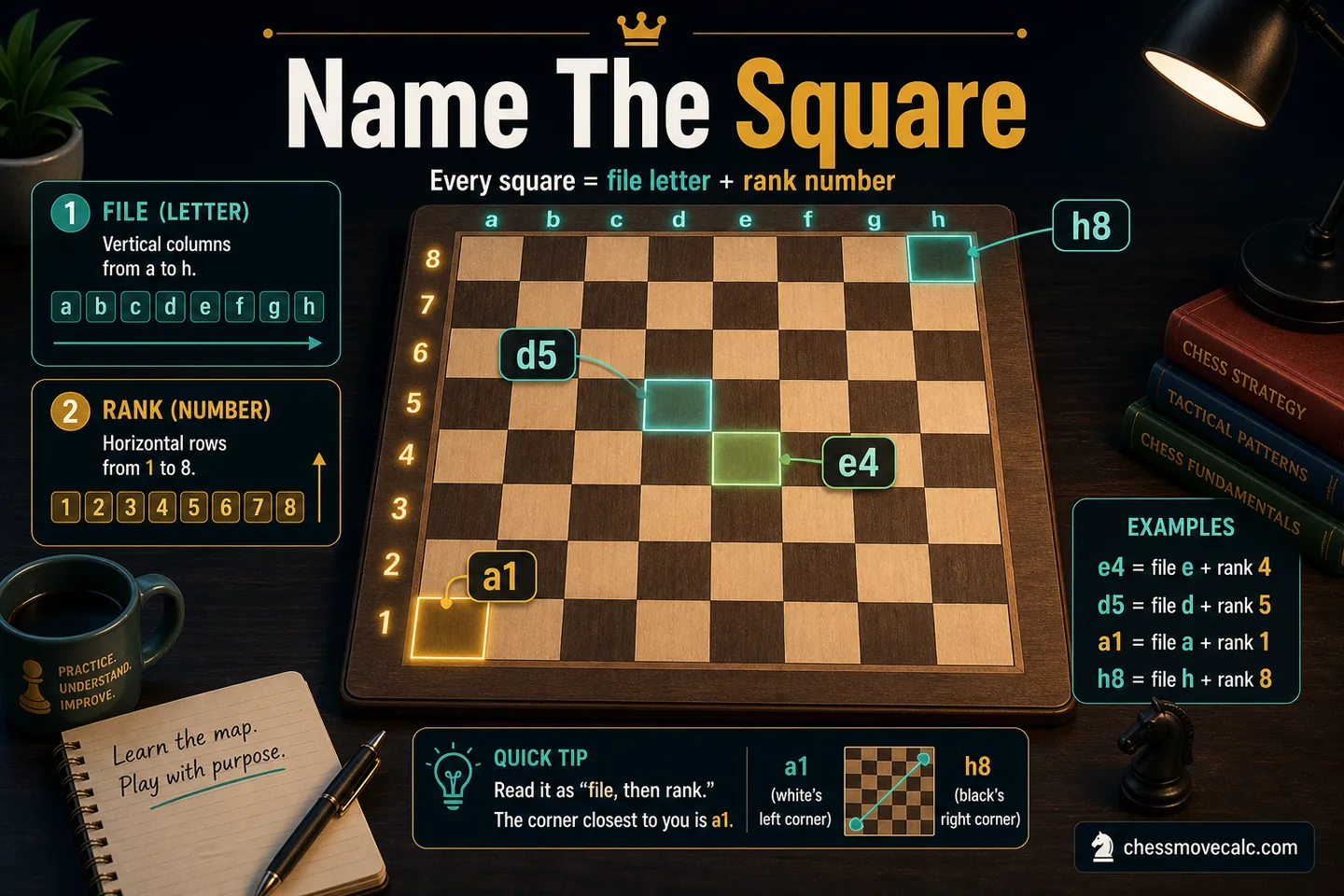
a square name is just the meeting point of one file and one rank.
How each square gets its name
That is why a1, e4, d1, h7, and h8 all follow the same tiny naming formula. Take the file letter first and the rank number second. That means e4 is the e-file and the fourth rank.
That is where many beginners either simplify too much or remember the rule in a half-correct way. Once you know the naming order, reading coordinates becomes much faster. The board stops feeling like 64 separate facts and starts feeling like one repeatable pattern.
- Take the file letter first and the rank number second.
- That means e4 is the e-file and the fourth rank.
- Once you know the naming order, reading coordinates becomes much faster.
- The board stops feeling like 64 separate facts and starts feeling like one repeatable pattern.
Small formula
Square name equals file plus rank. The order does not change.
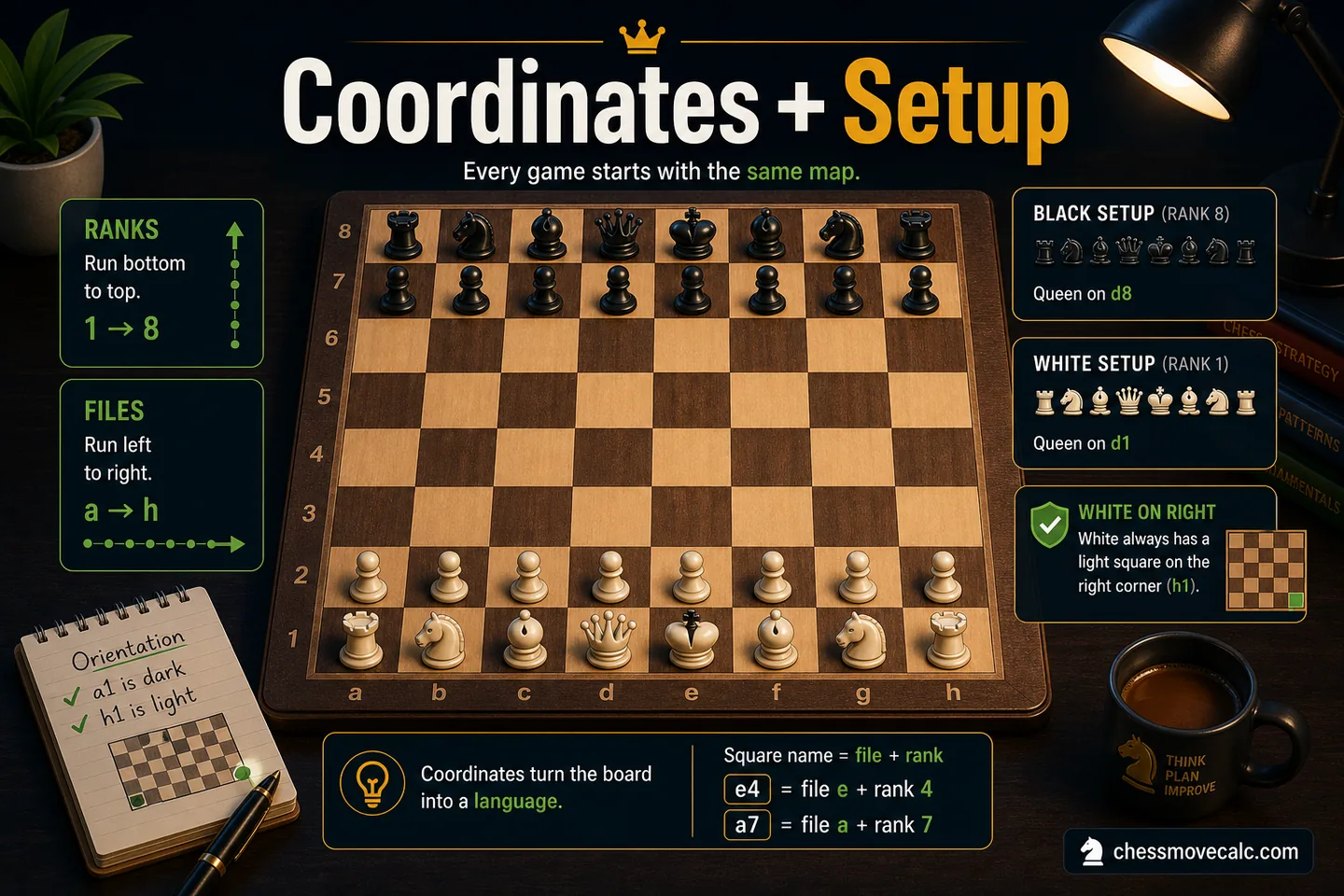
setup becomes easier when the center-piece squares are no longer vague spots in the middle.
How coordinates connect to setup
Coordinates let you name exactly where the kings and queens belong instead of relying only on memory slogans. White queen on d1 and white king on e1 become easier to remember once the board is named. Black queen on d8 and black king on e8 follow the same logic from the opposite side.
That is where many beginners either simplify too much or remember the rule in a half-correct way. That makes setup more reliable because you are using both color memory and coordinate memory together. When setup is tied to coordinates, notation learning also gets a head start.
- White queen on d1 and white king on e1 become easier to remember once the board is named.
- Black queen on d8 and black king on e8 follow the same logic from the opposite side.
- That makes setup more reliable because you are using both color memory and coordinate memory together.
- When setup is tied to coordinates, notation learning also gets a head start.
Pair the systems
Use coordinates with the queen-on-color rule so the setup becomes both visual and verbal.
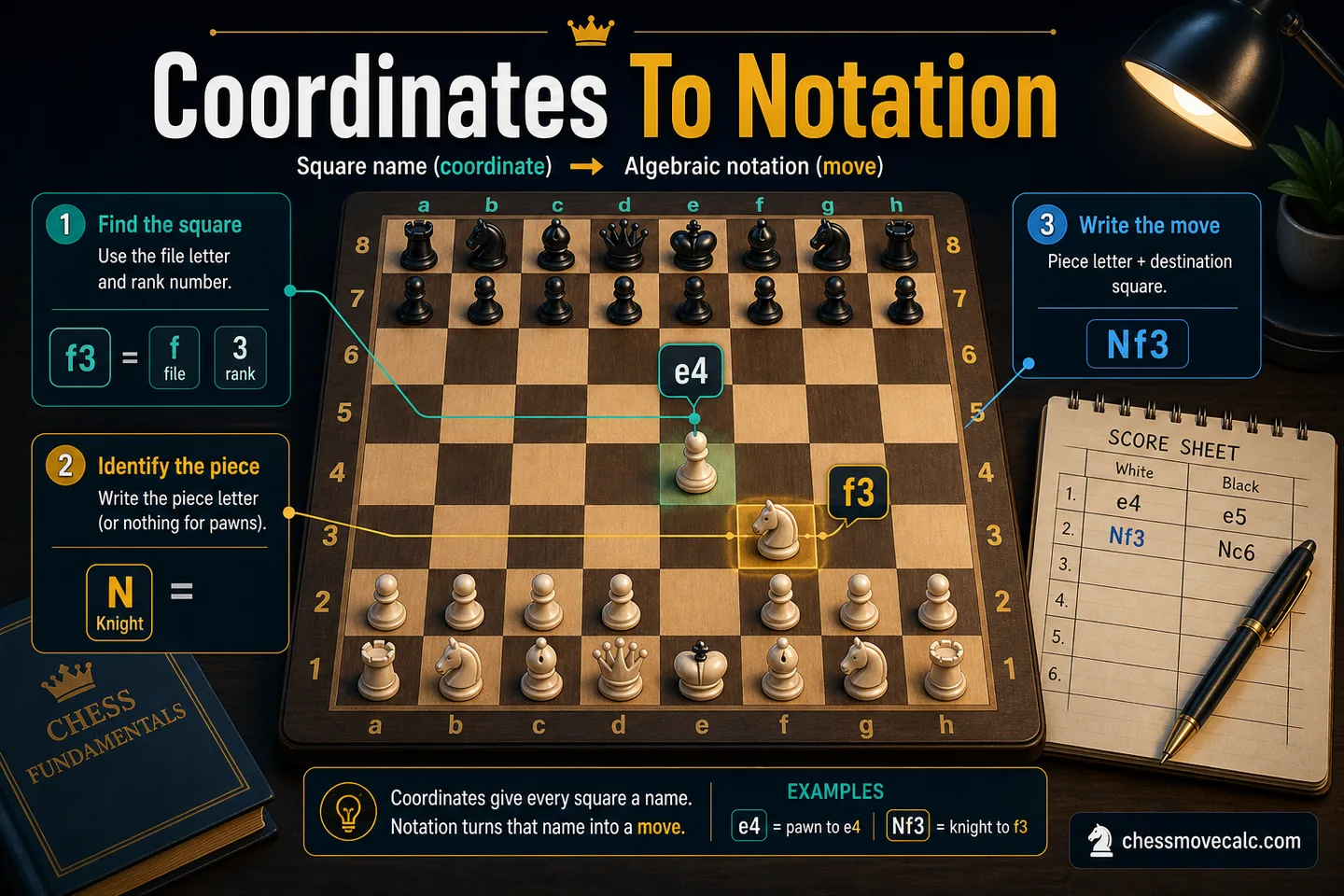
notation only works if square names already feel natural enough to recognize quickly.
How coordinates connect to notation
Moves like e4 or Nf3 are really instructions built on coordinate literacy. A pawn move such as e4 names the destination square directly. A piece move such as Nf3 uses both the piece letter and the target square.
That is where many beginners either simplify too much or remember the rule in a half-correct way. If coordinates are slow, notation stays slow even when the symbols are familiar. That is why board naming is one of the quiet foundations beneath notation fluency.
- A pawn move such as e4 names the destination square directly.
- A piece move such as Nf3 uses both the piece letter and the target square.
- If coordinates are slow, notation stays slow even when the symbols are familiar.
- That is why board naming is one of the quiet foundations beneath notation fluency.
Natural next read
Pair this page with the notation reading guide for faster decoding.
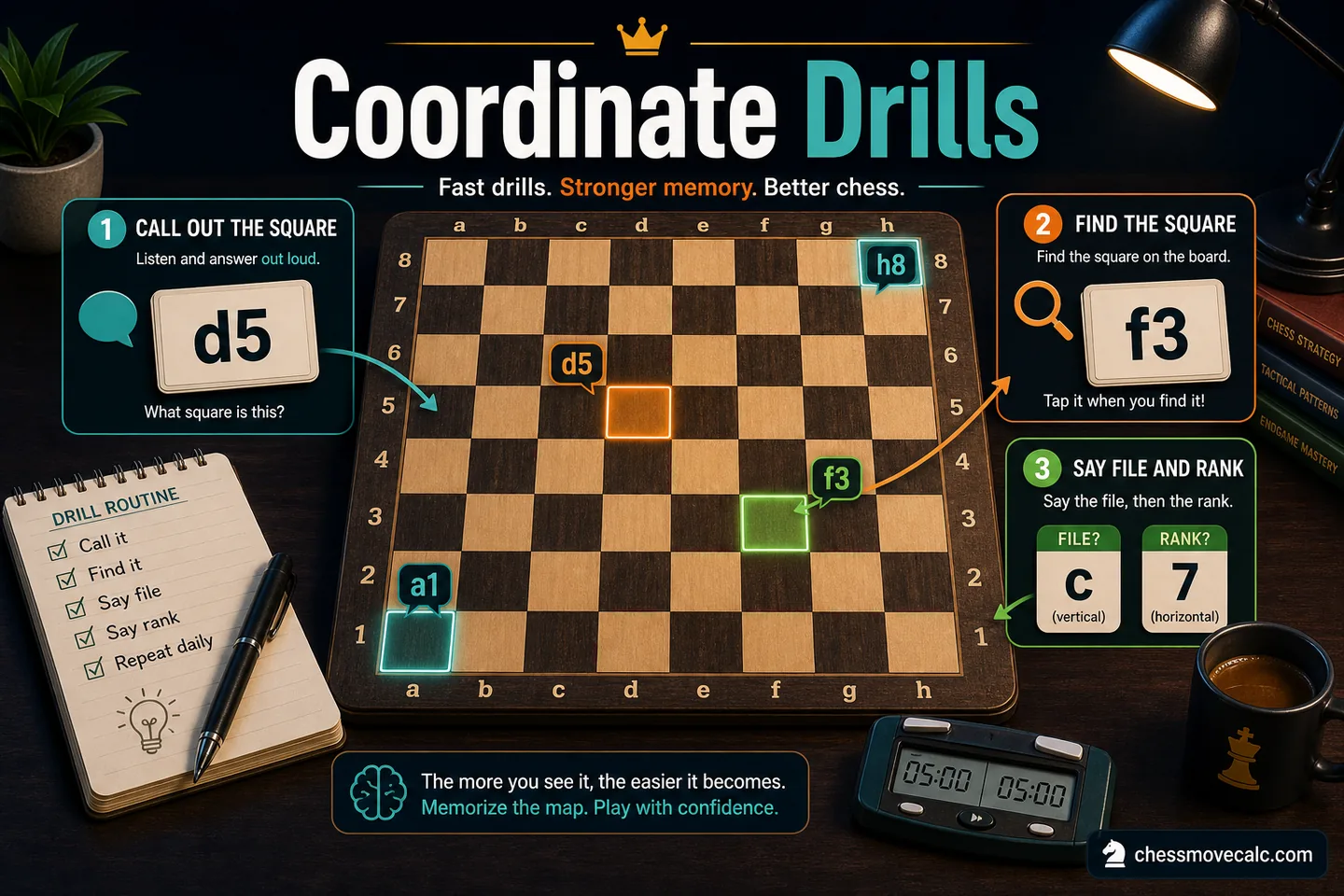
coordinates stick faster when you treat them like short recognition reps instead of one-time memorization.
Fast drills to memorize the board
Short drills teach the board the same way tactical flash reps teach patterns. Point to random squares and say their names out loud. Start with center squares, then corners, then key setup squares.
That is where many beginners either simplify too much or remember the rule in a half-correct way. Mix naming drills with notation drills so the board and the move language grow together. Five calm minutes a day works better than one long frustrated cram session.
- Point to random squares and say their names out loud.
- Start with center squares, then corners, then key setup squares.
- Mix naming drills with notation drills so the board and the move language grow together.
- Five calm minutes a day works better than one long frustrated cram session.
Best repetition style
Short daily board reps usually beat occasional marathon memorization.
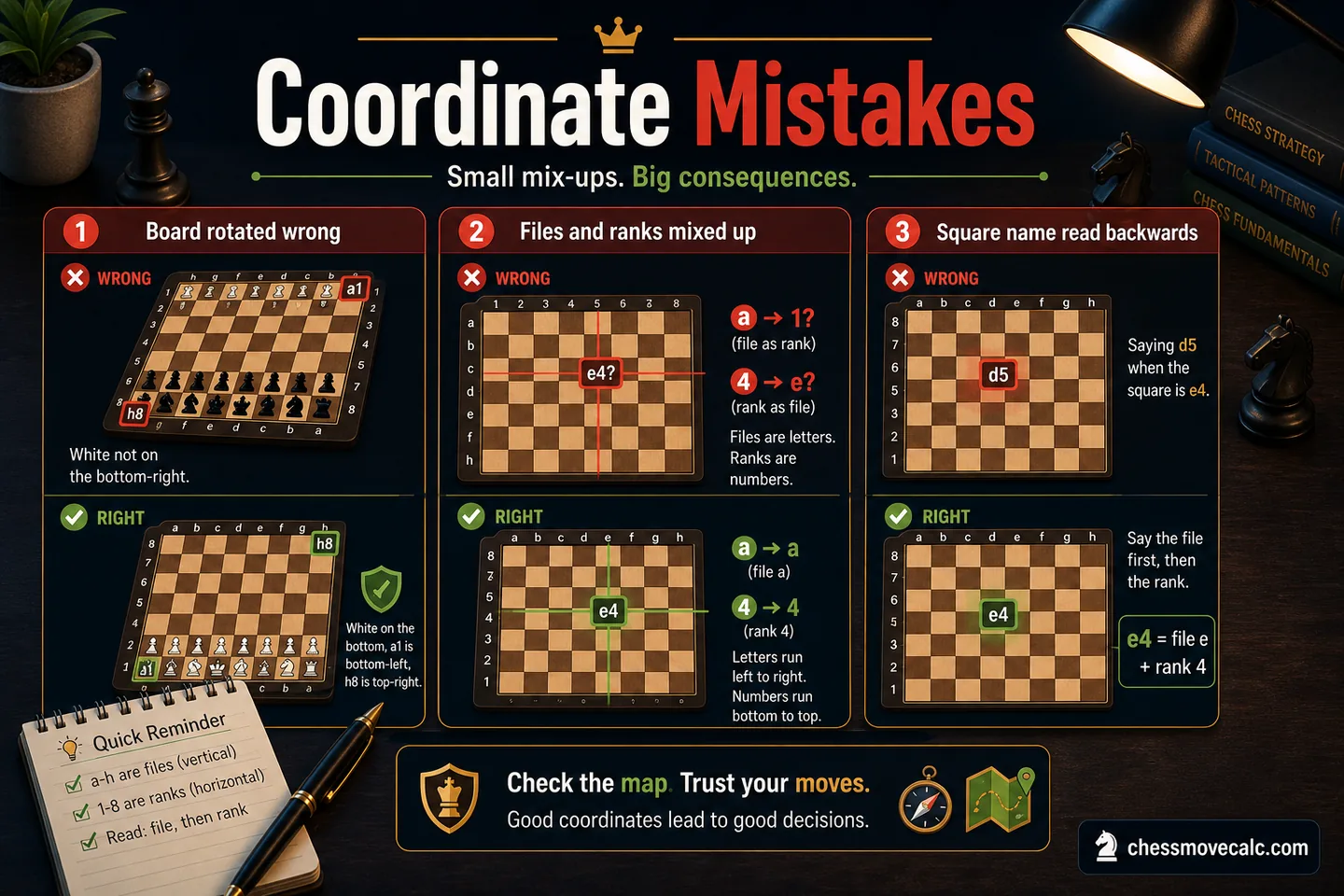
coordinate mistakes usually come from perspective errors rather than from the concept itself being hard.
Common mistakes with board coordinates
Once the board orientation is wrong, the rest of the naming system starts to feel unreliable. Players reverse file direction or imagine ranks from the wrong side. A rotated board makes d1 and e1 feel shifted even when the letters are remembered.
That is where many beginners either simplify too much or remember the rule in a half-correct way. That is why setup and orientation need to be checked before drilling coordinates deeply. Fixing perspective first makes coordinate learning much smoother.
- Players reverse file direction or imagine ranks from the wrong side.
- A rotated board makes d1 and e1 feel shifted even when the letters are remembered.
- That is why setup and orientation need to be checked before drilling coordinates deeply.
- Fixing perspective first makes coordinate learning much smoother.
Check orientation first
A board that is rotated wrong will teach the wrong coordinate habits.
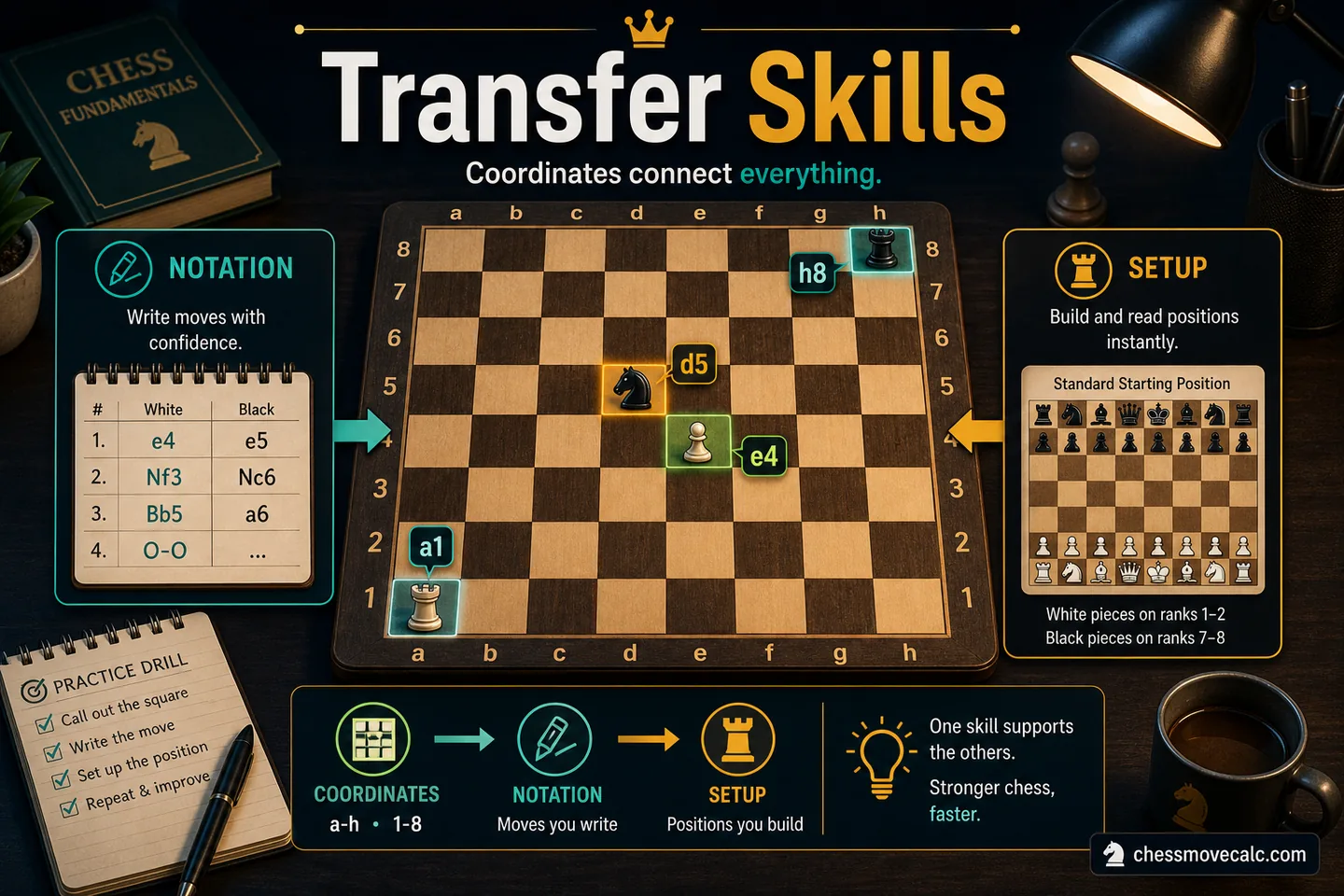
The best coordinate drills are useful because they connect straight into real chess tasks.
Coordinate drills that transfer directly into notation and setup
Board naming improves fastest when it is practiced through meaningful tasks instead of through disconnected memorization. Call out the queen and king setup squares until d1, e1, d8, and e8 feel instant. Mix square-finding drills with short notation examples so the board language and move language grow together.
Use center squares first, then corners, then tactical squares from real lessons. Five minutes of calm repetition often beats one long frustrated study burst.
A stronger habit is to ask what decision this concept should improve the very next time it appears. Practical drills make coordinates feel like tools instead of like vocabulary homework. That practical feeling is what makes the board much easier to navigate mentally.
That bridge is often the missing ingredient between reading an article once and truly keeping the lesson when the position becomes real.
- Call out the queen and king setup squares until d1, e1, d8, and e8 feel instant.
- Mix square-finding drills with short notation examples so the board language and move language grow together.
- Use center squares first, then corners, then tactical squares from real lessons.
- Five minutes of calm repetition often beats one long frustrated study burst.
- Practical drills make coordinates feel like tools instead of like vocabulary homework.
- That practical feeling is what makes the board much easier to navigate mentally.
Practical takeaway
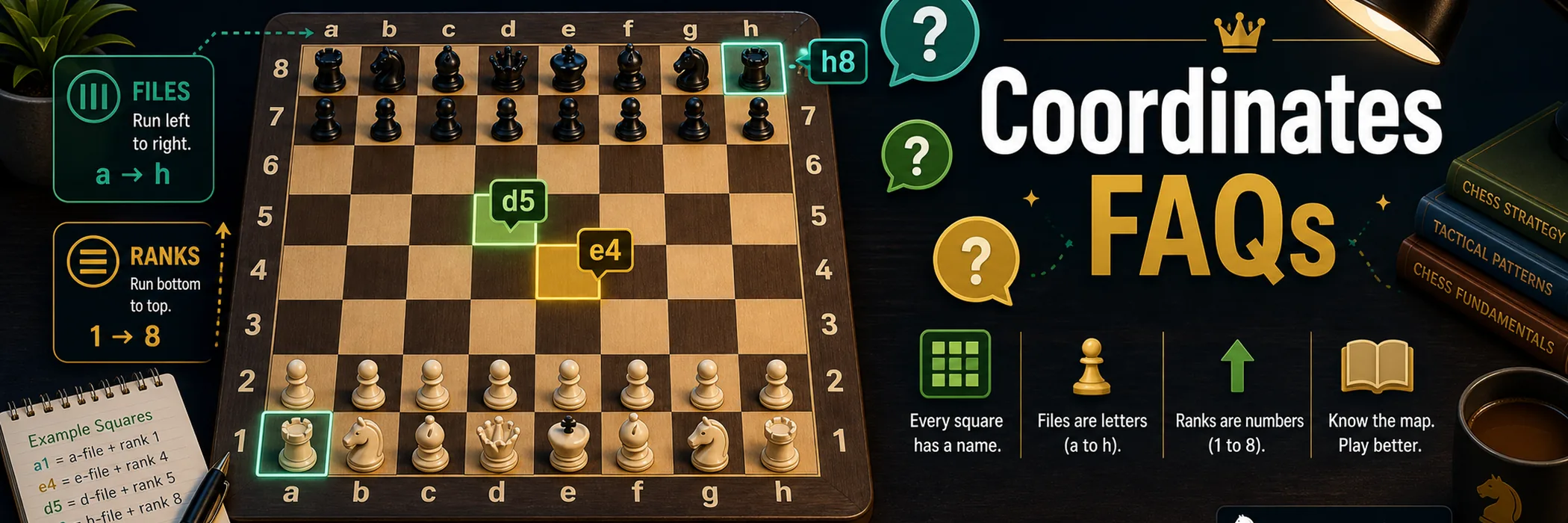
Chess Coordinates Explained FAQs
What are files and ranks in chess?
Files are the lettered columns and ranks are the numbered rows.
How do I know whether a square is e4 or d4?
Look at the file letter first, then the rank number. e4 and d4 differ by column.
Why does board orientation matter for coordinates?
Because a rotated board makes square names and setup memory much easier to mix up.
Do coordinates change from Black’s side?
The naming system stays the same for both players.
What is the fastest way to memorize square names?
Use short daily drills and connect coordinates directly to setup and notation.
Why should I learn coordinates early?
They make setup, notation, lessons, and board communication much easier.
Use coordinates in a real notation workflow
Turn square names into move-reading speed by pairing this guide with notation tools and setup practice.