A tiny rule becomes much easier once you connect color, square name, and board orientation
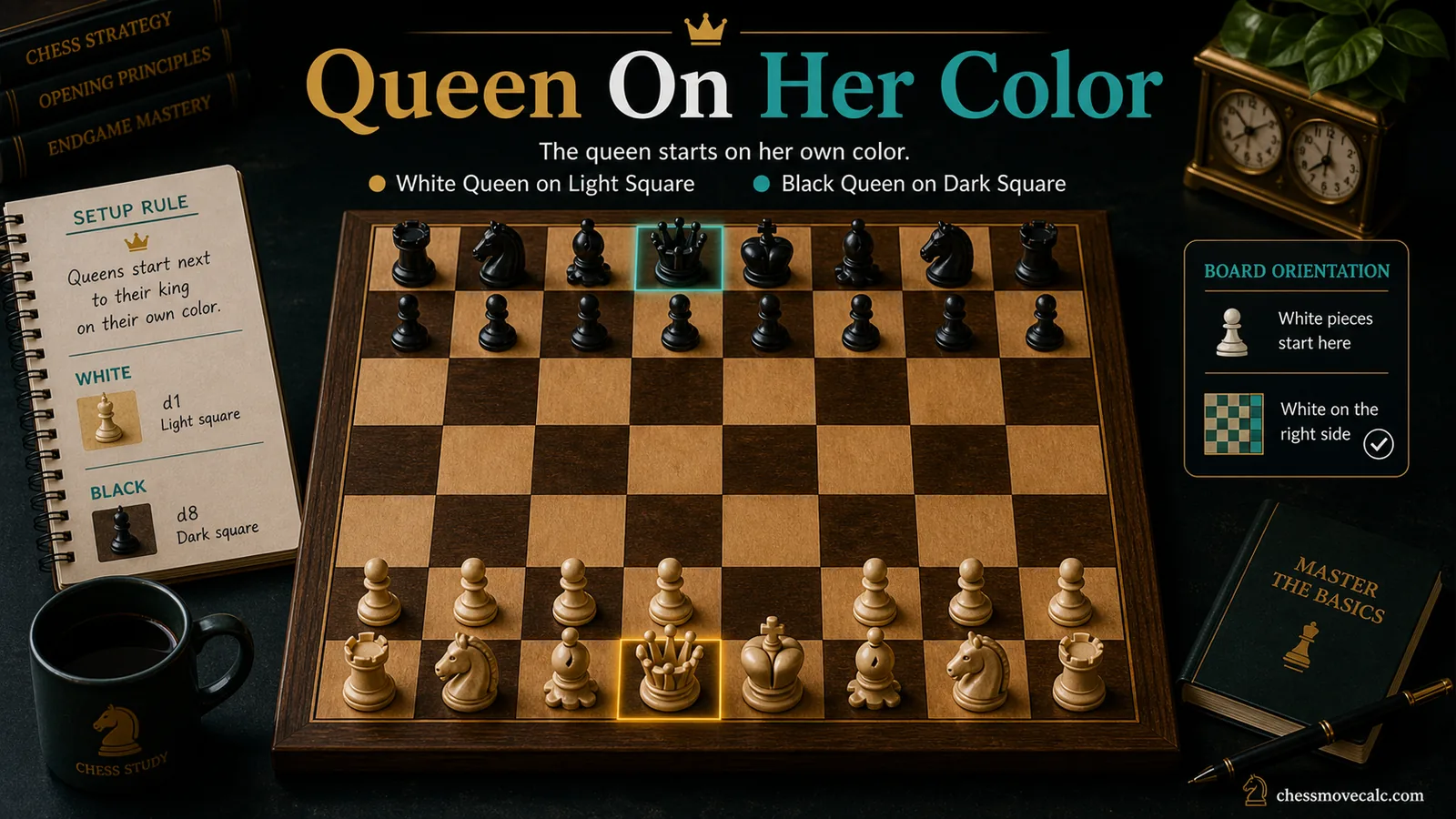
this is the fastest memory rule because it works for both colors at once.
Many beginners do not struggle with all of board setup. They struggle with one stubborn detail: where the queen goes. That is why this page stays narrow on purpose. It is built to dominate the exact question instead of wandering into every other setup rule at the same time.
The shortest correct answer is simple: the queen goes on her own color. White queen on a light square. Black queen on a dark square. In standard setup that means white queen on d1 and black queen on d8.
The reason the mistake keeps happening is that players often combine three small problems at once: the board is rotated incorrectly, the king and queen shapes feel similar, and the phrase “queen on her color” has not become automatic yet.
A good answer therefore needs more than the square name. It needs memory aids, orientation checks, and examples of what wrong setup actually looks like.
Once this rule sticks, board setup gets faster and the rest of beginner learning feels less fragile.
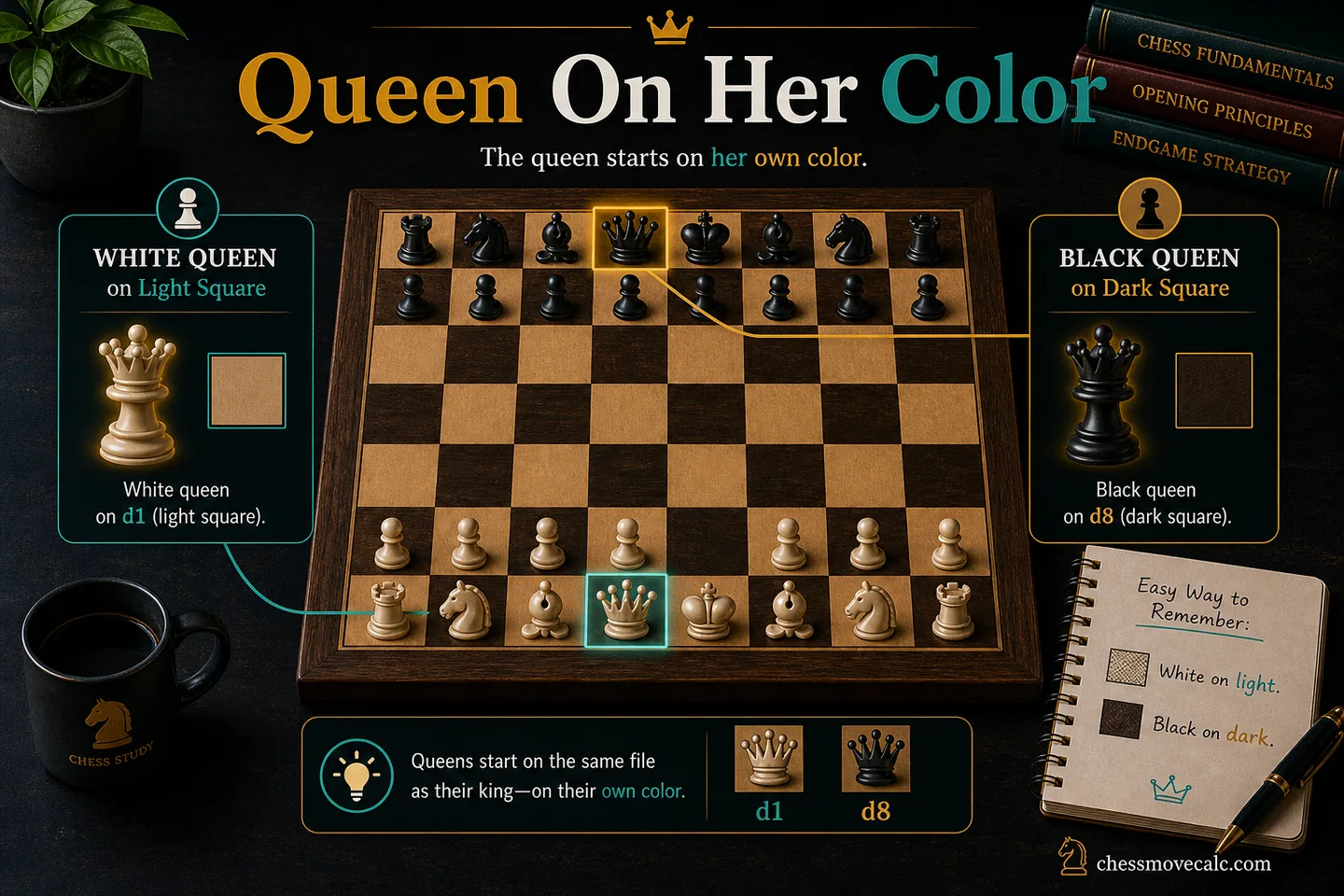
The queen-on-her-color rule
The queen-on-her-color rule matters because the white queen starts on a light square and the black queen starts on a dark square. White queen on d1 means the queen sits on a light square from White’s side. Black queen on d8 means the black queen sits on a dark square from Black’s side.
That is where many beginners either simplify too much or remember the rule in a half-correct way. Once that color rule is clear, the king naturally takes the remaining center square. This is easier to remember than memorizing four center-piece squares independently.
The practical goal is to make the rule easy to use over a real board, not just easy to recite in isolation.
- White queen on d1 means the queen sits on a light square from White’s side.
- Black queen on d8 means the black queen sits on a dark square from Black’s side.
- Once that color rule is clear, the king naturally takes the remaining center square.
- This is easier to remember than memorizing four center-piece squares independently.
Shortest memory trick
Queen on her own color. Say it once before every setup until it becomes automatic.
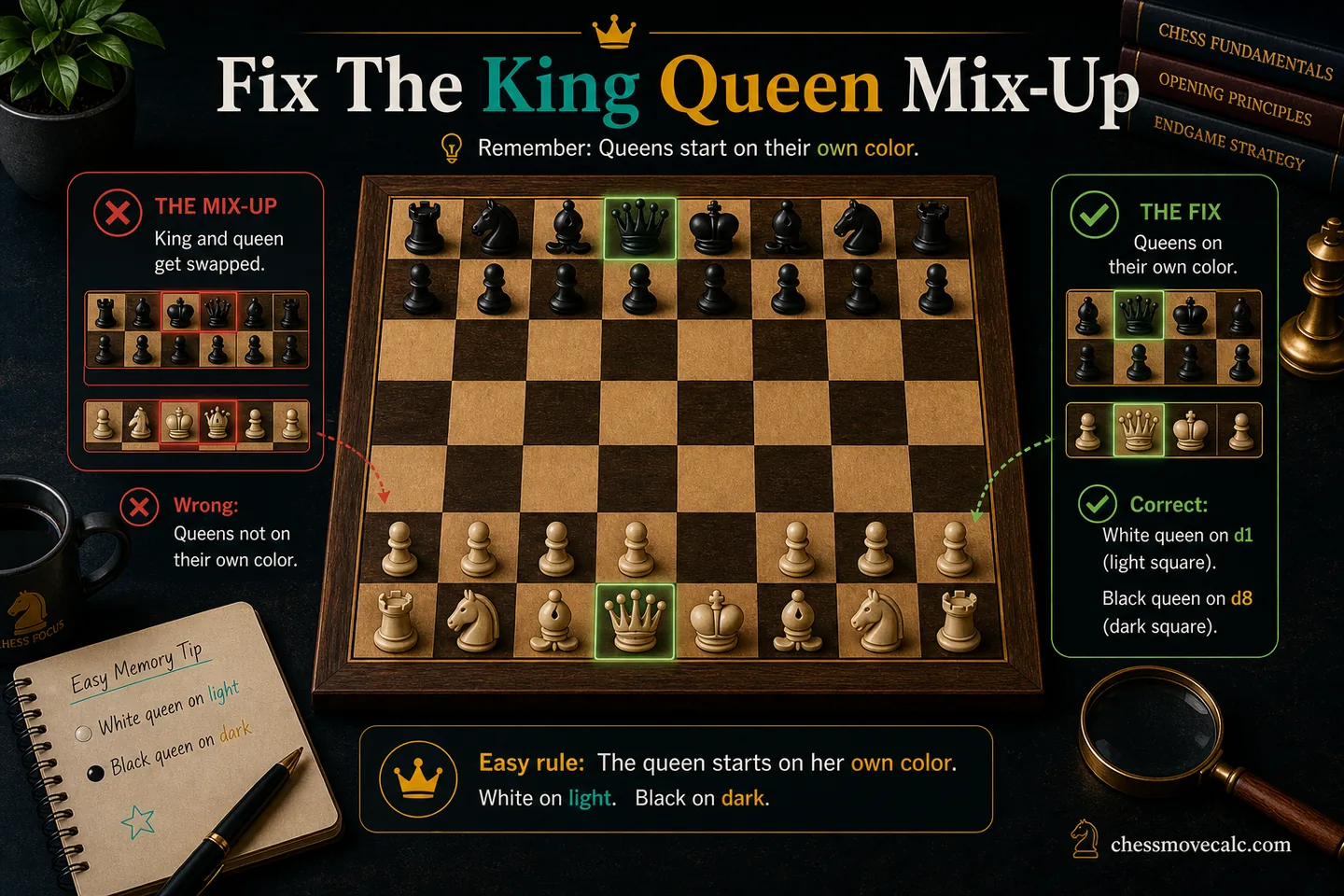
the mix-up is common because the mistake usually starts before the pieces are even placed.
Why players mix up the king and queen
A rotated board or a vague memory often makes the center pieces feel interchangeable. The king and queen stand beside each other, so one wrong first placement creates the second mistake automatically. Beginner sets can also make the two pieces look closer in shape than expected.
That is where many beginners either simplify too much or remember the rule in a half-correct way. That means the best fix is not only memory. It is also slowing down the first two center placements. A correct board orientation removes a lot of this confusion before it even starts.
- The king and queen stand beside each other, so one wrong first placement creates the second mistake automatically.
- Beginner sets can also make the two pieces look closer in shape than expected.
- That means the best fix is not only memory. It is also slowing down the first two center placements.
- A correct board orientation removes a lot of this confusion before it even starts.
Useful habit
Place the board correctly first, then place the queens before the kings if you tend to swap them.
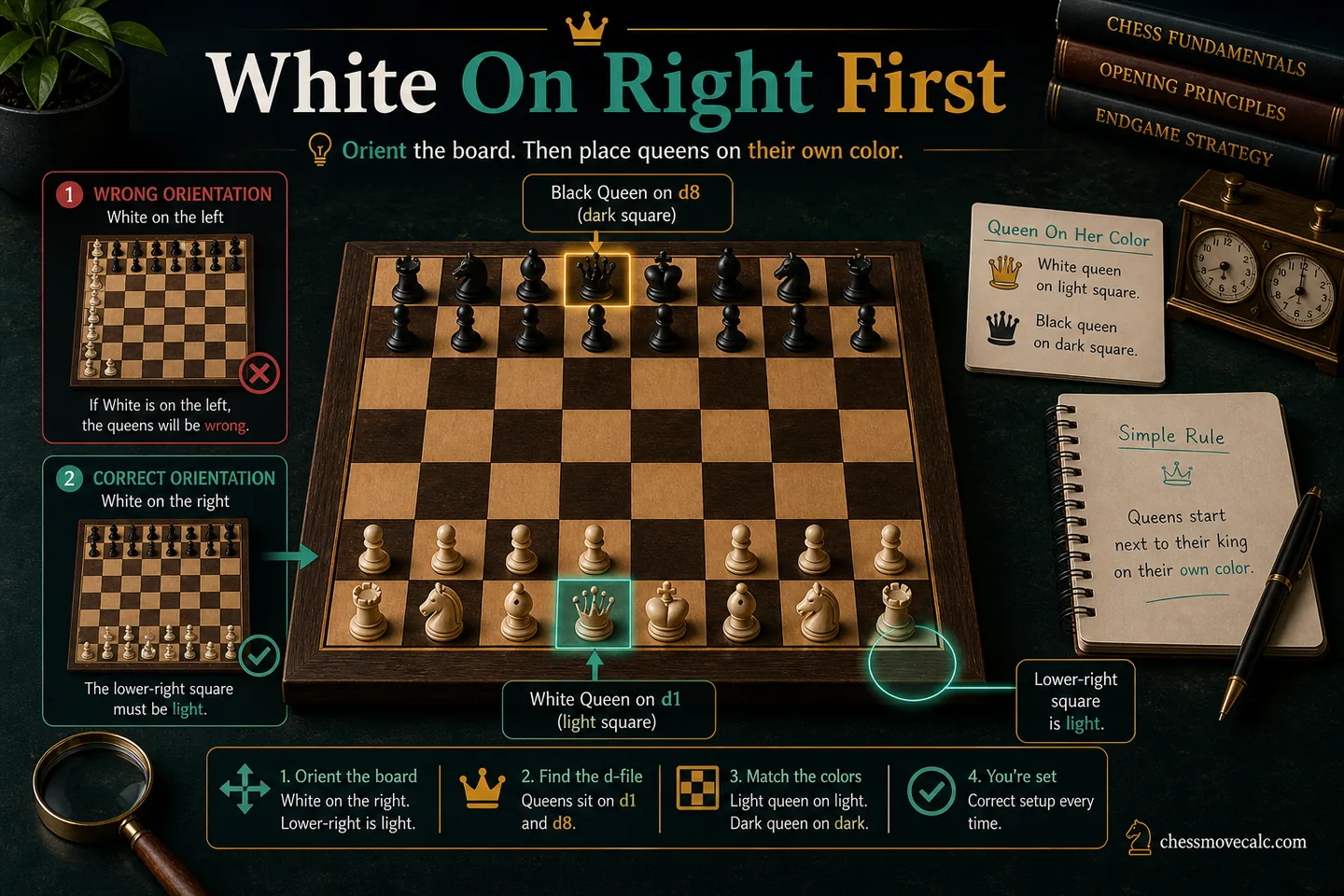
orientation is the hidden setup rule behind many queen-placement mistakes.
How board orientation affects queen placement
If the lower-right corner is not a light square from your side, the center-piece rule will break even if you remember the slogan. The classic board rule is white on right from each player’s perspective. If the board is rotated, d1 and d8 are no longer where you think they are visually.
That is where many beginners either simplify too much or remember the rule in a half-correct way. That is why some players swear they remembered the queen rule and still end up wrong. The color of the corner square is the fastest pre-check before placing any pieces.
- The classic board rule is white on right from each player’s perspective.
- If the board is rotated, d1 and d8 are no longer where you think they are visually.
- That is why some players swear they remembered the queen rule and still end up wrong.
- The color of the corner square is the fastest pre-check before placing any pieces.
Orientation first
If the board is rotated wrong, every setup memory trick becomes less reliable.
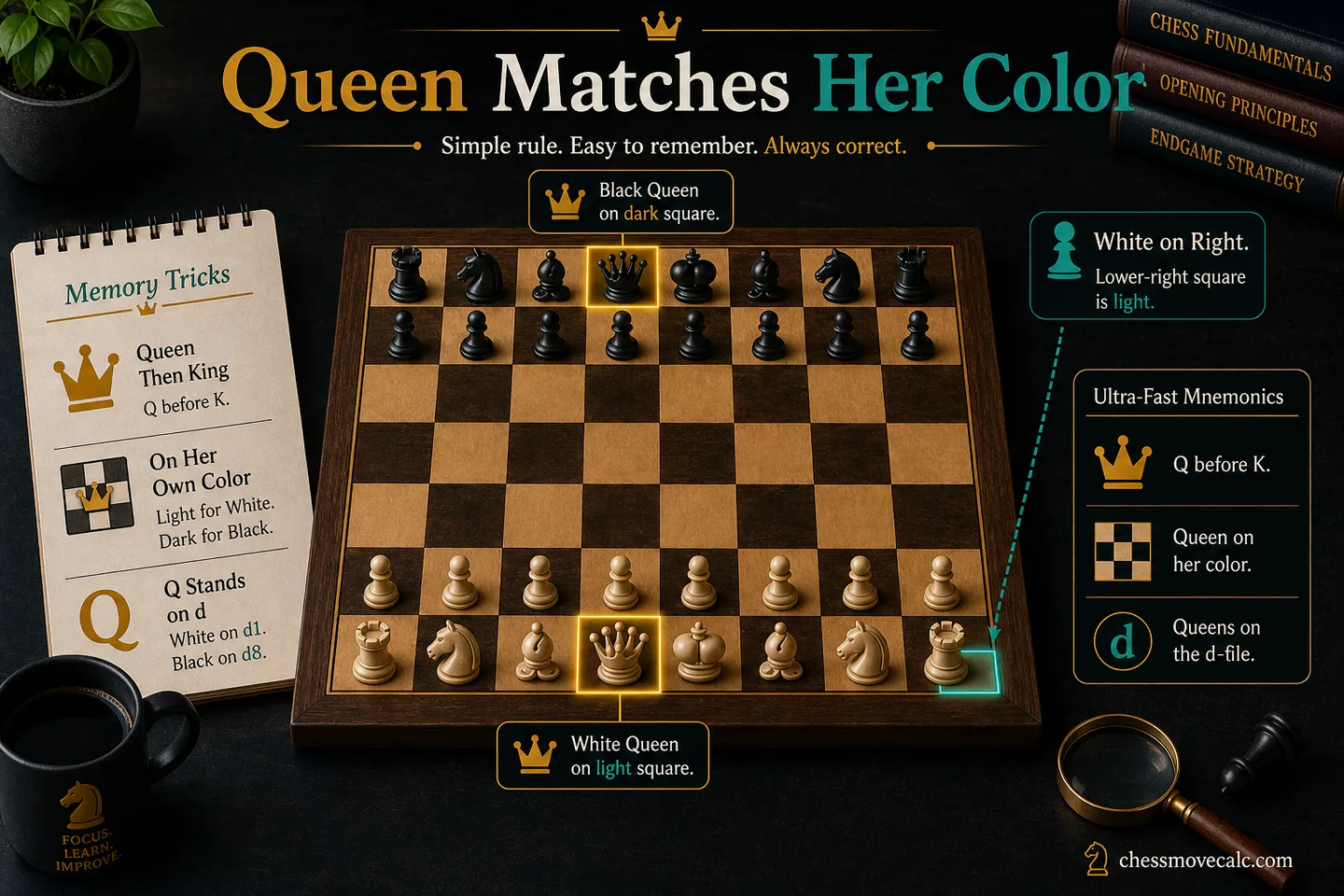
small rules stick better when the memory aid is visual, verbal, and repeatable.
Fast memory tricks that actually stick
You want a phrase that survives pressure and a picture that appears instantly in your head. Queen on her color is the main phrase because it handles both sides at once. Pairing that phrase with d1 and d8 gives you a square-name backup when notation matters.
That is where many beginners either simplify too much or remember the rule in a half-correct way. Mini-board repetition helps the rule become automatic faster than abstract memorization alone. A sticky memory trick should still work even when you are setting up quickly before a game.
- Queen on her color is the main phrase because it handles both sides at once.
- Pairing that phrase with d1 and d8 gives you a square-name backup when notation matters.
- Mini-board repetition helps the rule become automatic faster than abstract memorization alone.
- A sticky memory trick should still work even when you are setting up quickly before a game.
Best combo
Use the phrase, then verify the square names. Words plus coordinates make the rule much harder to forget.
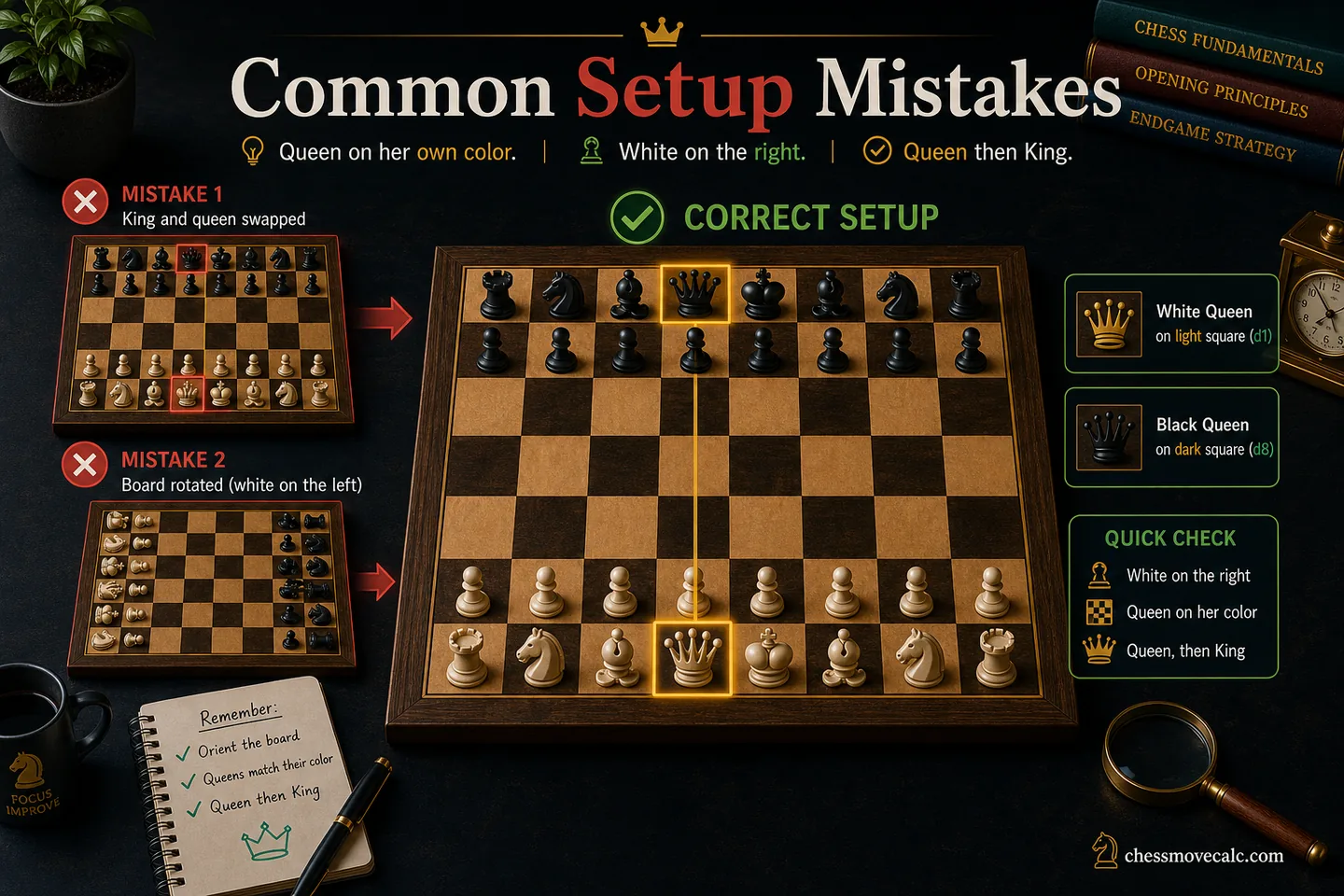
wrong setups are easiest to fix when you identify which part of the chain failed first.
Common wrong setups and how to fix them
Sometimes the queen is on the wrong color, sometimes the board is rotated, and sometimes both problems happened together. Check the corner-square orientation before moving any center pieces. Then check whether each queen sits on her own color.
That is where many beginners either simplify too much or remember the rule in a half-correct way. Finally confirm that the kings are beside the queens rather than replacing them. That quick three-step audit solves most beginner setup mistakes in seconds.
- Check the corner-square orientation before moving any center pieces.
- Then check whether each queen sits on her own color.
- Finally confirm that the kings are beside the queens rather than replacing them.
- That quick three-step audit solves most beginner setup mistakes in seconds.
Quick repair loop
Orientation, queen color, king beside queen. Run that loop and most setup errors disappear fast.
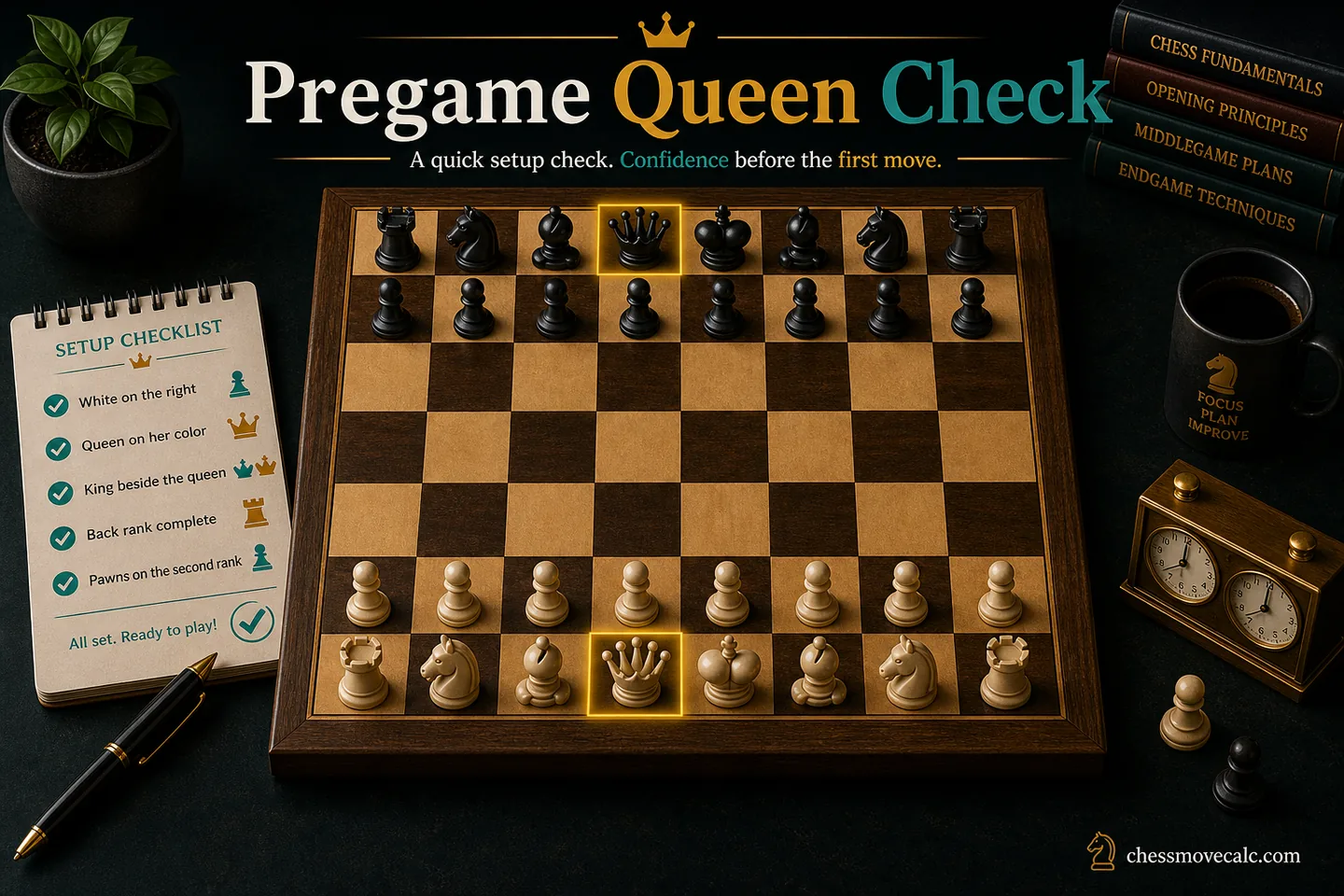
A tiny setup ritual is often all it takes to remove the most common beginner mistake.
A 30-second pregame setup check that prevents queen mistakes
A 30-second pregame setup check that prevents queen mistakes matters because this rule becomes automatic faster when it is tied to a repeatable board-check routine instead of to memory alone. Check the lower-right corner color before placing any center pieces. Say queen on her own color, then verify d1 and d8 if you know coordinates.
Place the queens before the kings if you are prone to swapping them. Do one final center-piece scan before the game starts.
A stronger habit is to ask what decision this concept should improve the very next time it appears. Small setup rituals reduce stress because you stop relying on rushed guesswork. That makes the rule much easier to keep even when you are setting up quickly.
That bridge is often the missing ingredient between reading an article once and truly keeping the lesson when the position becomes real.
- Check the lower-right corner color before placing any center pieces.
- Say queen on her own color, then verify d1 and d8 if you know coordinates.
- Place the queens before the kings if you are prone to swapping them.
- Do one final center-piece scan before the game starts.
- Small setup rituals reduce stress because you stop relying on rushed guesswork.
- That makes the rule much easier to keep even when you are setting up quickly.
Practical takeaway
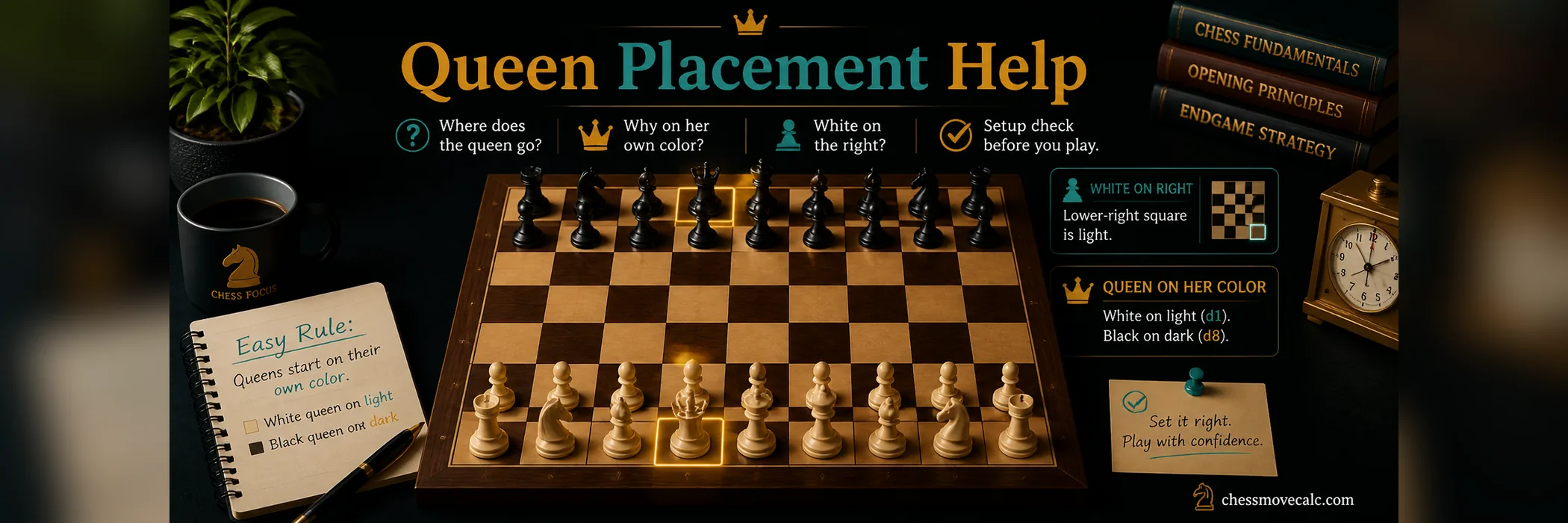
Where Does the Queen Go in Chess? FAQs
Does the queen go on d1 or e1?
The white queen starts on d1 and the white king starts on e1 in standard setup.
Why is the queen on her own color?
That rule gives you a simple memory shortcut for placing both queens correctly.
Does black follow the same rule?
Yes. Black queen starts on a dark square, which is d8 in the standard setup.
What happens if I swap the king and queen?
The setup is incorrect and should be fixed before the game begins.
What is the fastest way to remember queen placement?
Use the phrase queen on her own color, then verify d1 for White and d8 for Black.
Why do I still get it wrong sometimes?
Board orientation mistakes often cause queen-placement mistakes even when the phrase itself is remembered.
Turn the queen rule into full board confidence
Use the setup and coordinates guides together so queen placement becomes one part of a complete, reliable board routine.