Try a back-rank mate in one
White to move: Re8# is checkmate. The rook checks along the eighth rank, and Black’s pawns on f7, g7, and h7 block all forward escape squares. There is no defending piece that can capture the rook or block the check.
Before revealing the move, list every legal escape square for the black king. In a different position with the h-pawn already on h6, check whether h7 provides an escape.
Load this exact position:
6k1/5ppp/8/8/8/8/5PPP/4R1K1 w - - 0 1The reason this pattern repeats so often is that the warning signs look harmless until they suddenly do not
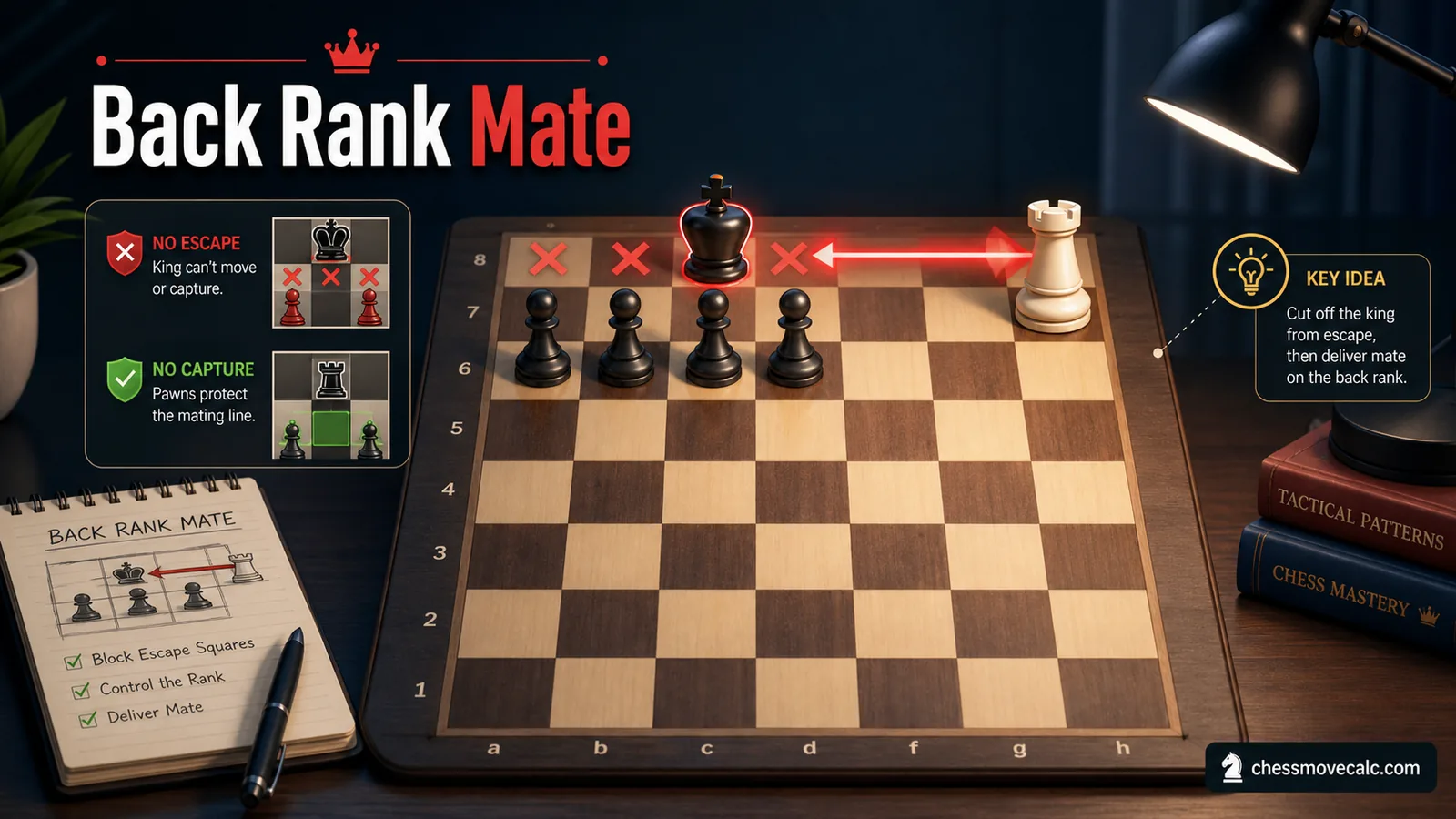
this pattern is simple once you understand that the mate is really about escape-square control, not only about the final checking piece.
Back rank mate is one of the most practical tactical themes in chess because it grows out of ordinary structure. A player develops pieces, pushes central pawns, and forgets that the king still has no breathing room. Then one file opens and the pattern appears instantly.
That makes this page intentionally narrower than the broader checkmate pattern guide. Here the focus is one pattern, one structure, one warning system, and one of the most useful defensive habits in club chess: creating luft.
A deep page is worthwhile here because mixed pattern lists rarely spend enough time on the defensive side. They show the mating picture, but they do not teach how to notice the danger three moves earlier.
That is where most real improvement happens. Spot the danger sooner, and the blunder rate drops fast.
The reward is practical: fewer sudden losses and more clean tactical wins when your opponent ignores the same warning signs.
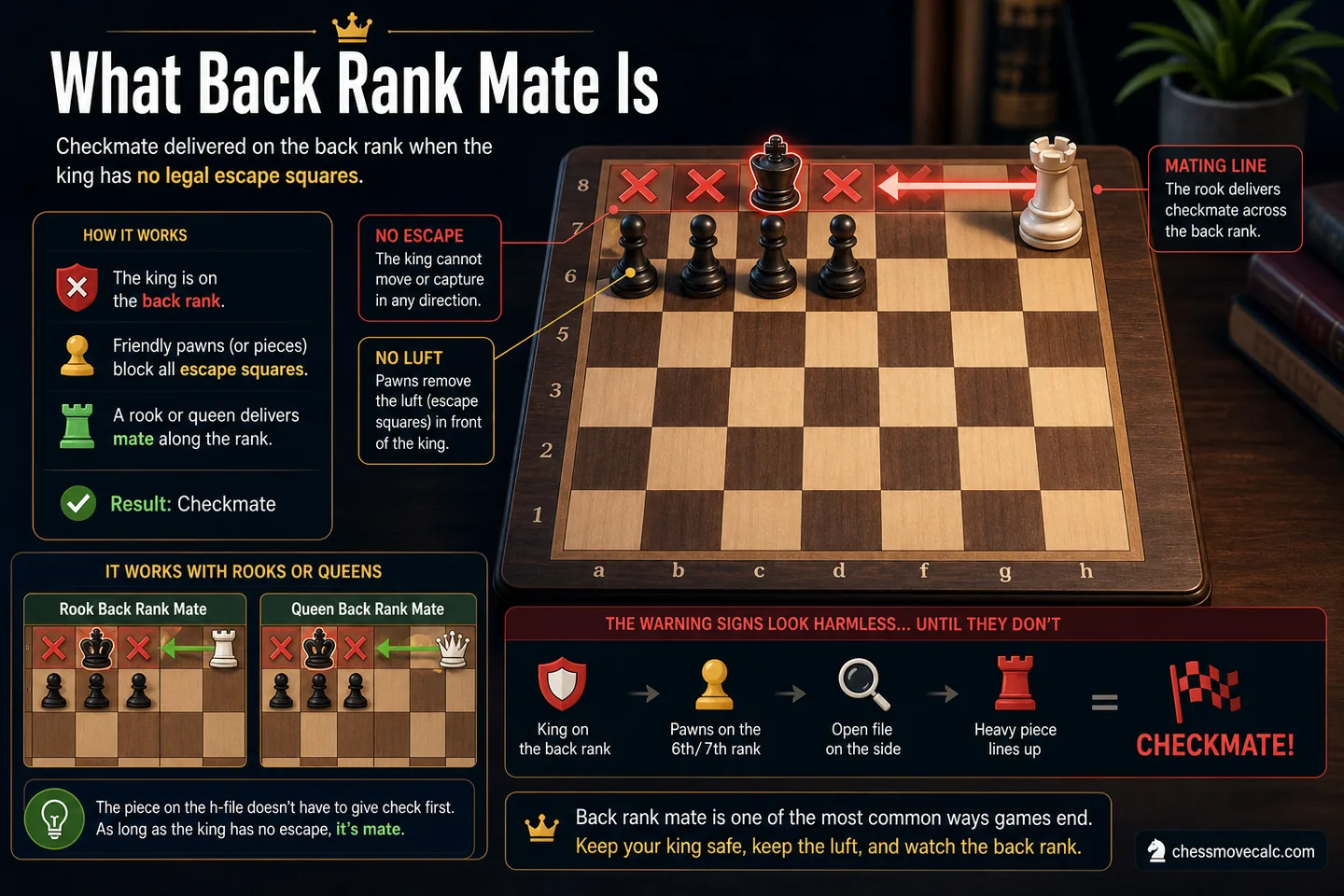
What back rank mate is
The king is trapped behind its own pawns while a rook or queen attacks along the back rank. The mating move works because the king cannot step forward or sideways to safety. Friendly pawns often become accidental prison bars instead of protection.
That means the pattern can appear even when the final checking move looks straightforward. The hidden hero or villain is usually the missing escape square.
- The mating move works because the king cannot step forward or sideways to safety.
- Friendly pawns often become accidental prison bars instead of protection.
- That means the pattern can appear even when the final checking move looks straightforward.
- The hidden hero or villain is usually the missing escape square.
Core picture
Back rank mate means no luft plus a heavy-piece line into the king.
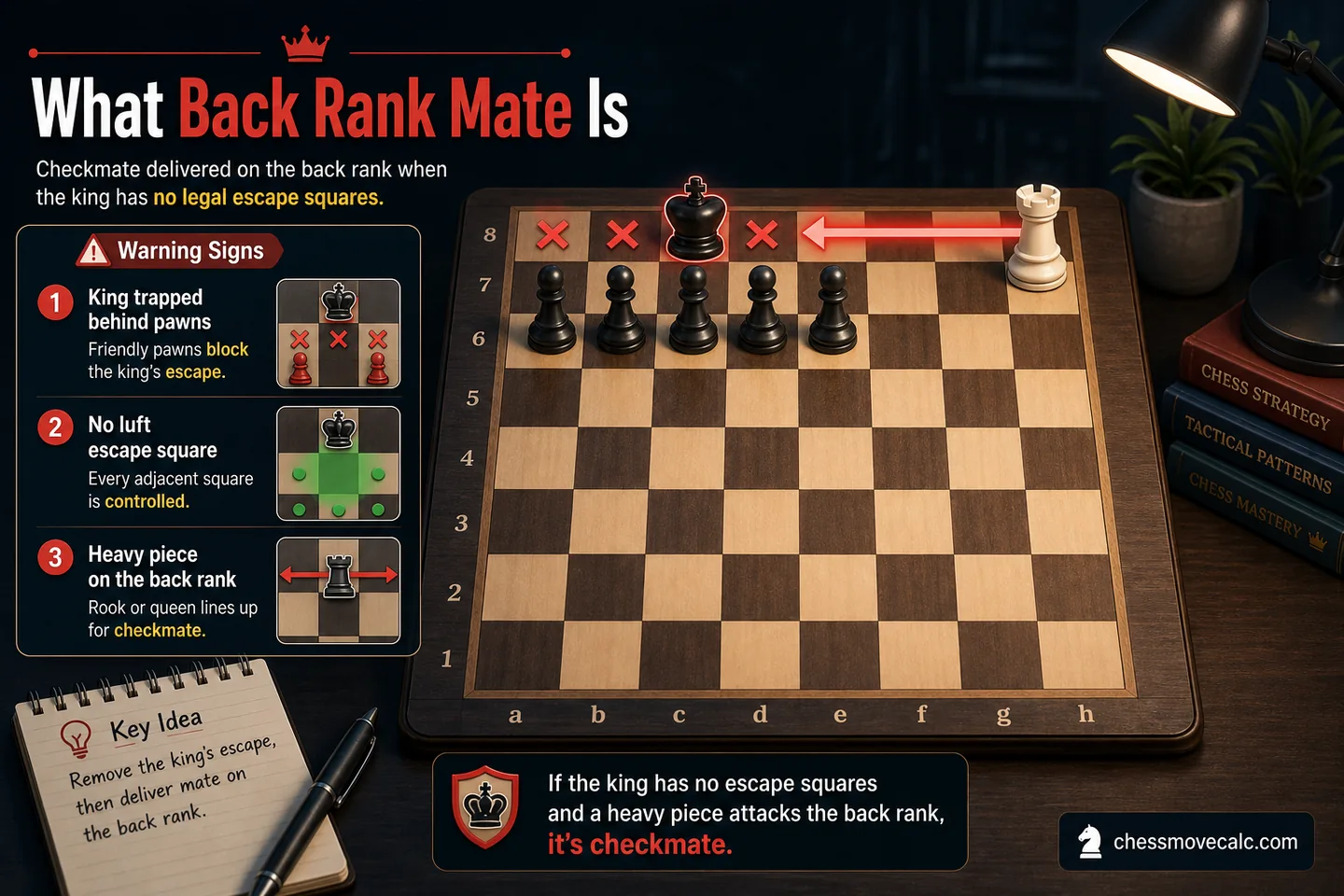
back rank blunders are easier to prevent when the warning signs are part of your normal scan.
The warning signs to spot early
The warning signs to spot early matters because you do not need to wait for mate. You can spot the structure that allows mate before the tactic starts. Blocked pawns in front of the king are the first clue. Open files or queen-rook alignment toward the back rank raise the danger level further.
A defender tied down elsewhere makes the pattern more likely to succeed. Once these cues appear together, the position deserves immediate respect.
- Blocked pawns in front of the king are the first clue.
- Open files or queen-rook alignment toward the back rank raise the danger level further.
- A defender tied down elsewhere makes the pattern more likely to succeed.
- Once these cues appear together, the position deserves immediate respect.
Useful scan habit
Whenever you see a boxed-in king, ask whether a rook or queen can invade on the back rank soon.
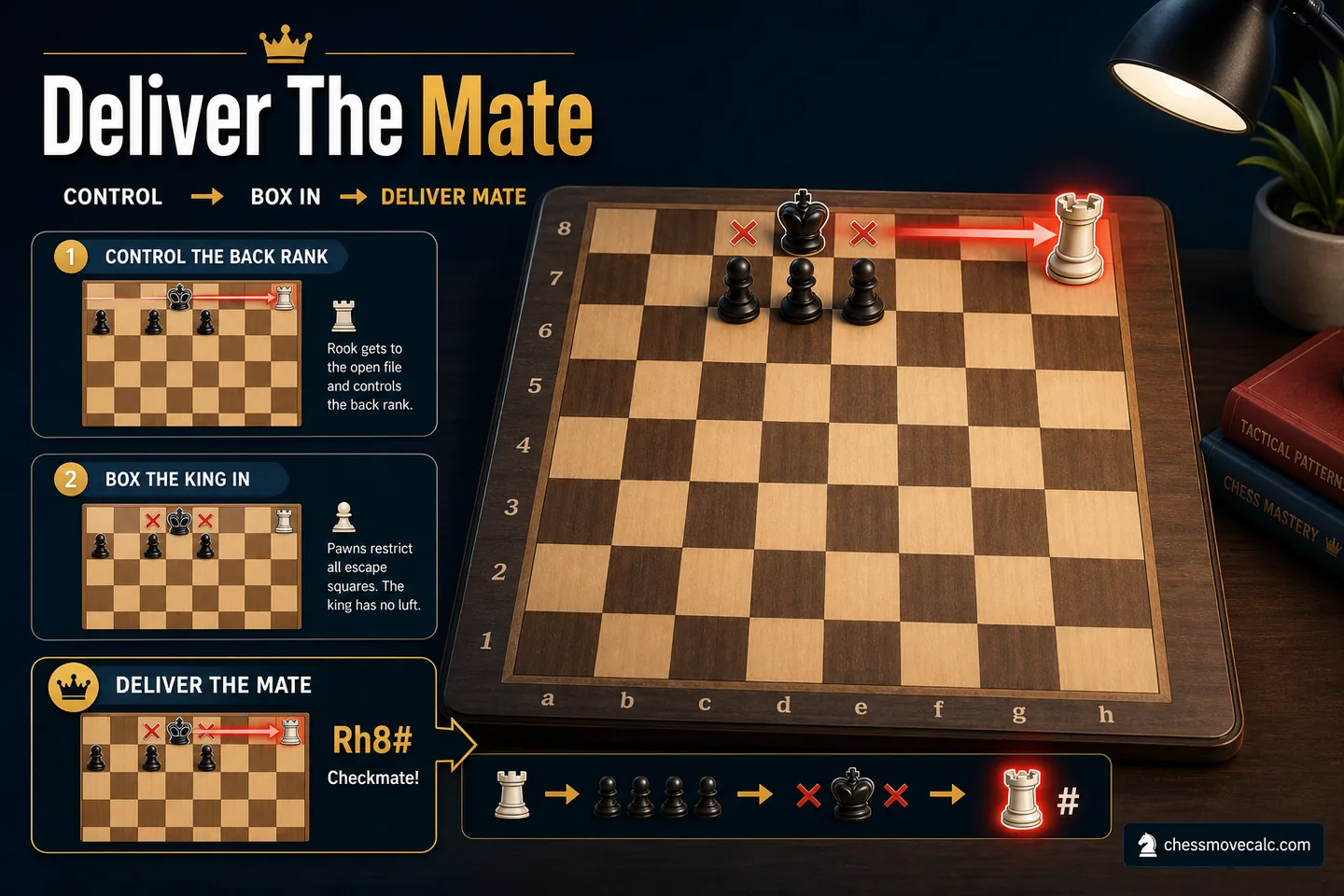
attacking well here is often about removing one defender or controlling one extra square before the final move.
How to deliver back rank mate
The mate itself is usually short, but the preparation teaches good tactical patience. Sometimes the line is open immediately and the mate is direct. Other times you must remove a guard, trade rooks, or deflect a defender first.
Knowing the pattern helps you recognize which preparatory move is worth calculating. That turns the attack from guesswork into a targeted mating net.
- Sometimes the line is open immediately and the mate is direct.
- Other times you must remove a guard, trade rooks, or deflect a defender first.
- Knowing the pattern helps you recognize which preparatory move is worth calculating.
- That turns the attack from guesswork into a targeted mating net.
Think preparation
When the final move is obvious but not yet legal, look for the defender or escape square that still needs to disappear.
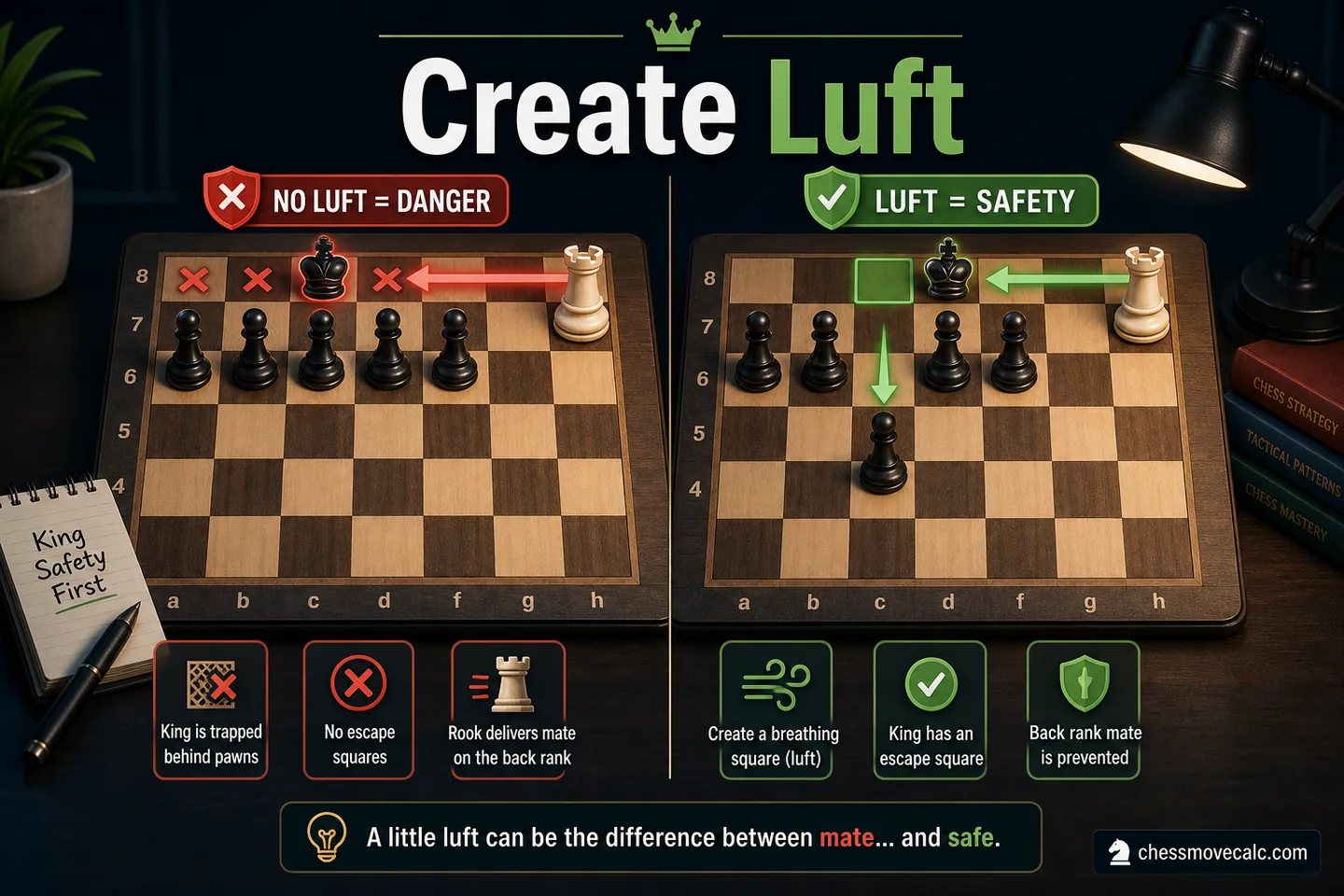
luft is one of the cleanest defensive ideas beginners can learn because it converts a mating pattern into a manageable threat.
How to avoid back rank mate with luft
One pawn move can give the king an escape square and completely change the tactical outcome. Creating luft does not guarantee total safety, but it often removes the clean mating picture. That is why strong players make small king-safety moves before the board punishes them.
Beginners sometimes resist luft because it feels slow, but the cost of not making it can be immediate. A single breathing square often matters more than one extra waiting move elsewhere.
- Creating luft does not guarantee total safety, but it often removes the clean mating picture.
- That is why strong players make small king-safety moves before the board punishes them.
- Beginners sometimes resist luft because it feels slow, but the cost of not making it can be immediate.
- A single breathing square often matters more than one extra waiting move elsewhere.
Best beginner habit
If your king is boxed in and the heavy pieces are active, creating luft is often a smart default question.
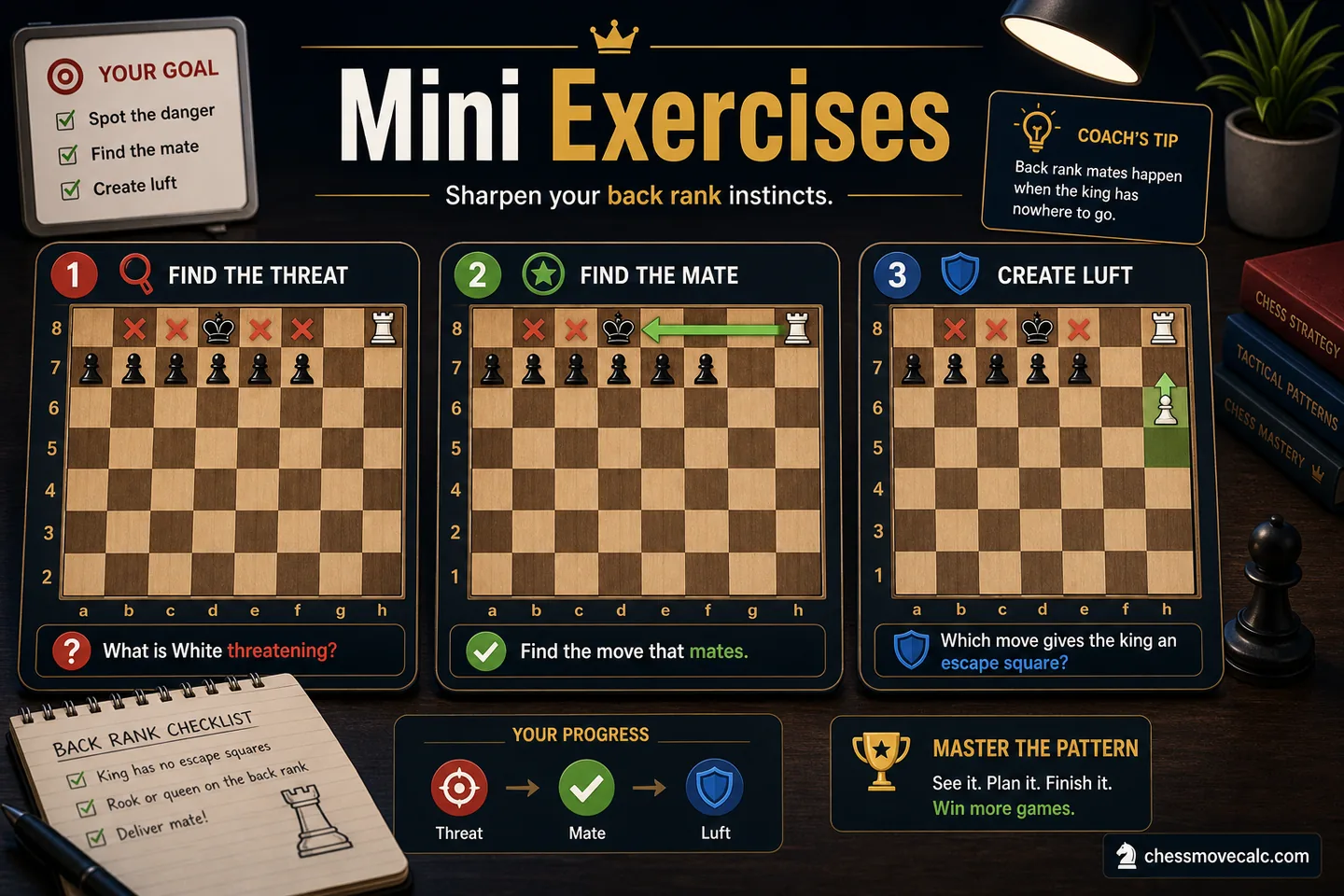
practice matters because back rank mate is a pattern you want to see almost instantly.
Training examples and mini exercises
Short exercises train both sides of the theme: spotting the attack and noticing the defense. Use positions where the threat exists but the mate is not immediate yet. Then solve positions where one preparatory move creates the final mating chance.
Finally solve defensive examples where one luft move saves the game. That mix creates recognition instead of one-sided memorization.
- Use positions where the threat exists but the mate is not immediate yet.
- Then solve positions where one preparatory move creates the final mating chance.
- Finally solve defensive examples where one luft move saves the game.
- That mix creates recognition instead of one-sided memorization.
Train both roles
A player who knows only how to attack the pattern will still lose many games to it. Train defense too.
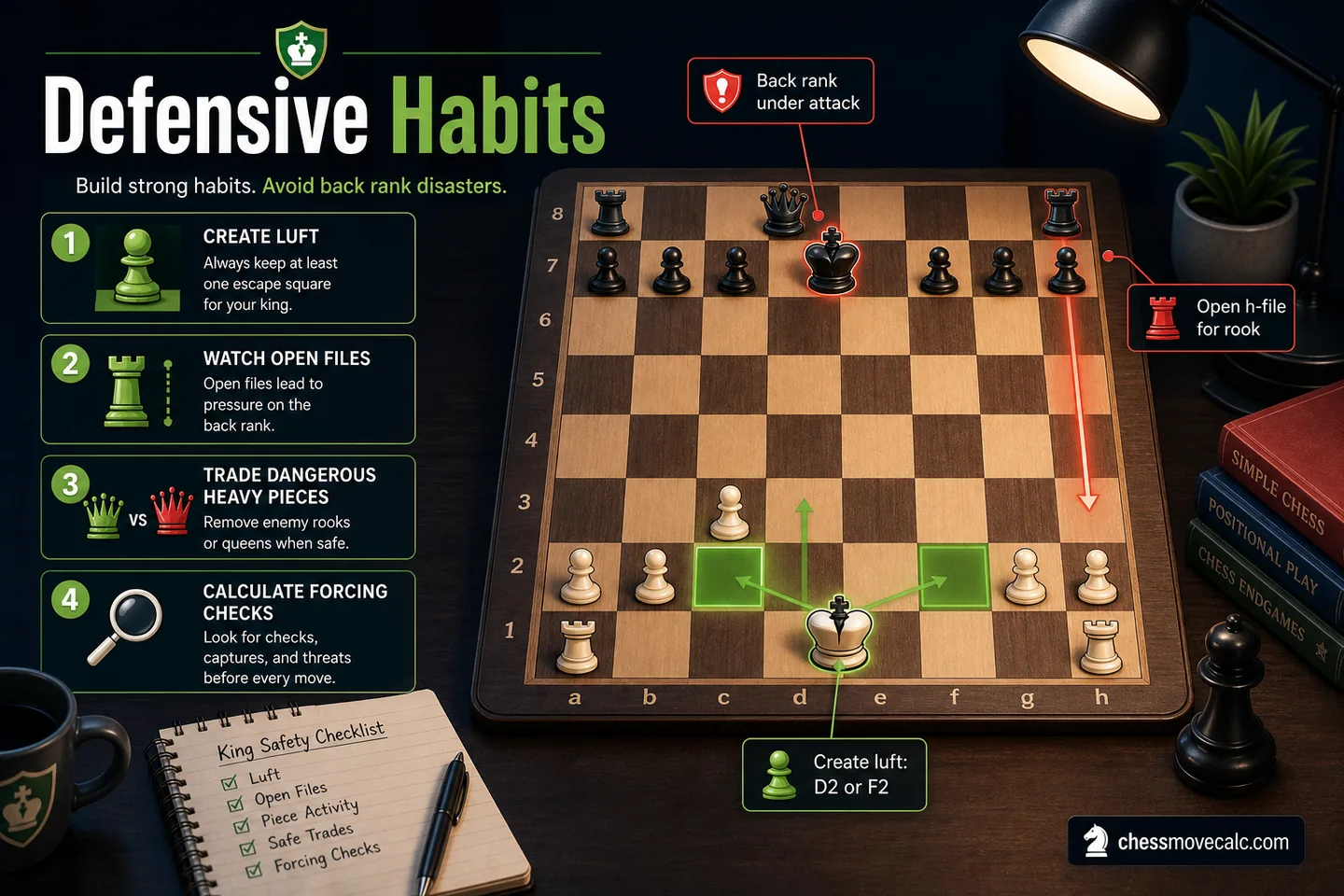
Back-rank safety is often a habit problem before it becomes a tactical problem.
Defensive habits that stop back-rank disasters before they start
The easiest way to reduce back-rank blunders is to notice the structure early enough to fix it before the attack is ready. Scan your own king shelter whenever heavy pieces become active on open files. Ask whether one pawn move could create useful luft without causing new weakness.
Respect quiet alignment of queen and rook even when no immediate check exists yet. Do not assume you can solve the threat later if the structure is already boxed in.
A stronger habit is to ask what decision this concept should improve the very next time it appears. Small defensive habits are often cheaper than emergency tactical defense. That is why back-rank awareness is really a king-safety routine, not just a mating motif.
That bridge is often the missing ingredient between reading an article once and truly keeping the lesson when the position becomes real.
- Scan your own king shelter whenever heavy pieces become active on open files.
- Ask whether one pawn move could create useful luft without causing new weakness.
- Respect quiet alignment of queen and rook even when no immediate check exists yet.
- Do not assume you can solve the threat later if the structure is already boxed in.
- Small defensive habits are often cheaper than emergency tactical defense.
- That is why back-rank awareness is really a king-safety routine, not just a mating motif.
Practical takeaway
Back Rank Mate Guide FAQs
What is a back rank mate?
It is a mate delivered on the back rank when the king is trapped by its own pieces and has no escape square.
How do I stop back rank mate from happening?
Watch for the warning signs early and create luft before heavy pieces invade.
What does luft mean in chess?
Luft means a breathing square for the king, usually created by moving a pawn.
Can queens and rooks both deliver back rank mate?
Yes. Either piece can finish the pattern if the lines and escape-square control are right.
Why do club players blunder this pattern so often?
Because the structural warning signs look quiet until the tactical line opens suddenly.
Is luft always necessary?
Not always, but in many boxed-in king structures it is a very useful defensive resource.
Train the pattern from both sides
Use practical positions to learn when to attack the back rank and when to create luft before the danger becomes real.