A concrete three-piece stalemate
Black has only a king on h8. White has a king on f7 and queen on g6. Black is not in check, but g8 is controlled by the white king and both g7 and h7 are controlled. Black has no other piece to move, so this position is stalemate.
Both kings must remain on the board. This is a three-piece example, including the kings; it is not a claim about the minimum sum of conventional piece values across every possible construction.
Load this exact position:
7k/5K2/6Q1/8/8/8/8/8 b - - 0 1This is a strange query, but it becomes useful once you translate it into normal chess language
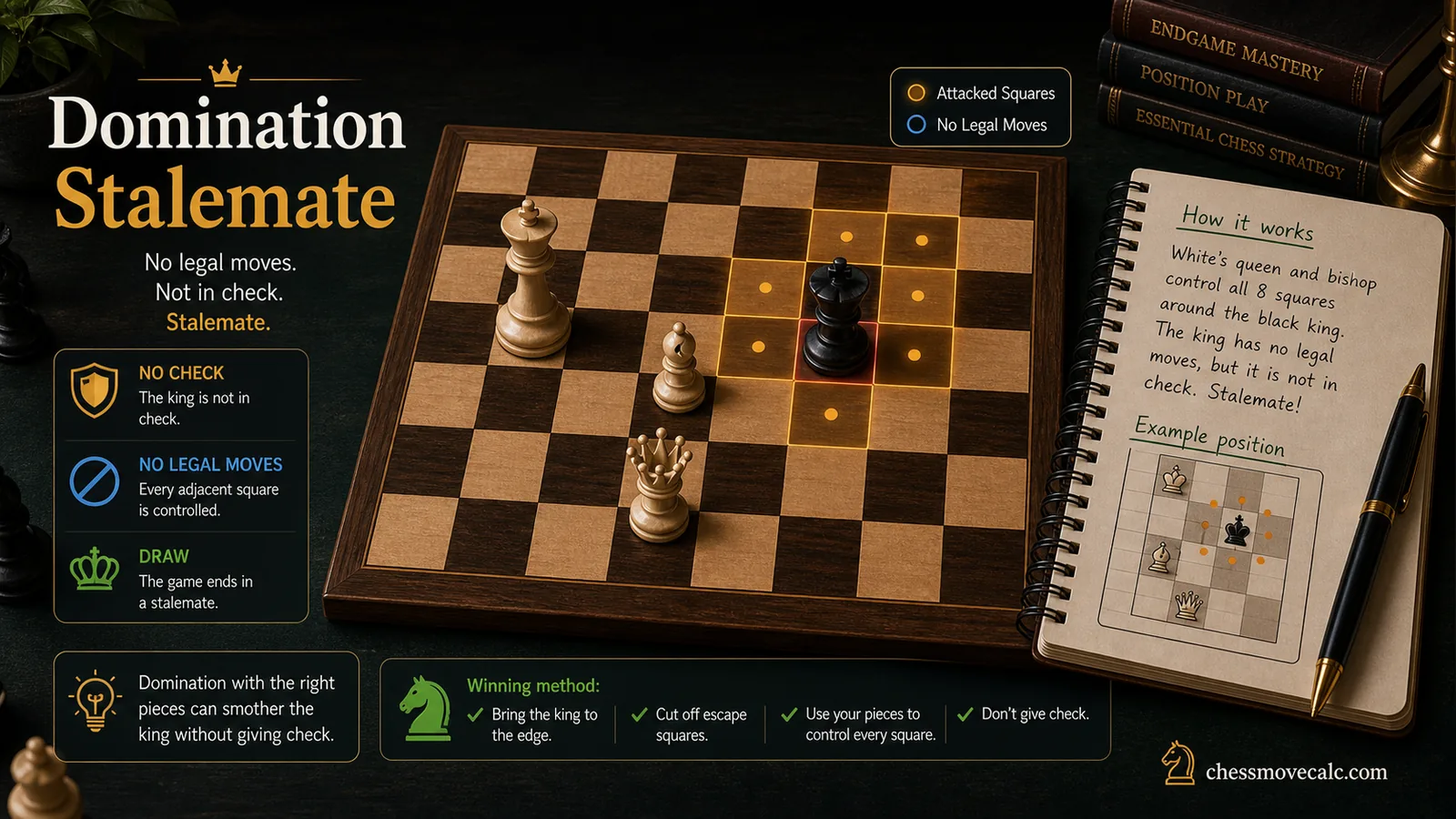
the phrase becomes much less strange once you reduce it to the legal definition.
Some chess searches are broad and practical. Others are oddly specific because they come from puzzles, arguments, or edge-case curiosity. Domination stalemate belongs to the second group. The phrase sounds unusual, but the underlying question is real: what does it mean to trap a king completely without checking it, and what is the smallest material that can do that legally?
That question matters because many quick answers online are sloppy. They confuse piece count with point value, they show illegal positions, or they present a king as stalemated when a legal move still exists. This page is meant to clean that up.
It also complements the practical anti-stalemate guide by showing the more puzzle-like side of total king restriction. One page is about avoiding blunders. This one is about understanding the edge-case geometry.
When handled carefully, this niche topic teaches something larger: stalemate is about legal move availability, not about how dominant the position looks emotionally.
That makes even this odd query surprisingly educational.
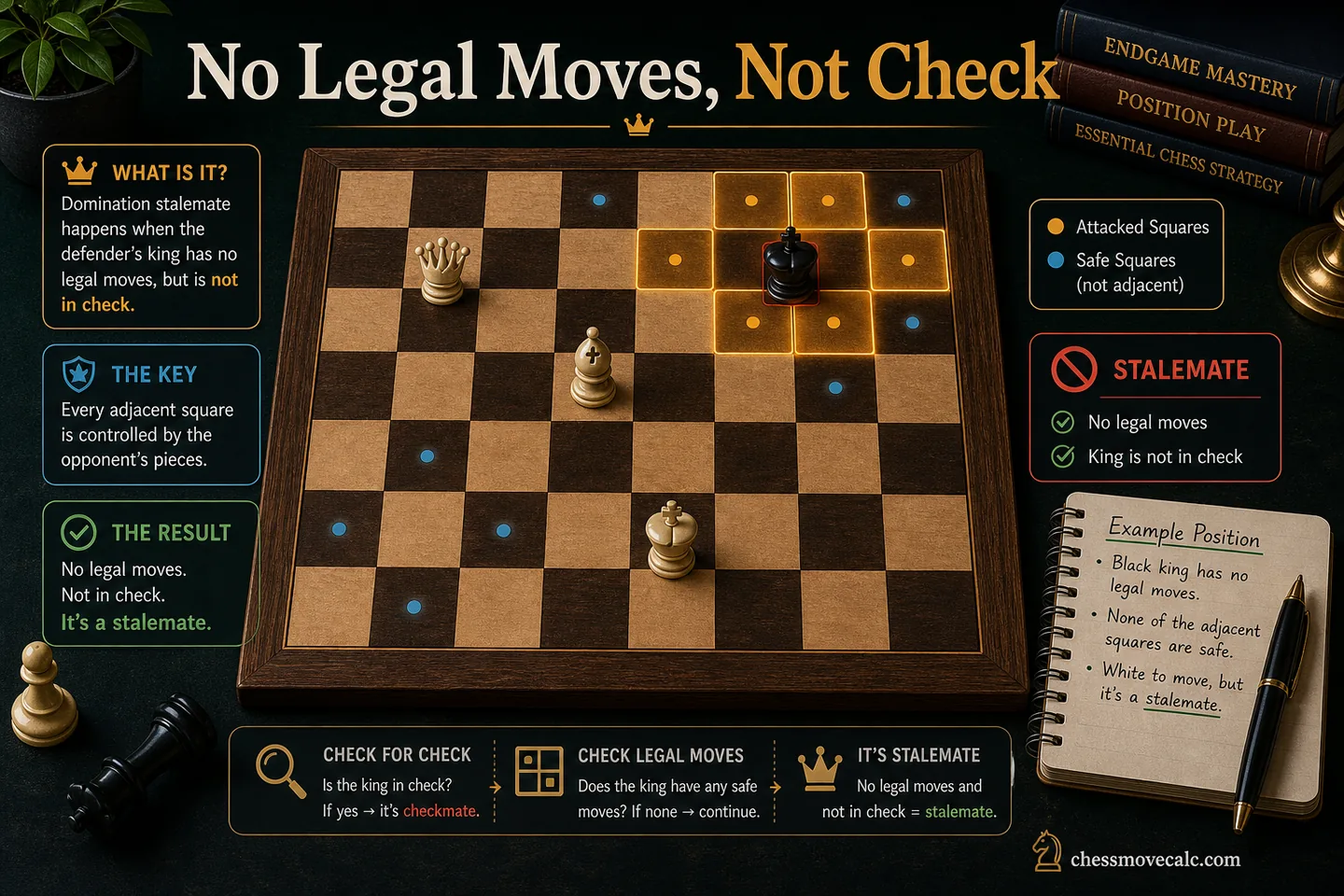
What “domination stalemate” actually means
The king has no legal moves, every escape square is controlled, and yet the king is not under direct attack. That is domination without check, which is why the result is stalemate rather than mate. The key is that the king feels trapped completely, but the final legal condition for mate is still missing.
This is what makes stalemate such an unintuitive rule for newer players. Total control does not automatically mean checkmate.
- That is domination without check, which is why the result is stalemate rather than mate.
- The key is that the king feels trapped completely, but the final legal condition for mate is still missing.
- This is what makes stalemate such an unintuitive rule for newer players.
- Total control does not automatically mean checkmate.
Legal core
No legal moves plus no check equals stalemate, even if the board looks overwhelmingly controlled.
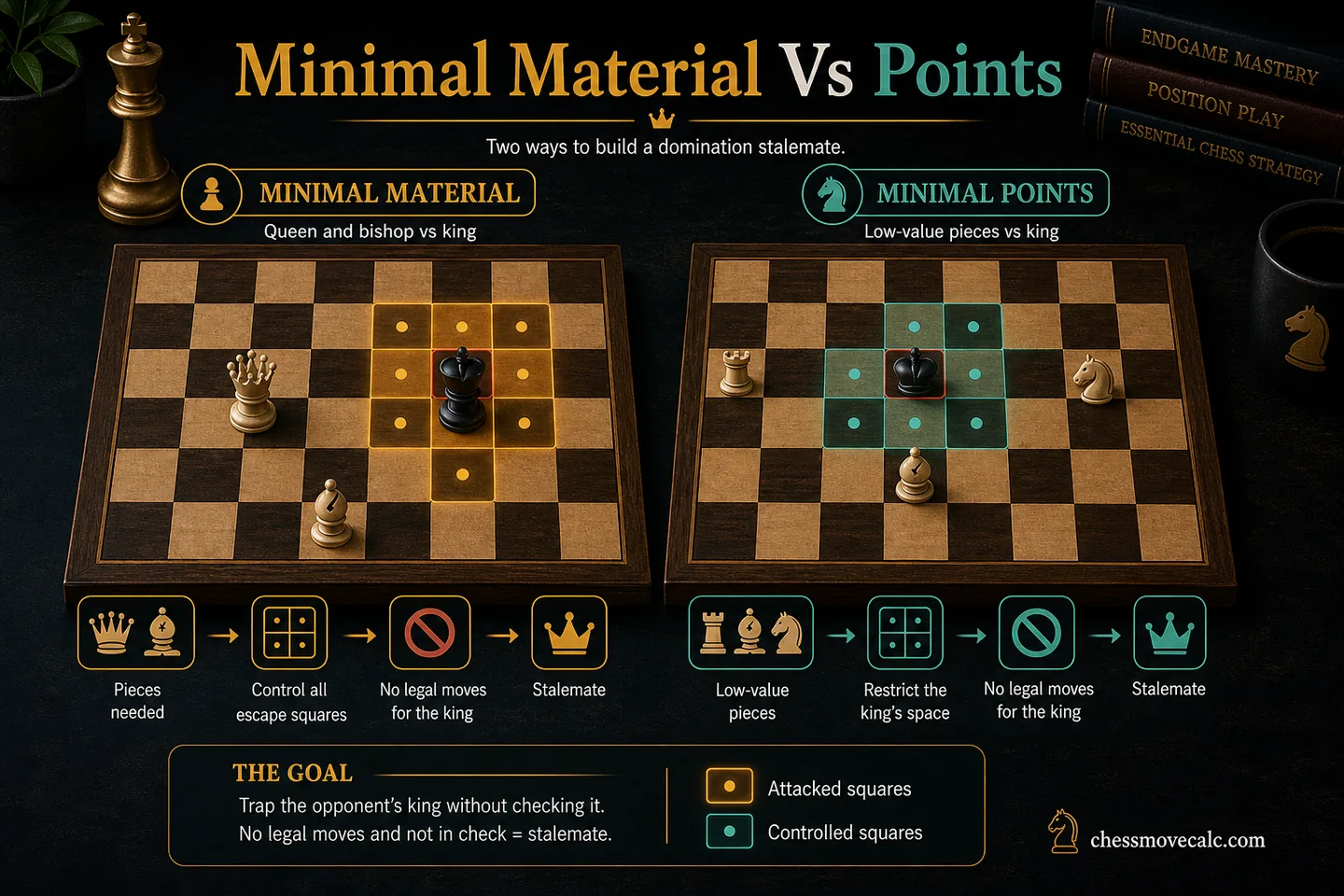
this distinction matters because the smallest number of pieces is not always the smallest amount of material value.
Minimal material vs minimal points explained
Some examples use very few pieces while others use slightly more pieces but fewer traditional point values. Piece count asks how many units are on the board. Point-value discussion asks how much material those units are considered to be worth.
Those are related but not identical questions. Separating them prevents a lot of messy online arguments.
- Piece count asks how many units are on the board.
- Point-value discussion asks how much material those units are considered to be worth.
- Those are related but not identical questions.
- Separating them prevents a lot of messy online arguments.
Do not mix the metrics
Fewest pieces and fewest points answer different versions of the same curiosity.
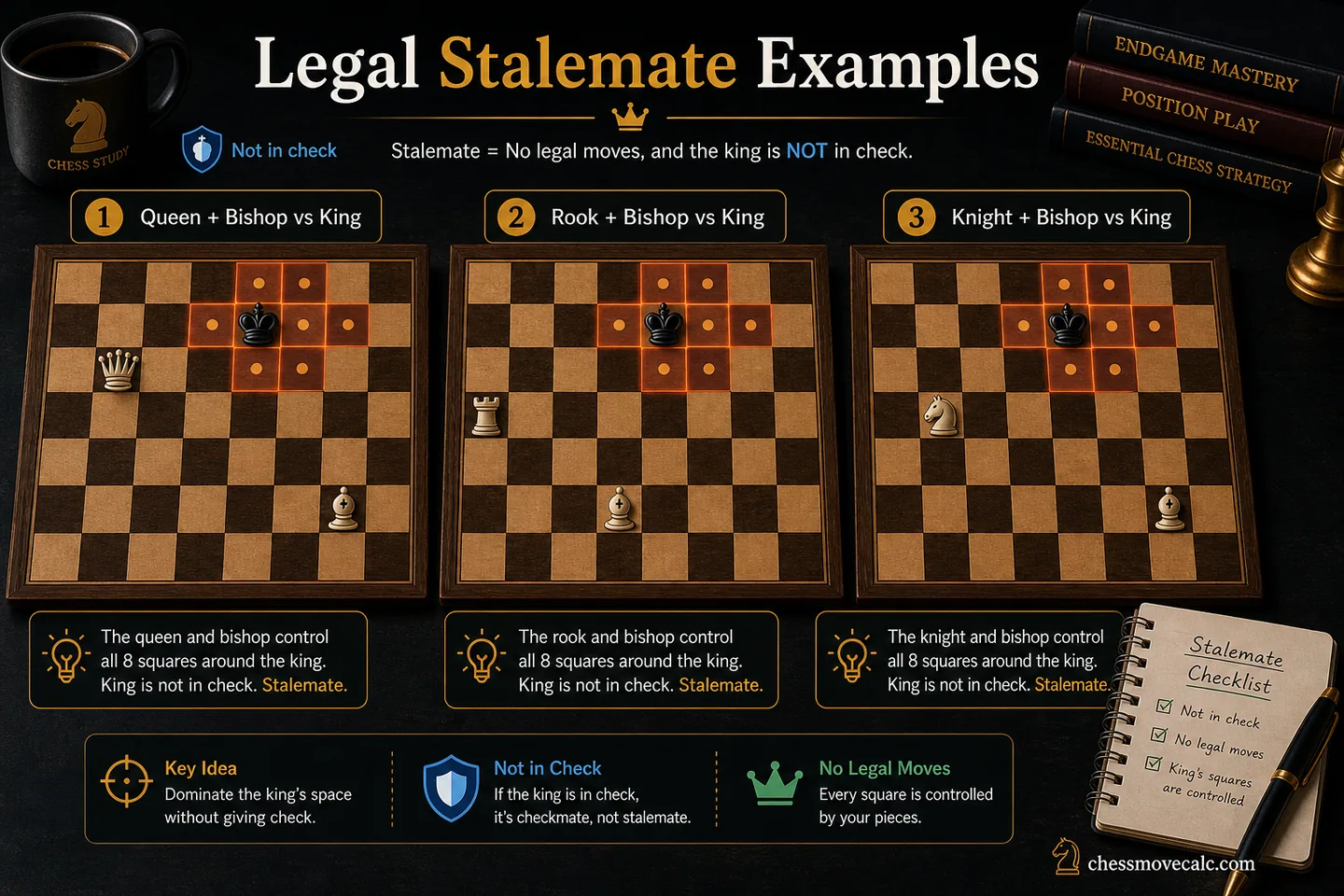
examples matter here because many people have never actually seen a legal version of the idea.
Legal domination-stalemate examples
The right examples show complete escape-square control while carefully avoiding direct check. A legal example proves the idea better than ten vague descriptions. It also teaches which surrounding pieces or king placements make the geometry work.
These examples are especially useful for puzzle solvers and endgame-curiosity readers. They turn the abstract phrase into something concrete and testable.
- A legal example proves the idea better than ten vague descriptions.
- It also teaches which surrounding pieces or king placements make the geometry work.
- These examples are especially useful for puzzle solvers and endgame-curiosity readers.
- They turn the abstract phrase into something concrete and testable.
Best question on each board
Ask two things: is the king checked, and does the king or any other piece have a legal move?
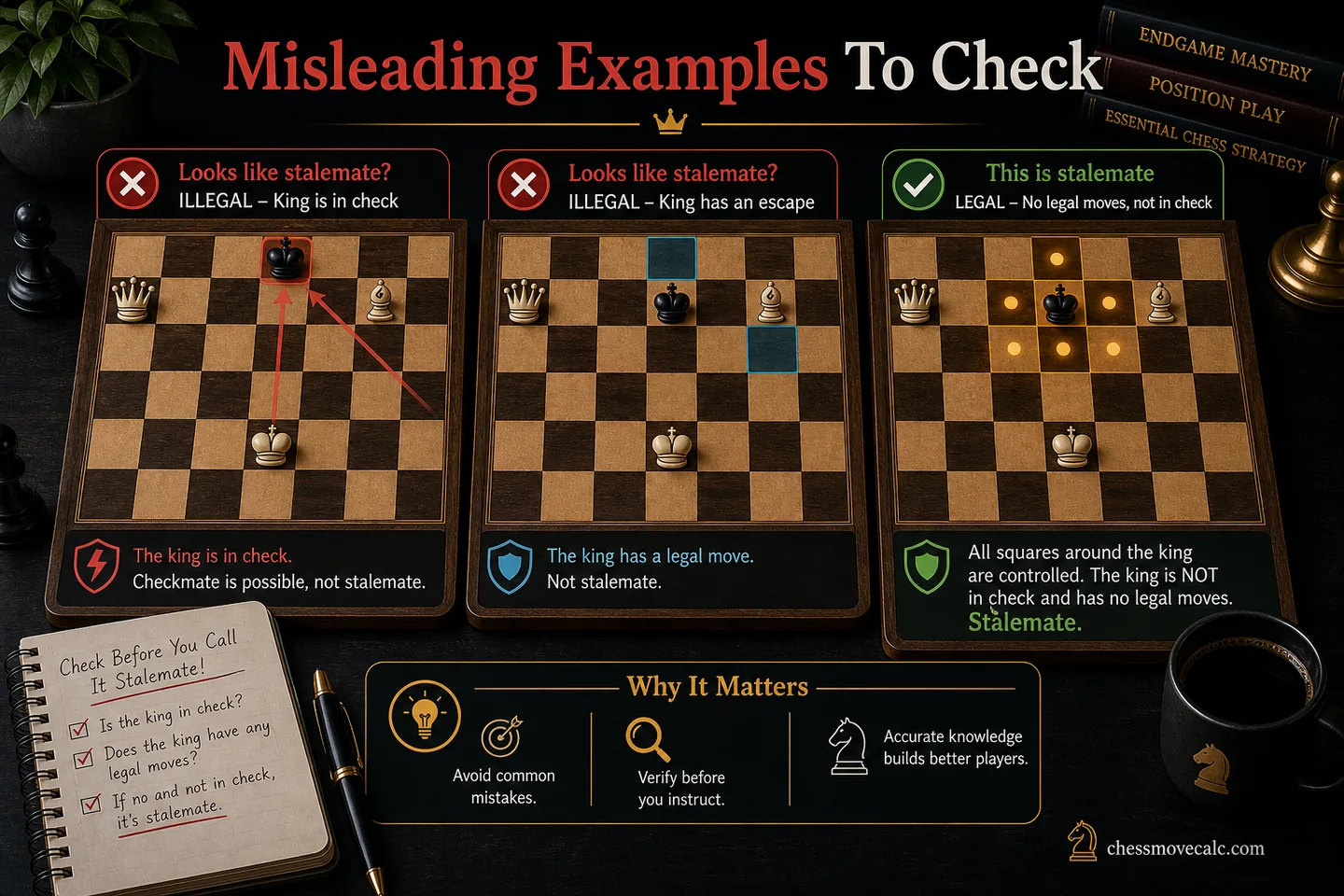
this topic is full of mislabeled diagrams because the eye is attracted to domination more than to legality.
Illegal or misleading examples people often repeat
A board can look beautifully trapped and still fail the actual stalemate test. Some famous-looking examples are actually checkmate because the king is directly attacked. Others are not stalemate at all because one hidden legal move still exists.
That is why legal verification matters more than visual drama. A careful reader should trust the rule first and the aesthetic second.
- Some famous-looking examples are actually checkmate because the king is directly attacked.
- Others are not stalemate at all because one hidden legal move still exists.
- That is why legal verification matters more than visual drama.
- A careful reader should trust the rule first and the aesthetic second.
Verify, do not assume
Edge-case chess examples should always be checked move by move, not judged by appearance alone.
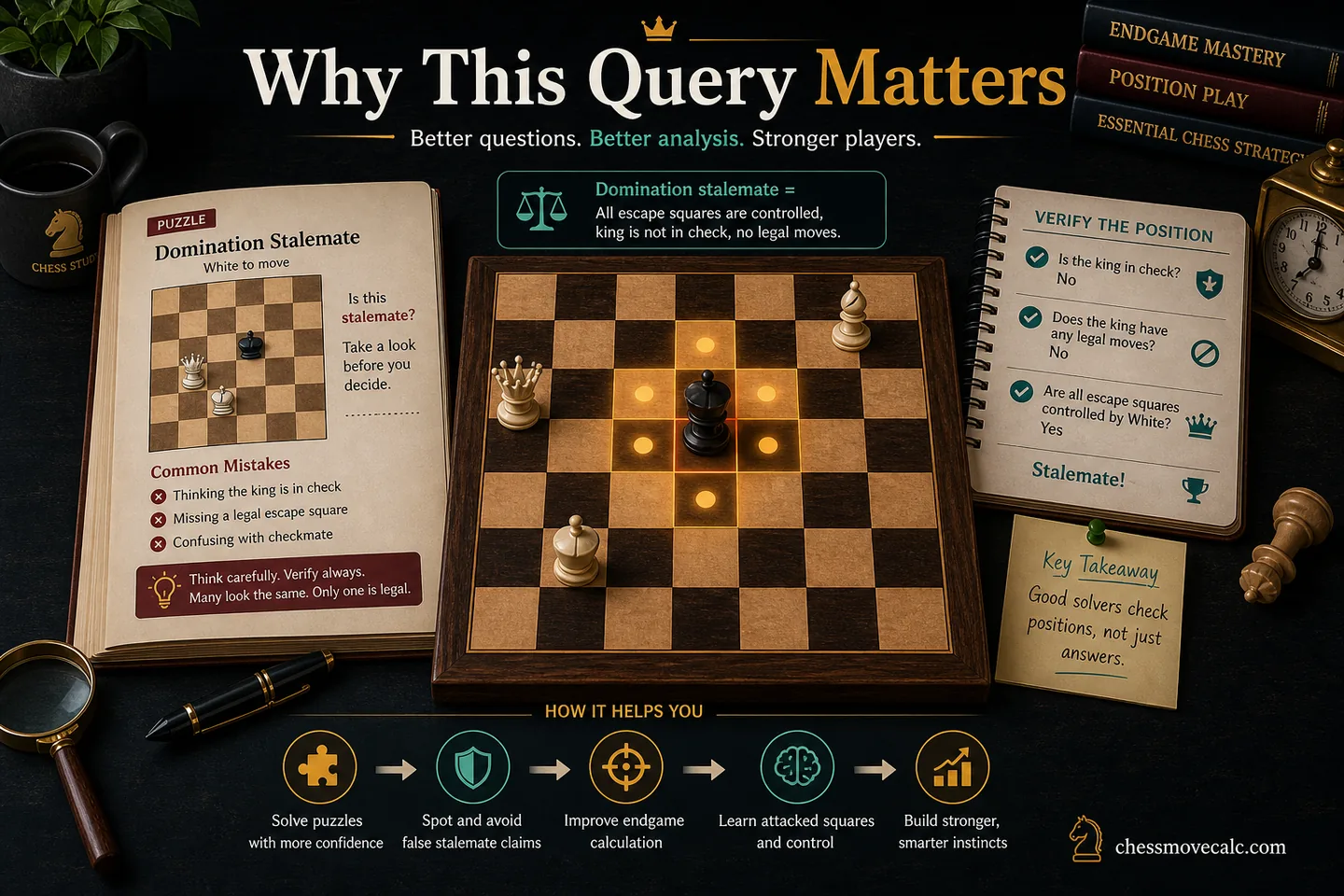
even niche stalemate questions teach practical habits about legal move counting and king restriction.
Why this weird query matters for real players and puzzle solvers
Understanding this edge case makes you better at verifying endings, spotting draw resources, and reading puzzle geometry accurately. Puzzle solvers benefit because many studies depend on exact legal-state awareness. Practical players benefit because accidental stalemate prevention uses the same legal mindset.
The topic is niche, but the habit it teaches is broadly useful. That is why a strange query can still deserve a serious answer.
- Puzzle solvers benefit because many studies depend on exact legal-state awareness.
- Practical players benefit because accidental stalemate prevention uses the same legal mindset.
- The topic is niche, but the habit it teaches is broadly useful.
- That is why a strange query can still deserve a serious answer.
Bigger lesson
The real value of this page is not the trivia. It is the legal precision it teaches.
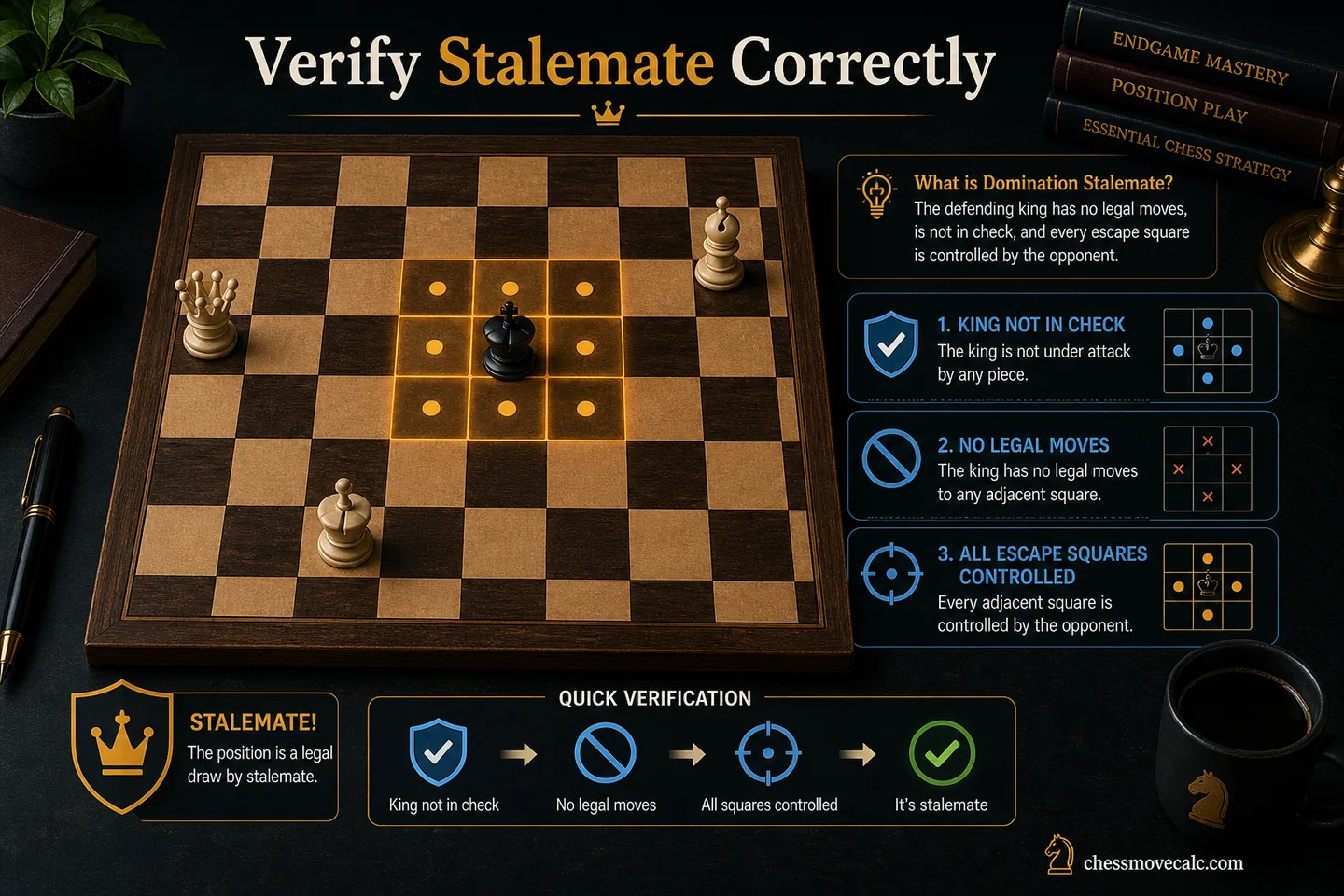
Legal verification matters more than visual drama in edge-case stalemate positions.
How to verify a suspected domination stalemate correctly
This topic becomes useful when it trains you to verify legality carefully instead of trusting how dramatic the board looks. Check first whether the king is directly attacked; if it is, the position is not stalemate. Then check whether any legal king move or other legal move still exists.
Separate the visual idea of domination from the legal result you are naming. Keep piece-count questions separate from point-value questions so the discussion stays clean.
A stronger habit is to ask what decision this concept should improve the very next time it appears. This verification habit is useful far beyond one niche query. It strengthens puzzle accuracy and endgame precision more generally.
That bridge is often the missing ingredient between reading an article once and truly keeping the lesson when the position becomes real.
- Check first whether the king is directly attacked; if it is, the position is not stalemate.
- Then check whether any legal king move or other legal move still exists.
- Separate the visual idea of domination from the legal result you are naming.
- Keep piece-count questions separate from point-value questions so the discussion stays clean.
- This verification habit is useful far beyond one niche query.
- It strengthens puzzle accuracy and endgame precision more generally.
Practical takeaway
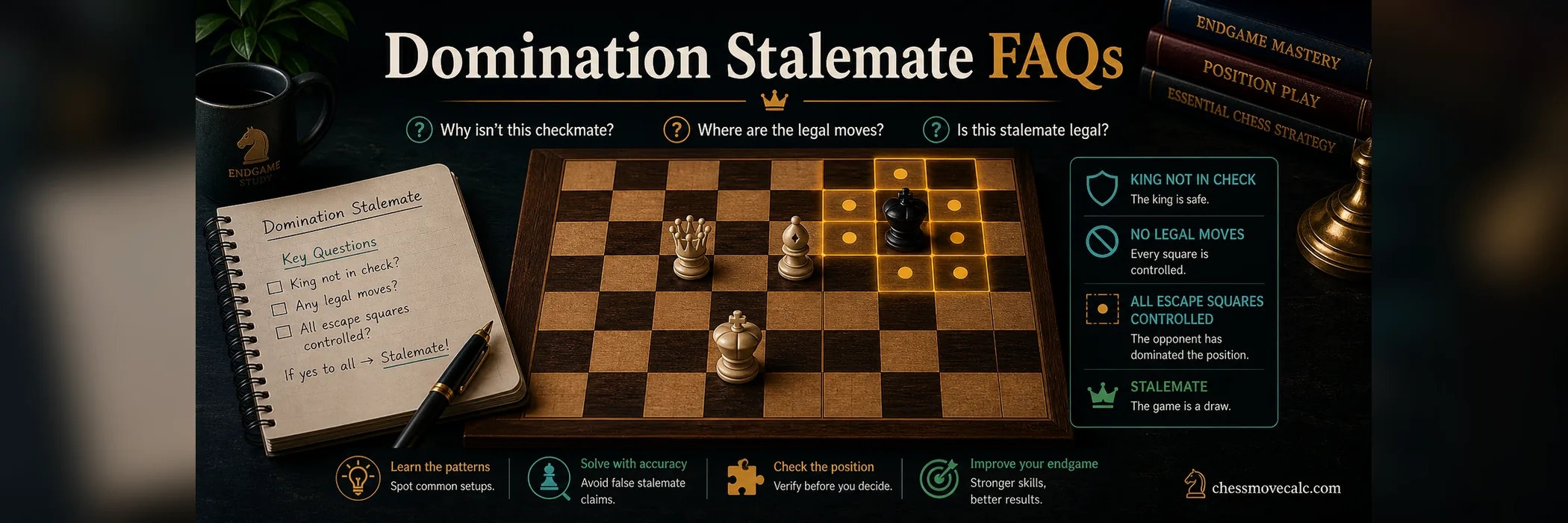
Domination Stalemate in Chess: Minimal Material Guide FAQs
What does domination stalemate mean in chess?
It means the king is completely trapped with no legal move, but is not actually in check.
What is the difference between minimal material and minimal points?
Minimal material asks about the fewest pieces, while minimal points asks about the lowest traditional material value.
Can domination stalemate be legal without checking the king?
Yes. That is exactly what makes it stalemate instead of checkmate.
Why are so many online examples wrong?
Because they often look convincing visually while failing the actual legal test.
Is this only useful for puzzles?
It is especially useful for puzzles, but it also sharpens your endgame legality awareness.
What is the main practical lesson?
Always verify whether the king is in check and whether any legal move still exists before naming the result.
Test edge-case endings on a live board
Use the solver and analysis pages to verify whether a strange-looking ending is really stalemate, mate, or something in between.