You just finished an intense chess game. Maybe you won brilliantly, maybe you blundered away a winning position. But here's the real question: do you know why?
The secret to rapid chess improvement isn't just playing more games—it's analyzing the games you've already played. Proper chess game analysis reveals your blind spots, solidifies your strengths, and transforms losses into valuable lessons. In this comprehensive guide, you'll learn how to analyze chess games like a professional using free tools, identify critical moments, and create a systematic improvement plan.
Why This Matters
A single analyzed game teaches you more than ten games played on autopilot. Chess analysis is how grandmasters improve—and now you can use the same techniques with free, powerful chess position analysis tools.
Why Analyze Your Chess Games?
Many players make the critical mistake of jumping into their next game immediately after a loss. This is called "tilt-queueing" and it reinforces bad habits. Post-game analysis breaks this cycle and provides concrete benefits:
- Find your mistakes and patterns: Discover whether you're prone to tactical oversights, positional errors, or time-pressure blunders.
- Learn more from losses than wins: A well-analyzed loss is infinitely more valuable than an unexamined win. Your opponent punished your mistakes—find out what they were.
- Track improvement over time: Watching your average centipawn loss decrease and blunder frequency drop is incredibly motivating.
- Build opening repertoire: Identify where you deviate from theory and whether those deviations work.
Start treating chess game analysis as an essential part of your training routine, not an optional chore. The players who improve fastest are those who analyze chess games consistently.
Using a Computer Chess Engine
Gone are the days when you needed a grandmaster coach to point out your errors. Modern chess analysis engines like Stockfish provide superhuman evaluation for free. But you need to understand how to interpret what they're telling you.
Understanding the Evaluation Bar
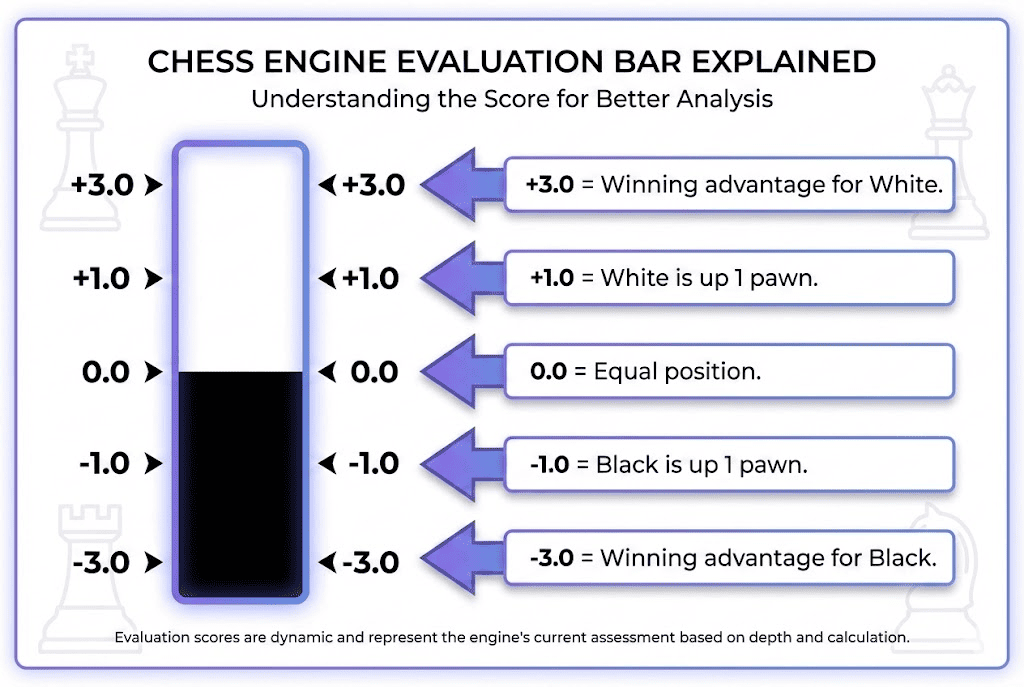
Understanding the evaluation bar is crucial for effective chess position analysis
The evaluation bar is your compass during chess analysis. It shows who's winning and by how much:
- +1.0: White has an advantage equivalent to one pawn (roughly 100 centipawns)
- -2.5: Black is winning by roughly 2.5 pawns (250 centipawns)
- 0.00: The position is completely equal—a balanced game
- ±3.0 or more: A decisive, often winning advantage
- M5, M12: Forced checkmate in 5 moves, 12 moves, etc.
Pro Tip: Centipawn Understanding
A centipawn is 1/100th of a pawn. So an evaluation of +50 centipawns (or +0.50) means White is ahead by half a pawn's value. This is the standard unit for measuring position strength in stockfish analysis.
How to Use Our Free Chess Calculator
You don't need expensive software subscriptions. Our Free Chess Calculator powered by Stockfish 16 lets you analyze chess positions at grandmaster strength.
Simple workflow:
- Set up the position from your game where you felt confused or where the evaluation swung dramatically
- Click "Analyze" to see the engine's top recommended move
- Compare the engine's suggestion to the move you actually played
- Understand why the engine's move is better—this position analyzer will often reveal tactics you completely missed
Step-by-Step Analysis Process
Don't just turn on the engine and blindly accept its suggestions. Follow this structured chess analysis process to truly learn from your games.
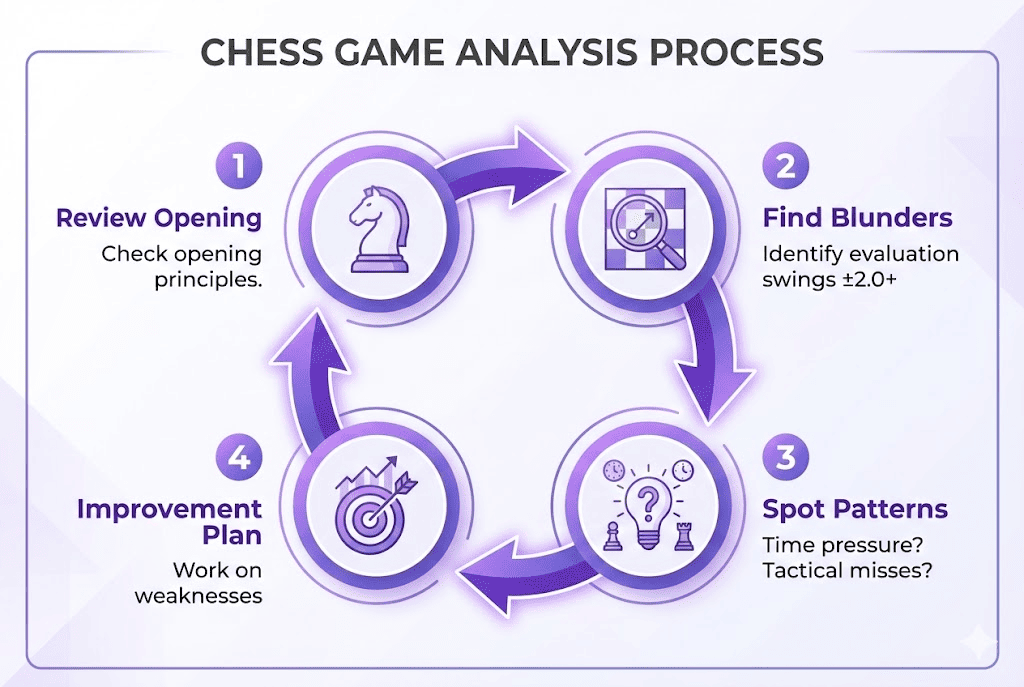
The systematic 4-step approach to analyzing any chess game
Step 1: Review the Opening
Did you survive the opening phase with equality, or were you already in trouble by move 10? An opening review reveals whether you need to study theory or if you made conceptual mistakes.
Key questions for opening analysis:
- Did you control the center with pawns (e4, d4, e5, d5)?
- Did you develop your pieces efficiently (knights before bishops, castle early)?
- Did you ensure king safety before launching an attack?
- Where did you deviate from known opening theory, and was it justified?
Identifying opening mistakes early prevents you from starting every middlegame already behind. If you consistently get bad positions from the opening, invest time studying that specific opening line on chess resources.
Step 2: Find Critical Moments (Blunders)
This is the most painful but absolutely necessary part of chess game analysis. Use the engine to find blunders—moves where the evaluation swung dramatically.
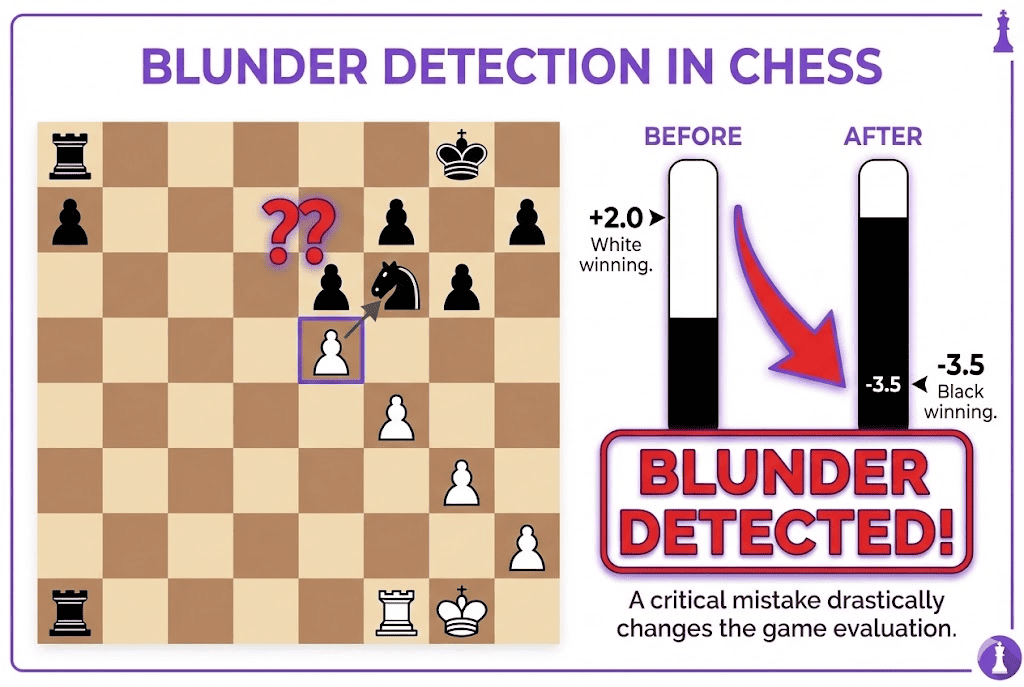
A blunder: evaluation swings from White winning (+2.0) to Black winning (-3.5) in one move
Focus on moves where the evaluation changes by ±2.0 or more. These are critical moments where the game's outcome likely changed. Ask yourself:
- "What did I miss?" Was it a tactical blow, a piece trap, or a defensive resource?
- "Why did I play this move?" Understand your flawed thought process.
- "What was the correct move?" Study the engine's suggestion until you understand why it's better.
Common Analysis Trap
Don't spend 20 minutes analyzing a position where the evaluation went from +0.3 to +0.1. That's noise. Focus on the big chess mistakes—the game-changing blunders. This is efficient analysis.
Step 3: Identify Patterns
One isolated mistake is bad luck; three identical mistakes is a pattern that needs fixing. Look for recurring themes in your chess patterns:
- Time trouble mistakes: Do you regularly blunder when you have less than 30 seconds?
- Tactical blindness: Do you consistently miss knight forks, pins, or back-rank mates?
- Endgame weakness: Do you throw away winning endgames because you don't know the technique?
- Positional errors: Do you ignore pawn structure or piece activity?
This weakness identification is gold. Once you know your specific problem areas, you can target them with focused practice.
Step 4: Create an Improvement Plan
Analysis without action is useless. Based on your identified weaknesses, create a concrete improvement plan:
- If you miss tactics: Solve 20 chess puzzles daily on Lichess or Chess.com
- If you struggle in endgames: Study fundamental endgames (King + Pawn vs King, Rook endgames)
- If your opening is weak: Learn one solid opening for White and one for Black
- If you blunder in time trouble: Play longer time controls or practice faster calculation
This systematic approach is exactly how to get better at chess. You're not guessing—you're diagnosing specific problems and fixing them methodically.
Understanding Move Annotations
When studying master games or using analysis software, you'll see specific symbols describing move quality. These chess annotations help you quickly scan analysis and understand which moments mattered most.
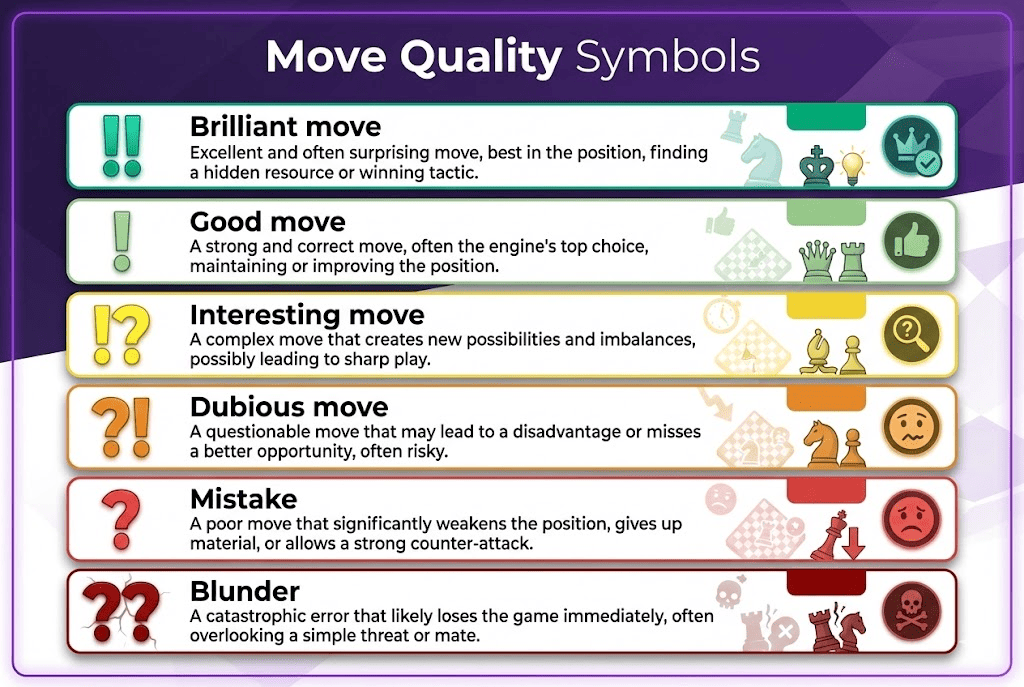
Master these move symbols to read professional chess analysis like a pro
Standard Chess Annotation Symbols
- !! (Brilliant Move): An exceptional, often surprising move that's hard to find. Usually involves a deep sacrifice or tactical blow. The best move in a complex position.
- ! (Good Move): A strong, correct move—often the engine's top choice. It maintains or improves the position.
- !? (Interesting/Speculative Move): A creative move that creates complications and imbalances. Objectively might not be best, but poses practical problems.
- ?! (Dubious Move): A questionable move that may lead to a disadvantage or misses a better opportunity. Often risky without clear justification.
- ? (Mistake): A poor move that significantly weakens your position, gives up material, or allows a strong counter-attack. Inaccuracy with consequences.
- ?? (Blunder): A catastrophic error that likely loses the game immediately. Often overlooks a simple tactic, threat, or allows checkmate.
Understanding these move symbols makes reading annotated games and engine analysis much faster. When you see "??", you know to pay close attention to what went wrong.
Free vs Paid Analysis Tools Comparison
You have many options for chess analysis. Here's an honest comparison of the best chess analysis tools available:
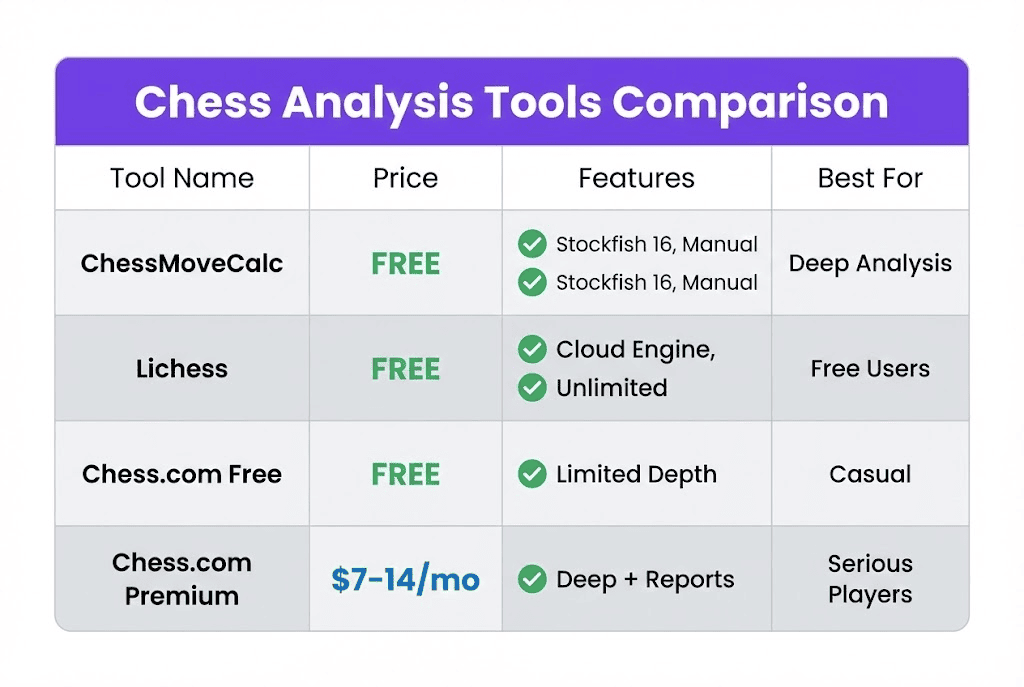
Choose the right tool for your analysis needs—you don't need to pay for quality
Tool-by-Tool Breakdown
ChessMoveCalc (Our Free Calculator):
- Price: FREE
- Engine: Stockfish 16, latest version
- Best for: Deep, manual position analysis. Perfect for studying specific critical positions from your games.
- Limitation: Manual setup—you analyze one position at a time, not auto-annotated full games.
Lichess (Free Cloud Analysis):
- Price: FREE
- Engine: Cloud-based Stockfish, unlimited depth
- Best for: Casual players who want automated game analysis after every match. Excellent for quick reviews.
- Advantage: Fully automated—request analysis and get annotated PGN with mistakes/blunders highlighted.
Chess.com Free Tier:
- Price: FREE
- Engine: Limited depth analysis
- Best for: Beginners wanting simple feedback on major mistakes.
- Limitation: Daily analysis limit, shallow depth (won't catch deep tactics).
Chess.com Premium ($7-14/month):
- Price: $7-14/month subscription
- Engine: Deep Stockfish + detailed reports
- Best for: Serious players who want unlimited detailed analysis with accuracy graphs, opening explorer integration, and personalized insights.
- Advantage: Beautiful UI, comprehensive reports, tracks long-term improvement patterns.
Our Recommendation
For most players, the combination of Lichess for automated full-game analysis + ChessMoveCalc for deep critical position study gives you grandmaster-level free analysis tools without spending a cent. Only upgrade to premium if you value the convenience and UI of Chess.com's reports.
Common Analysis Mistakes to Avoid
Even when analyzing games, players make avoidable errors. Here's how not to analyze:
Mistake #1: Only Analyzing Losses
You make mistakes in games you win too—your opponent just failed to punish them. Analyze wins to find where you got lucky and could have been punished. This prevents overconfidence and reveals hidden weaknesses.
Mistake #2: Spending Too Much Time on Irrelevant Positions
If the engine evaluation changed by 0.1 pawns, don't waste 15 minutes on that position. Focus on the critical moments where evaluations swung by 2+ pawns. This is efficient, targeted analysis.
Mistake #3: Passive Studying
Don't just stare at the engine's suggestion. Before checking the engine's line, try to guess the best move yourself. Active engagement burns the lesson into your brain far better than passive observation.
Mistake #4: Not Writing Down Lessons
Keep an analysis notebook (digital or physical). After each analysis session, write down 1-3 key takeaways: "I need to check for back-rank mates before trading rooks" or "In this pawn structure, the bishop is superior to the knight." Reviewing these notes weekly reinforces learning.
Mistake #5: Analysis Paralysis
Don't spend 3 hours analyzing a 10-minute blitz game. Diminishing returns kick in fast. A good rule: spend 1/3 to 1/2 of the game length on analysis. 10-minute game = 3-5 minute analysis. 60-minute classical game = 20-30 minute analysis.
Frequently Asked Questions
How long should I spend analyzing one game?
For a rapid game (10-15 minutes), spend 10-15 minutes on analysis. For a classical game (60-90 minutes), invest 30-60 minutes in deep analysis. The key is focusing on critical moments, not analyzing every move. Quality over quantity.
Should I analyze every game I play?
No, that's overkill and leads to burnout. Analyze 1-2 games per week deeply rather than 10 games superficially. Choose games where: (1) the result surprised you, (2) you made a comeback or choked a lead, or (3) you faced an unfamiliar opening. These teach the most.
What depth should the engine analyze to?
Depth 20-22 is sufficient for 99% of amateur analysis. Our chess calculator runs to high depths automatically. Beyond depth 25, improvements are marginal unless you're analyzing grandmaster-level endgames or extreme tactics.
How do I export games from Chess.com to analyze here?
Click on your completed game on Chess.com, then click "Analysis" → "Copy PGN." Paste this into our Notation Converter or manually set up key positions on our board to get Stockfish analysis.
Is analyzing with an engine enough, or do I need a coach?
Engines excel at tactics and calculation but struggle with explaining why positional moves are good. Engines show what to do; coaches explain why. Use engines for self-study, but consider a coach if you plateau or want personalized guidance on strategy and planning.
How do I know if I'm improving from analysis?
Track metrics over time: (1) Average centipawn loss per game (lower is better), (2) Blunders per game (should decrease), (3) Rating trend (upward trajectory). Chess.com and Lichess provide these stats. If you analyze consistently but don't see improvement after 2-3 months, reassess your improvement plan.
Ready to Analyze Your Chess Games?
Take your latest game and start analyzing with our free Stockfish 16-powered calculator. Find your mistakes, understand critical moments, and improve systematically. No registration, no cost—just pure chess improvement.
Open Free Chess Calculator