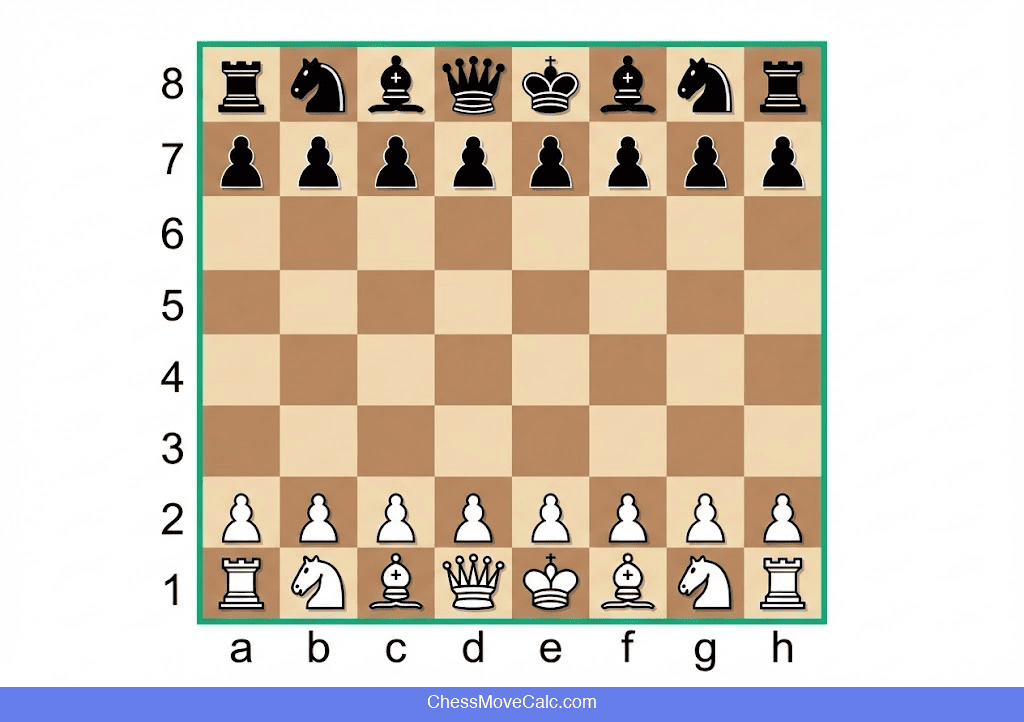
Complete chess board setup - notice the white square in the bottom-right corner and queen on her color
Setting up a chess board correctly is the first step every player must master. Whether you're a complete beginner or just need a refresher, this comprehensive guide covers everything about chess board setup and chess piece placement. The most common questions? "Where does the queen go?" and "Which square should be in the corner?" We'll answer both with clear diagrams, memory tricks, and step-by-step instructions. By the end of this guide, you'll never set up your chess board wrong again.
The Golden Rule: "White on Right"
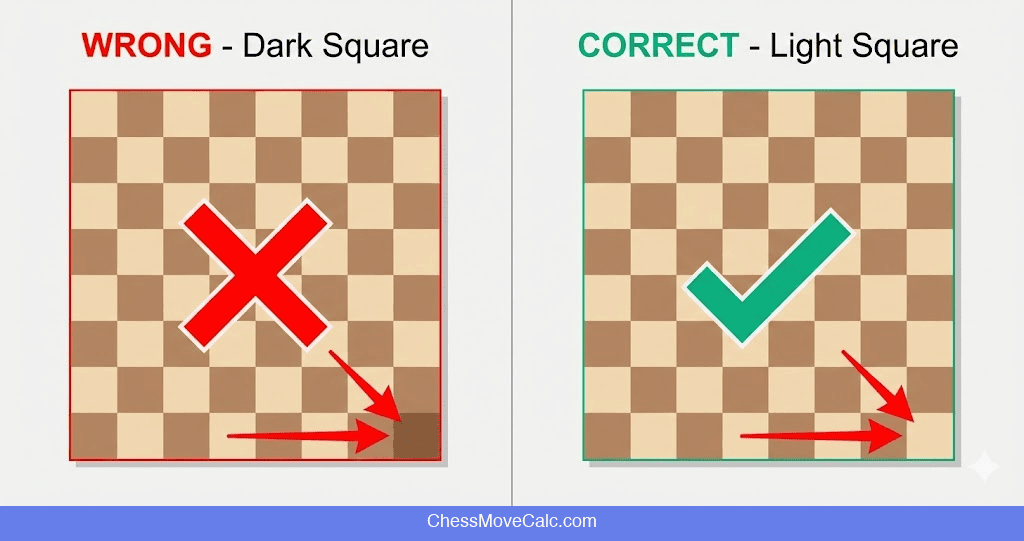
✗ WRONG: Dark corner | ✓ CORRECT: Light corner - Remember "White on Right"
Before placing any pieces, you must orient the board correctly. The single most important rule for chess board setup is: The bottom-right square MUST be a white (light-colored) square.
Memory Phrase
"White on Right" or "Light on Right"
Why it matters: If you flip the board 90 degrees, all the pieces will be on wrong squares. The files (columns) are labeled a-h from left to right for White, and the ranks (rows) are numbered 1-8 from bottom to top for White. Getting this wrong means notation won't work and you can't share positions with others.
Common Mistake
Many beginners set up with a black/dark square in the bottom-right corner. This is backwards! Always check this FIRST before placing pieces.
Memory Tricks for Board Orientation:
- "White on right, game is right"
- "Light on right, setup's right"
- "Check your corner, make it lighter"
Queen on Her Color - The #1 Rule
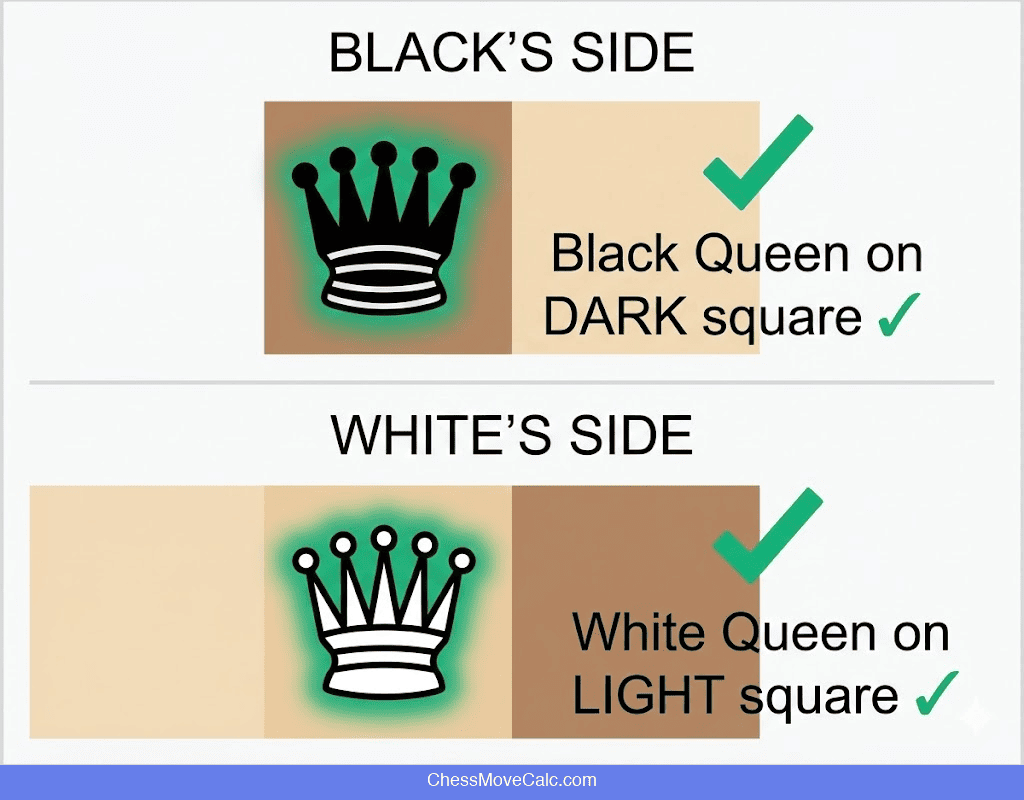
The #1 Rule: Queen on her own color! White queen on light d1, Black queen on dark d8
Question: Where does the queen go on a chess board?
Answer: The queen ALWAYS goes on her own color.
- ⚪ White Queen → White (Light) Square (d1)
- ⚫ Black Queen → Black (Dark) Square (d8)
This is THE most searched chess setup question. Why? Because queens and kings look similar, and it's easy to swap them!
Visual Check
✓ Look at your white queen. Is she standing on a light-colored square? Correct!
✓ Look at your black queen. Is she standing on a dark-colored square? Correct!
Memory Tricks for Queen Placement:
- "Queen matches her dress" - The queen's color matches the square color
- "Queen on Color" - Simple and effective
- "Fashionable Queen" - Queens are fashionable and color-coordinate
The King Goes Next To Her:
- White King: e1 (5th square from left, on DARK square for White)
- Black King: e8 (5th square from left, on LIGHT square for Black)
Key Takeaway
If you remember nothing else from this guide, remember: Queen on her own color!
Complete Back Rank Setup (Rank 1 & 8)
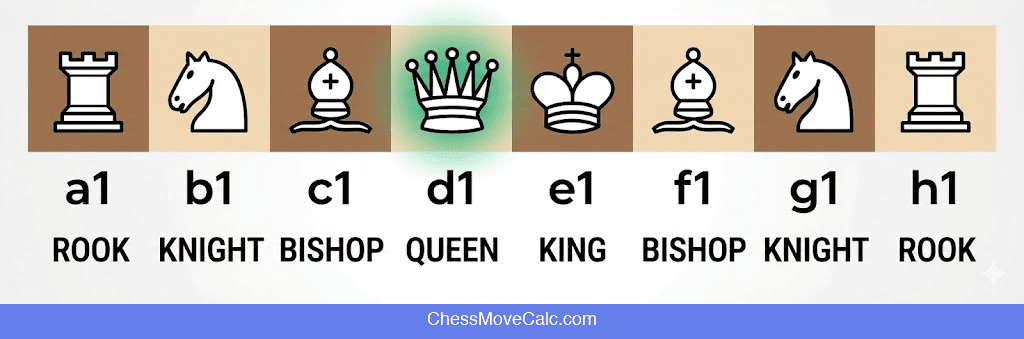
Back rank order: R-N-B-Q-K-B-N-R (Rook, Knight, Bishop, Queen, King, Bishop, Knight, Rook)
Now that you know board orientation and queen placement, let's set up the entire back rank (first row) for both sides. Both White and Black follow the same pattern, just mirrored.
Step-by-Step Back Rank Order (From Left to Right)
1️⃣ Rooks in the Corners (a1, h1, a8, h8)
The rooks (castle-shaped pieces) always go in the corners. Think: "Rooks guard the corners like castle towers." White rooks on a1 and h1. Black rooks on a8 and h8.
2️⃣ Knights Next to Rooks (b1, g1, b8, g8)
The knights (horse-shaped pieces) go right next to the rooks. They're the rook's loyal cavalry. White knights on b1 and g1. Black knights on b8 and g8.
3️⃣ Bishops Next to Knights (c1, f1, c8, f8)
Bishops (pieces with pointed tops) go next to knights. One bishop will be on a light square, one on a dark square. White bishops on c1 (dark) and f1 (light). Black bishops on c8 (light) and f8 (dark).
4️⃣ Queen and King in the Center (d1, e1, d8, e8)
The royalty goes in the middle. Remember: Queen on her own color! The king fills the remaining center square. For White: Queen on d1 (light square), King on e1 (dark square). For Black: Queen on d8 (dark square), King on e8 (light square).
Memory Mnemonics for Back Rank:
- "Rooks in the corners, knights by their side, bishops next, then royalty inside"
- "R-N-B-Q-K-B-N-R" (Spell it out)
- "Castle towers guard the edges, horses stand guard, clergy pray nearby, rulers reign in center"
Pawn Placement (Rank 2 & 7)
Pawns are the smallest pieces and form the front line of your army. Setting up pawns is simple:
- White Pawns: Place all 8 pawns on the 2nd rank (row 2). Every square from a2 to h2 gets a pawn.
- Black Pawns: Place all 8 pawns on the 7th rank (row 7). Every square from a7 to h7 gets a pawn.
Why Pawns Matter
Pawns protect the more valuable pieces behind them and control the center of the board.
Visual Check: After setup, you should see two ranks of pawns facing each other with four empty ranks (3rd, 4th, 5th, 6th) between them. This creates the starting position for the game.
Memory Trick:
- "Pawns are soldiers standing in front of their army"
Complete Chess Board with Coordinates
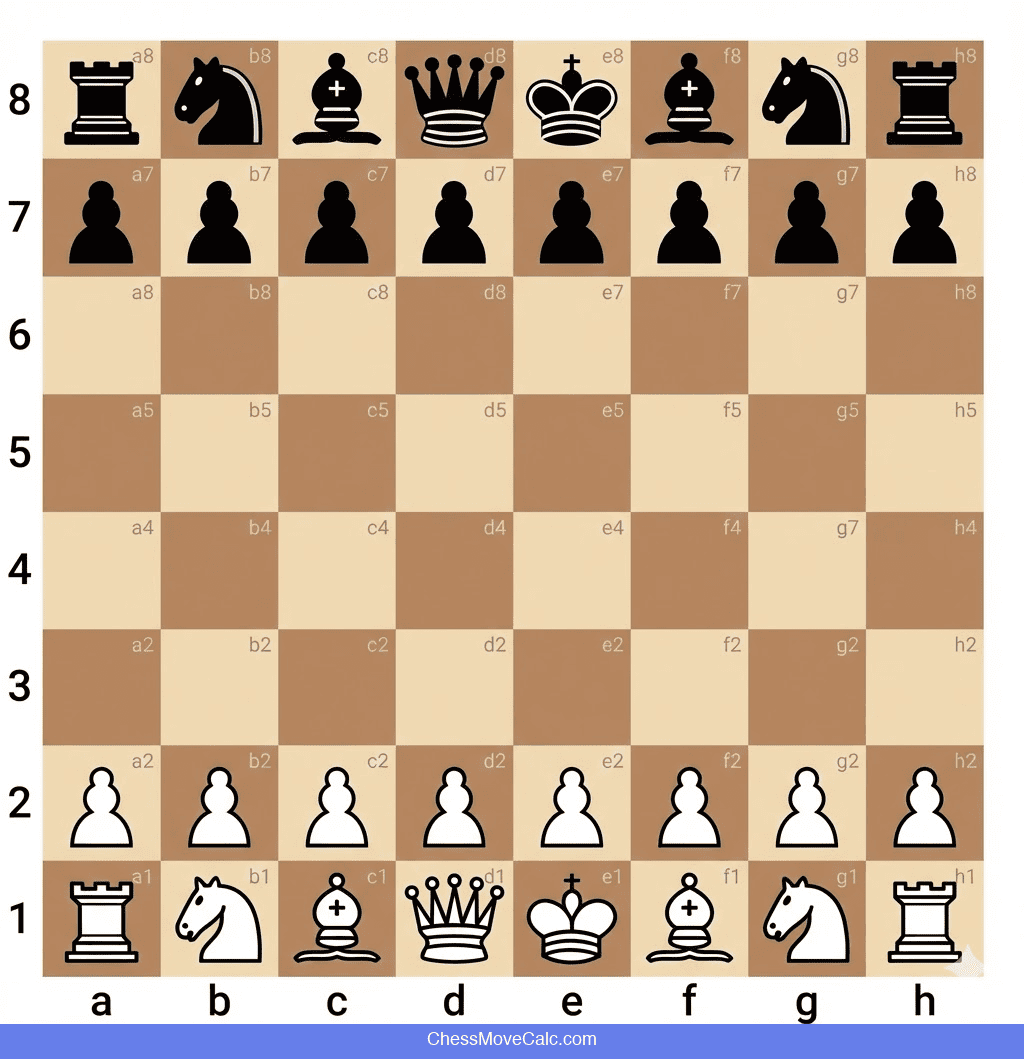
Complete board with algebraic notation - each square has a unique coordinate (file + rank)
Above is the complete chess board setup with algebraic notation labels. The files (vertical columns) are labeled a through h from left to right (from White's perspective). The ranks (horizontal rows) are numbered 1 through 8 from bottom to top.
How to Read Coordinates
Each square has a unique name combining file + rank. For example: "e4" = file e, rank 4. This notation system is used worldwide for recording chess moves.
Common Chess Board Setup Mistakes
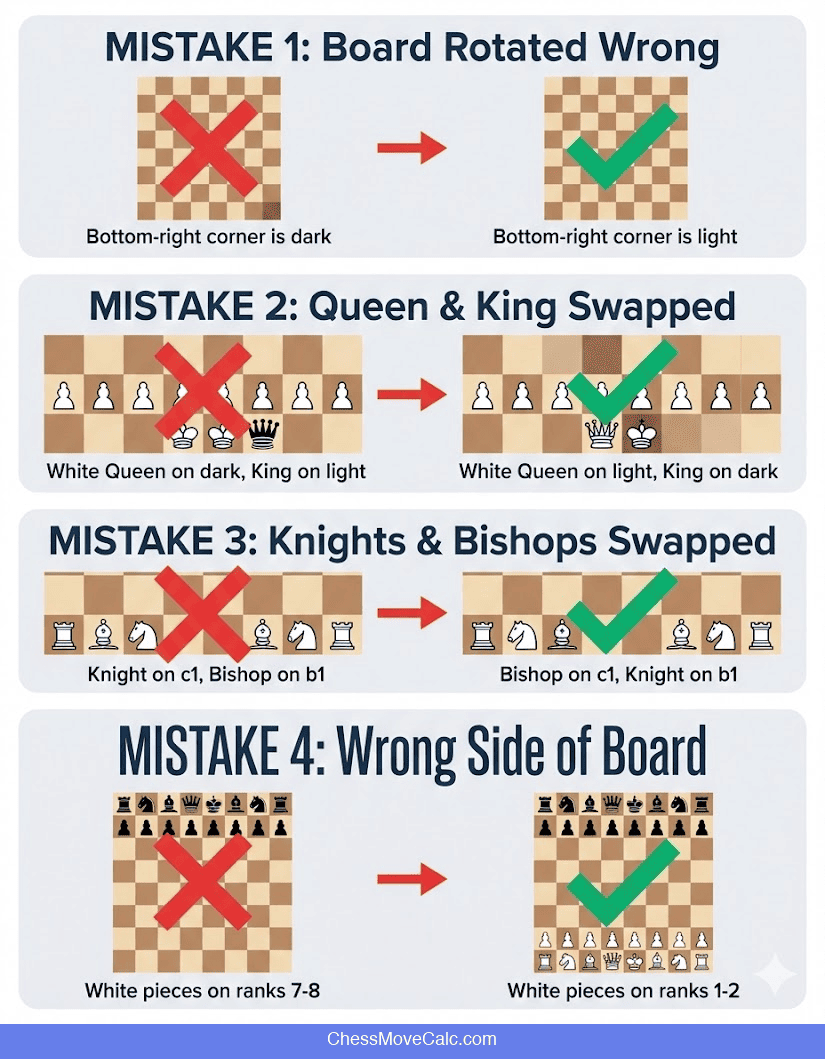
Avoid these 4 common mistakes when setting up your chess board
Mistake #1: Board Rotated Wrong (Dark Square on Right)
Symptoms: Bottom-right square is black/dark
Fix: Rotate board 90 degrees until bottom-right is white
Impact: This is the #1 setup mistake - makes all notation incorrect
Mistake #2: Queen and King Swapped
Symptoms: White queen on dark square (e1) or black queen on light square (e8)
Fix: Remember "Queen on color" - swap the king and queen positions
Impact: The queen should ALWAYS be on her matching color
Mistake #3: Knights and Bishops Swapped
Symptoms: Bishops on b1/g1 and knights on c1/f1
Fix: Knights go NEXT TO rooks (b1, g1). Bishops are one square further in (c1, f1)
Impact: Wrong piece development patterns
Mistake #4: Pieces on Wrong Side of Board
Symptoms: White pieces on ranks 7-8 instead of 1-2
Fix: White ALWAYS starts on ranks 1-2 (bottom). Black starts on ranks 7-8 (top)
Impact: Complete setup failure, game can't be recorded
Memory Tricks to Never Forget Setup
Board Orientation Tricks:
- "White on right, game is right"
- "Light on right, setup's right"
- "Check your corner, make it lighter"
Queen Placement Tricks:
- "Queen matches her dress"
- "Queen on her color"
- "Fashionable queen coordinates"
- "The queen likes her color"
Back Rank Order Tricks:
- "Rooks in corners, knights by their side, bishops next, royalty inside"
- "R-N-B-Q-K-B-N-R" (spell it out)
- "Castle towers guard the edges, horses stand guard, clergy pray nearby, rulers reign in center"
Visual Association Tricks:
- Rooks are castle towers → corners protect the kingdom
- Knights are cavalry → mobile, near the edges
- Bishops are religious figures → stand near royalty
- Queen and King → center of power
Quick Setup Checklist
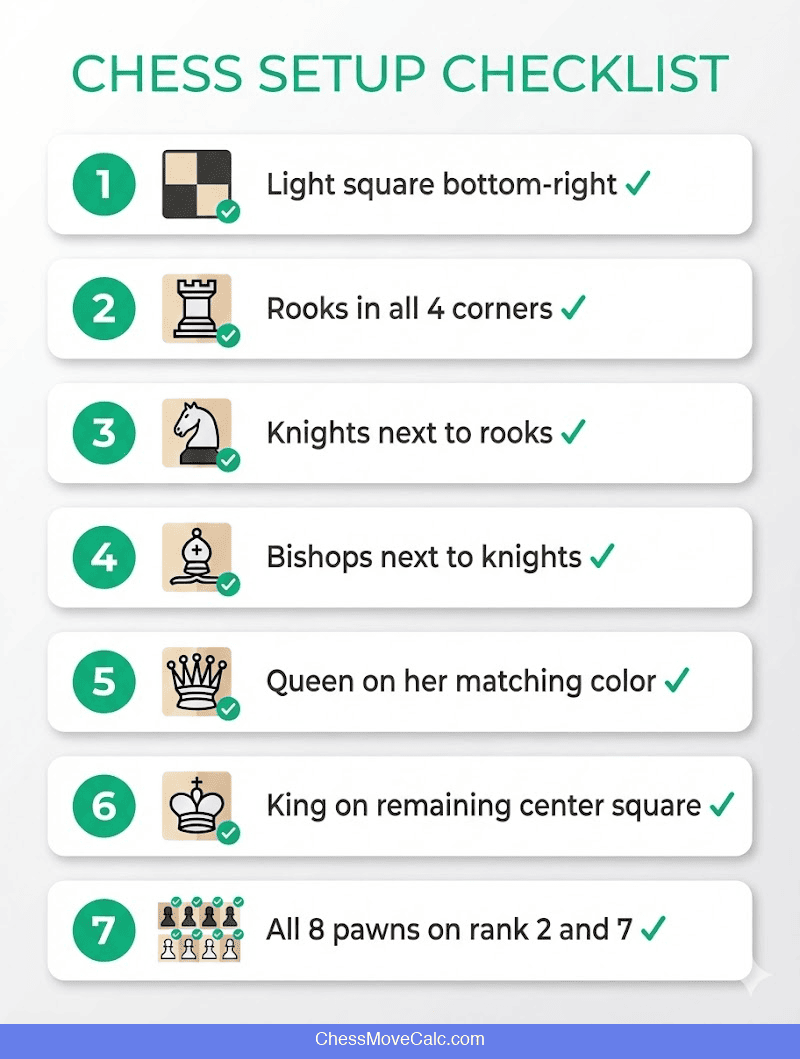
Your 7-step quick reference guide to perfect chess board setup
- Board oriented correctly (white/light square bottom-right)
- Rooks in all four corners (a1, h1, a8, h8)
- Knights next to rooks (b1, g1, b8, g8)
- Bishops next to knights (c1, f1, c8, f8)
- Queens on matching color (White queen on d1 light, Black queen on d8 dark)
- Kings on remaining center square (e1, e8)
- All 8 white pawns on rank 2 (a2-h2)
- All 8 black pawns on rank 7 (a7-h7)
- Two empty ranks between pawns (ranks 3-6)
Chess Board Setup FAQ
Which corner should be white?
The bottom-right corner (h1 for White, a8 from Black's perspective) should always be a white/light-colored square. This applies regardless of which side you're sitting on.
Does the queen go on d1 or e1?
The WHITE queen goes on d1 (the light/white center square). The WHITE king goes on e1 (the dark center square). For Black, it's reversed: Black queen on d8 (dark square), Black king on e8 (light square). Remember: Queen on her own color!
Can I start with pieces in different positions?
Standard chess always uses the setup described in this guide. However, there's a variant called Chess960 (or Fischer Random Chess) where the back rank pieces are randomized while following certain rules. This is advanced and not recommended for beginners. Learn standard setup first.
Does it matter which way the rooks face?
Physically, no. The pieces should be stable and visible but orientation doesn't affect gameplay. Some decorative sets have pieces facing certain directions for aesthetics.
Why does board orientation matter?
Proper orientation is essential for algebraic notation to work correctly. When recording moves, we use coordinates like e4, Nf3, etc. If the board is rotated wrong, all the coordinates are flipped, making it impossible to follow game notation or share positions with others.
How long does setup take once you know it?
With practice, setting up a chess board takes about 30-60 seconds. Once the pattern is muscle memory, it becomes almost automatic.
How to Find Winning Chess Strategies?
Once your board is set up correctly, you need a winning strategy to outplay your opponents. Understanding opening principles, tactical patterns, and endgame techniques is crucial for improvement.
Use our Chess Next Move Solver to find brilliant moves in your games. Analyze your positions with Stockfish engine to discover the best move in any situation and learn from grandmaster-level analysis. Our free calculator helps you identify winning combinations, tactical opportunities, and strategic plans.
Recommended tools for chess improvement:
- Next Move Calculator - Find the best move with Stockfish analysis
- Practice vs AI - Improve your skills against computer
- Track Your Rating - Monitor your chess progress
You're Ready to Play!
Now that you know the correct chess board setup, start playing and improving your game with our free tools.